Archive for the 'Design discourse' Category


Updated Planning Discourse Positions

Re-examining various efforts and proposals on discourse support over time, I have tried to identify and address some key issues or problems that require attention and rethinking. Briefly, the list of issues includes the following (in no particular order of importance):

•        The question of the appropriate Conceptual Framework for the discourse support system;

•      The preparation and use of discourse, issue and argument maps,  ncluding the choice of map ‘elements’ (questions, issues, arguments, concepts or topics…);

•      The design of the organizational framework:  the ‘platform’;

•      The Software problem: Specifications for discourse support software;

•      Questions of appropriate process;

•        The role and design of discourse mapping;

•       The aspect of distributed information;

•      The problem of complexity of information  (complexity of linear verbal or written discussion, complex reports, systems model information);

•       The role of experts;

•      Negative associations with the term ‘argument’;

•      The problem of ‘framing’ the discourse;

•      Inappropriate focus on insignificant issues;

•       The role of media;

•      Appropriate Discussion representation;

•      Incentives / motivation for participation (‘Voter apathy’)

•      The ‘familiar’ (comfortable?) linear format of discussions versus the need (?) for structuring discourse contributions;

•      The need for overview of the number of issues / aspects of the problem and their relationships;

•      The effect of ‘last word’ contributions (e.g. speeches) on collective decisions; or mere ‘rhetorical brilliance’;

•      Linking discussion merit / argument merit with eventual decisions;

•      The issue of maps ‘taking sides’;

•      The problem of evaluation: of proposals, arguments, discussion contributions;

•      The role of ‘systems models’ information in common (verbal, linear, including ‘argumentative’) discourse

•      The question of argument reconstruction.

•      The appropriate formalization or condensation needed for concise map representation;

•      Differences between requirements for e.g. ‘argument maps’ as used in e.g. law or science versus planning;

•      The deliberate or inadvertent ‘authoritative’ effect of e.g. argument representation as ‘valid’; (i.e. the extent of evaluative content of maps);

•      The question of appropriate sequence of map generation and updating;

•    The question of representation of qualifiers in evaluation forms.


In previous work on the structure and evaluation of ‘planning arguments’ within the overall framework of the ‘Argumentative Model of Planning’ (as proposed by Rittel), I have been making various assumptions with regard to these questions — assumptions differing from those made in other studies and proposed discourse support tools. Such assumptions, for example regarding the conceptual framework, as manifested in the choice of vocabulary, — adopted as a mostly unquestioned matter of course in my proposals as well as in other’s work, — have significant implications on the development of such discourse support tools. They therefore should be raised as explicit issues for discussion and re-examination.

A first step in such a re-examination might begin with an attempt to explicitly state my current position, for discussion. This position is the result, to date, of experience with my own ideas as well as the study of others’ proposals. Not all of the issues listed above will be addressed in the following. Some position items still are, in my mind, more ‘questions’ than firm convictions, but I will try to state them as ‘provocatively’ as possible, for discussion and questioning.

1       The development of a global support framework for the discussion of global planning and policy agreements, based on wide participation and assessment of concerns, is a matter of increasingly critical concern; it should be pursued with high priority.

While no such system can be expected to achieve definitive universal validity and acceptance, and therefore many different efforts for further development of alternative approaches should be encouraged, there is a clear need for some global agreements and decisions that must be based on wide participation as well as thorough evaluation of concerns and information (evidence).

The design of a global framework will not be structurally different from the design of such systems for smaller entities, e.g. local governments. The differences would be mainly ones of scale. Therefore, experimental systems can be developed and tested at smaller scales to gain sufficient experience before engaging in the investments that will be needed for a global framework. By the same token, global systems for initially very narrow topics would serve the same purpose of incremental development and implementation.

2      The design of such a framework must be based on — and accommodate — currently familiar and comfortable habits and practices of collective discussion.

While there are analytical techniques and tools with plausible claims of greater effectiveness, ability to deal with the amount and complexity of data etc., the use of these tools in discourse situations with wide participation of people of different educational achievement levels would either be prohibitive of wide participation, or require implausibly massive information/education programs for which precisely the needed tools for reaching agreement on the selection of method / approach (among the many competing candidates) are currently not available.

3      Even with the growing use of new information technology tools, the currently most familiar and comfortable discourse pattern seems to be that of the traditional ‘linear discussion’ (sequential exchange of questions and answers or arguments) — the pattern that has been developed in e.g. the parliamentary tradition, the agreement of giving all parties a chance to speak, air their concerns, their pros and cons to proposed collective actions, before making a decision.

This form of discourse, originally based on the sequential exchange of verbal contributions, is of course complemented and represented by written documents, reports, books, and communications.

4      A first significant attempt to enhance the ‘parliamentary’ tradition with systematic information system, procedural and technology support was Rittel’s ‘Argumentative Model of Planning’. It is still a main candidate for the common framework.

Rittel’s main argument for the general acceptance of this model was the insight that its basic, general conceptual framework of ‘questions’, ‘issues’ (controversial questions), ‘answers’, and ‘arguments’ could in principle accommodate the content of any other framework or approach, and thus become a bridge or common forum for planning at all levels. This still seems to be a valid claim not matched by any other theoretical approach.

5      However, there are sufficiently worrisome ‘negative associations’ with the term ‘argument’ of Rittel’s model to suggest at least a different label and selection of more neutral key concepts and terms for the general framework

            The main options are to only refer to ‘questions’ and ‘responses’ and ‘claims’, and to avoid ‘argument’ as well as the concepts of ‘pro’s and ‘cons’ — arguments in favor and opposed to plan proposals or other propositions.

Argumentation can be seen as the mutually cooperative (positive) effort of discussion participants to point out premises that support their positions, but that also are already believed to true or plausible by the ‘opponent‘, (or will be accepted by the opponent upon presentation of evidence or further arguments). But the more common, apparently persistent view is that of argumentation as a ‘nasty’, adversarial, combative ‘win-lose’ endeavor. While undoubtedly discourse by ay other label will produce arguments, pros and cons etc., the question is whether these should be represented as such in support tools, or in a more neutral vocabulary.

Experiments should be carried out with representations of discourse contributions — in overview maps and evaluation forms — as ‘questions’ and ‘answers’.

6      Any re-formatting, reconstruction, condensing of discussion contributions carries the danger of changing the meaning of an entry as intended by its author.

Regardless of the choice of such formatting — which should be the subject of discussion — the framework must preserve all original entries in their ‘verbatim’ form for reference and clarification as needed. Ideally, any reformatting of an entry should be checked with its author to ensure that it represents its intended meaning. (Unfortunately, this is not possible for entries whose authors cannot be reached, e.g. because they are dead.)

7      The framework should provide for translation services not only for translation between natural languages, but also from specialized discipline ‘jargon’ entries to natural language.

8      While researchers in several disciplines are carrying out significant and useful efforts  towards the development of discourse support tools, and some of these efforts seem to claim to produce universally applicable tools, such claims are overly optimistic.

The requirements for different disciplines are different, and lead to different solutions that cannot comfortably be transferred to other realms. Specifically, the differences between scientific, legal, and planning reasoning are calling for quite different approaches. and discourse support systems. However, they are not independent: the planning discourse contains premises from all these realms that must be supported with the tools pertinent to those differences.  The diagram suggests how different discourse and argument systems are related to planning:

(Sorry, diagram will be added later)

9      Analysis and problem-solving approaches can be distinguished according to the criteria they recommend as the warrant for solution decisions:

–         Voting results (government, management decision systems, supported by experts);

–             ‘Backwards-looking’ criteria:  ‘Root cause’ (Root cause analysis, ‘Necessary conditions, contributing factors (‘Systematic Doubt’ analysis), historical data (Systems models);

–        ‘Process/Approach’ criteria (“the ‘right’ approach guarantees the solution”);

solutions legitimized by participation vote or authority position; or argument merit;

–        ‘Forward-looking’ criteria:  Expected result performance, Benefit-Cost Ratio, simulated performance of selected variables over time, or stability of the system, etc.

It should be clear that the framework must accommodate all these approaches, or preferably, be based on an approach that could integrate all these perspectives, as applicable to context and characteristics of the problem. There is, to my knowledge, currently no approach matching this expectation, though some are claiming to do so   (e.g. ‘Multi-level Systems Analysis’, which however is looking at only approaches deemed to fit within the realm of ‘Systems Thinking).

10        While the basic components of the overall framework should be as few, general, and simple as possible, — for example ‘topic’,  ‘question’ and ‘claim’ or ‘response’, — actual contributions in real discussions can be lengthy and complex, and must be accommodated as such (in ‘verbatim’ reference files). However, for the purposes of overview by means of visual relationship mapping, or systematic evaluation, some form of condensed formatting or formalization will be necessary.

The needed provisions for overview mapping and evaluation are slightly different, but should be as similar as possible for the sake of simplicity.

11      Provisions for mapping:

a.   Different detail levels of discourse maps should be distinguished:  ‘Topic maps’, ‘Issue maps’ (or ‘question maps’), and ‘argument maps’ or ‘reasoning maps’.

–      Topic maps merely show the general topics or concepts and their relationship as linked by discussion entries.  Topics are conceptually linked (simple line) if they are connected by a relationship claim in a discussion entry.

–      Issue or question maps show the relationships between specific questions raised about topics. Questions can be identified by type: e.g. factual, deontic, explanatory, instrumental questions. There are two main kinds of relationships: one is the ‘topic family’ relation (all questions raised about a specific topic); the other is the relationship of a question (a ‘successor’ question) having been raised as a result of challenging or query for clarification of an element (premise) of another (‘predecessor‘) question.

–       Argument or reasoning maps show the individual claims (premises) making up an answer or argument about an issue (question), and the questions or issues having been raised as a result of questioning any such element (e.g. challenging or clarifying, calling for additional support for an argument premise.

b.  Reasoning maps (argument maps) should show all the claims making up an argument, including claims left not expressed in the original ‘verbatim’ entry as assumed to be ‘taken for granted’ and understood by the audience.

Reasoning maps aiming at encouraging critical examination and thinking about a controversial subject might show ‘potential’ questions (for example the entire ‘family of issues for a topic) that could or should be raised about an answer or argument. These might be shown in gray or faint shades, or a different color from actually raised questions.

c.   Reasoning maps should not identify answers or arguments as ‘pro’ and ‘con’ a proposal or position (unless it is made very clear that these are only the author’s intended function.)

The reason is that other participants might disagree with one or several of the premises of an intended ‘pro’ argument, in which case the set of premises (not with the respective participant’s negation) can constitute a ‘con’ argument — but the map showing it as ‘pro’ would in fact be ‘taking sides’ in the assessment. This would violate the principle of the map serving as a neutral, ‘impartial’ support tool.

d.  For the same reason, reasoning maps should not attempt to identify and state the reasoning pattern (e.g. ‘modus ponens’ or modus tollens’ etc.) of the argument. Nor should they ‘reconstruct’ arguments into such (presumably more ‘logical’, even ‘deductively valid’) forms.

Again, if in a participant’s opinion, one of the premises of such an argument should be negated, the pattern (reasoning rule) of the set of claims will become a different one. Showing the pattern as the originally intended one by the author, (however justified by its inherent nature and validity of premises it may seem to map preparers), the map would inadvertently or deliberately be ‘taking sides’ in the assessment of the argument.

e.   Topic, issue and reasoning maps should link to the respective elements in the verbatim and any formalized records of the discussion, including to source documents, and illustrations (pictures, diagrams, tables).

d.      The ‘rich image’ fashion (fad?) of adding icons and symbols (thumbs up or down, plus or minus signs) or other decorative features to the maps — moving bubbles, background imagery, etc. serve as distracting elements more than as well-intended user-friendly devices, and should be avoided.

12      Current discourse-based decision approaches exhibit a significant shortcoming in that there is no clear, transparent, visible link between the ‘merit’ of discussion contributions and the decision.

Voting blatantly permits disregarding discussion results entirely. Other approaches (e.g. Benefit-Cost Analysis, or systems modeling) claim to address all concerns voiced e.g. in preparatory surveys, but disregard any differences of opinion about the assumptions entering the analysis. (For example: some entities in society would consider the ‘cost’ of government project expenditures as ‘benefits’ if they lead to profits for those entities (e.g. industries) from government contracts).

The proposed expansion of the Argumentative Model with Argument Evaluation (TM 2010) provides an explicit link between the merit of arguments (as evaluated by discourse participants) and the decision, in the form of measures of plan proposal plausibility. This approach should be integrated into an approach dropping the ‘argumentative‘ label, even though it requires explicit or implicit evaluation of argument premises.

13      Provisions for evaluation.

In discussion-based planning processes, three main evaluation tasks should be distinguished: the comparative assessment of the merit of alternative plan proposals (if more than one); the evaluation of one plan proposal or proposition, as a function of the merit of arguments; and the evaluation of the merit of single contributions, (item of information, arguments) to the discussion.

For all three, the basic principle is that evaluation judgments must be understood as subjective judgments, by individual participants, about the quality, plausibility, goodness, validity desirability etc. While traditional assessments e.g. of truth of argument premises and conclusions were aiming at absolute, objective truth, the practical working assumption here is that while we all strive for such knowledge, we must acknowledge that we do not have any more than (utterly subjective) estimate judgments of it, and it is on the strength of those estimates we have to make our decisions. The discussion is a collective effort to share and hopefully improve the basis of those judgments.

The first task above is often approached by means of a ‘formal evaluation’ procedure developing ‘goodness’ or performance judgments about the quality of the plan alternatives, resulting on an overall judgment score as a function of partial judgments about the plans’ performance with respect to various aspects. sub-aspects etc. Such procedures are well documented; the discourse may be the source of the aspects, but more often, the aspects are assembled (by experts) by a different procedure.

The following suggestions are exploring the approach of developing a plausibility score for a plan proposal based on the plausibility and weight assessments of the (pro and con) arguments and argument premises. (following TM 2010 with some adaptations).

a.  Judgment criterion: Plausibility.

All elements to be ‘evaluated’ are assessed with the common criterion of ‘plausibility’, on an agreed-upon scale of +n  (‘completely plausible’) to -n (‘completely implausible’), the midpoint score of zero meaning ‘don’t know’ or ‘neither plausible nor implausible’.

While many argument assessment approaches aim at establishing the (binary) truth or falsity of claims, ‘truth’, (not even ‘degree of certainty’ or probability about the truth of a claim), does not properly apply to deontic (ought-) claims and desirability of goals etc. The plausibility criterion or judgment type applies to all types of claims, factual, deontic, explanatory etc.

b.   Weights of relative importance

Deontic claims (goals, objectives) are not equally important to people. To express these differences in importance, individuals assign ‘weight of relative importance) judgments to deontics in the arguments, on an agreed upon scale of zero to 1 such that all weights relative to an overall judgment add up to 1.

c.       All premises of an argument are assigned premise plausibility judgments ppl; the deontic premises are also assigned their weight of relative importance pw.

d.       The argument plausibility argpl of an argument is a function of the plausibility values of all its premises.

e.       Argument weight argw is a function of argument plausibility argpl and the weight ppw of its deontic premise.

f.      Individual Plan or Proposal plausibility PLANpl is a function of all argument weights.

g.  ‘Group’ assessments or indicators of plan plausibility GPLANpl can be expressed as some function of all individual PLANpl scores.

However, ‘group scores’ should only be used as a decision guide, together with added consideration of degrees of disagreement (range, variance), not as a direct decision criterion. The decision may have to be taken by traditional means e.g. voting. But the  correspondence or difference between deliberated plausibility scores and the final vote adds an ‘accountability’ provision: a participant having assigned a deliberated positive plausbility score for a plan but voting against it will face strong demands for explanation.

h.   A potential ‘by-product’ of such an evaluation component of a collective deliberation process is the possibility of rewarding participants for discussion contributions not only with reward points for making contributions — and making such contributions speedily, (since only the ‘first’ argument making the same point will be included in the evaluation) — but modifying these contribution points with the collective assessments of their plausibility. Thus, participants will have an incentive — and be rewarded for — making plausible and meritorious contributions.

14      The process for deliberative planning discourse with evaluation of arguments and other discourse contributions will be somewhat different from current forms of participatory planning, especially if much or all of it is to be carried out online.

            The main provisions for the design of the process pose no great problems, and small experimental projects can be carried out with current tools ‘by hand’ with human facilitators and support staff using currently available software packages.  But for larger applications adequate integrated software tools will first have to be developed.

15      The development of  ‘civic merit accounts’ based on the evaluated contributions to public deliberation projects may help the problem of citizen reluctance (often referred to as the problem of ‘voter apathy’) to participate in such discourse.

However, such rewards will only be effective incentives if they can become a fungible ‘currency’ for other exchanges in society.  One possibility is to use the built-up account of such ‘civic merit points’ as one part of qualification for public office — positions of power to make decisions that do not need or cannot wait for lengthy public deliberation. At the same time, the legitimization for power decisions must be ‘paid for’ with appropriate sums of credit points — a much-needed additional form of control of power.

16      An important, yet unresolved ‘open question’ is the role of complex ‘systems modeling’ information in any form of argumentative planning discourse with the kind of evaluation sketched above.

Just as disagreement and argumentation about model assumptions are currently not adequately accommodated in systems models, the information of complex systems models and e.g. simulation results is difficult to present in coherent form in traditional arguments, and almost impossible to represent in argument maps and evaluation tools. Since systems models arguably are currently the most important available tools for detailed and systematic analysis and understanding of problems and system behavior, the integration of these tools in the discourse framework for wide public participation must be seen as a task of urgent and high priority.

17      Another unresolved question regarding argument evaluation (and perhaps also mapping) is the role of statement qualifiers. 

Whether arguments that are stated with qualifiers (‘possibly’, ‘perhaps’; ‘tend to’ etc.) in the original ‘verbatim’ version should show such qualifiers in the statements (premises) to be evaluated. Arguably, qualifiers can be seen as statements about how an unqualified, categorical claim should be evaluated; the proponent of a claim qualified with a ‘possible’ does not ask for a complete 100% plausibility score. This means that the qualifier belongs to a separate argument about how the main categorical claim should be assessed, and thus should not be included in the ‘first-level’ argument to be evaluated.  The problem is that the qualified claim can be evaluated — as qualified — as quite, even 100% plausible — but that plausibility can (in the aggregation function) be counted as 100% for the unqualified claim. Unless the author can be persuaded to add an actual suggested plausibility value in lieu of the verbal qualifier, one that other evaluators can view and perhaps modify according to their own judgment (unlikely and probably impractical), it would seem better to just enter unqualified claims in the evaluation forms, even though this may be seen as misrepresenting the author’s real intended meaning.

18       Examples of topic, issue, and argument maps according to the preceding suggestions.

a.  A ‘topic map’ of the main topics addressed in this article:
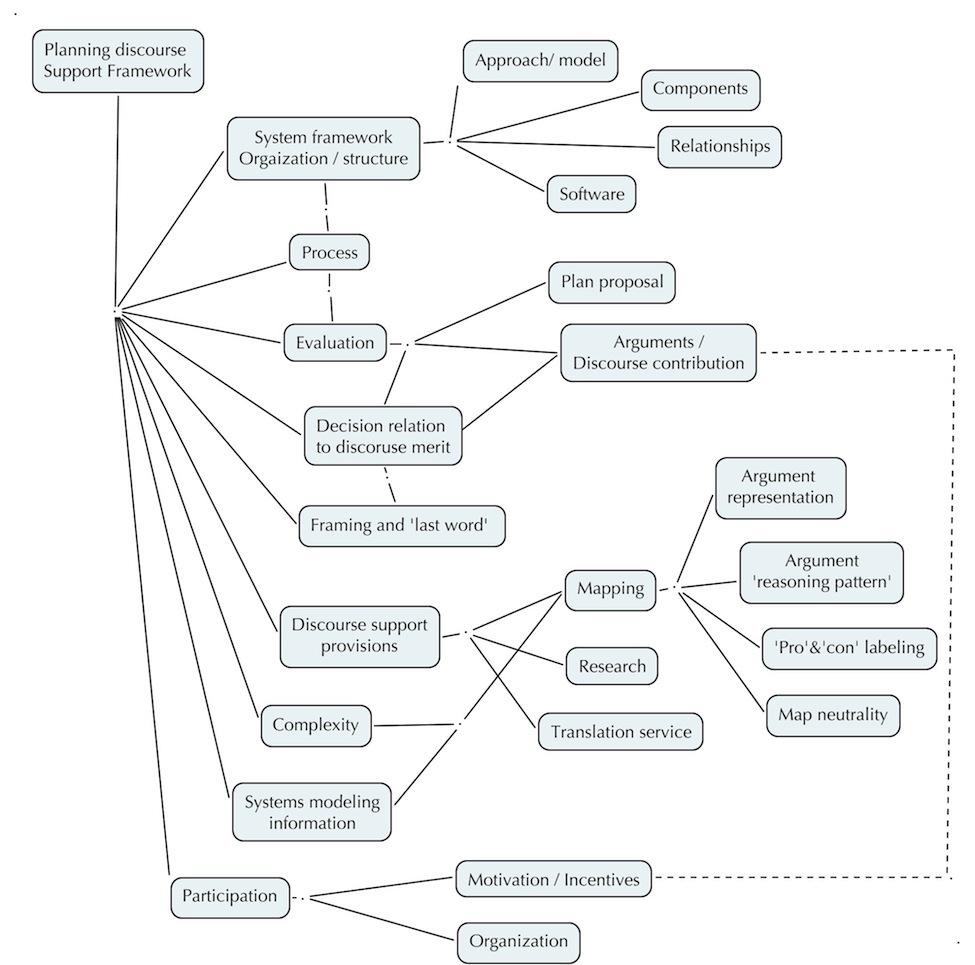
Topic map

Map of topics discussed

b.  An issue map for one of the topics:

Mapping issues

Argument mapping issues

c.  A map of the ‘first level’ arguments in a planning discourse: the overall plan plausibility as a function of plausibility and weight assessments of the planning arguments (pro and con) that were raised about the plan.Plan plausibility

The overall hierarchy of plan plausibility judgments

      d.  The preceding diagram with ‘successor’ issues and respective arguments added.Successor issues
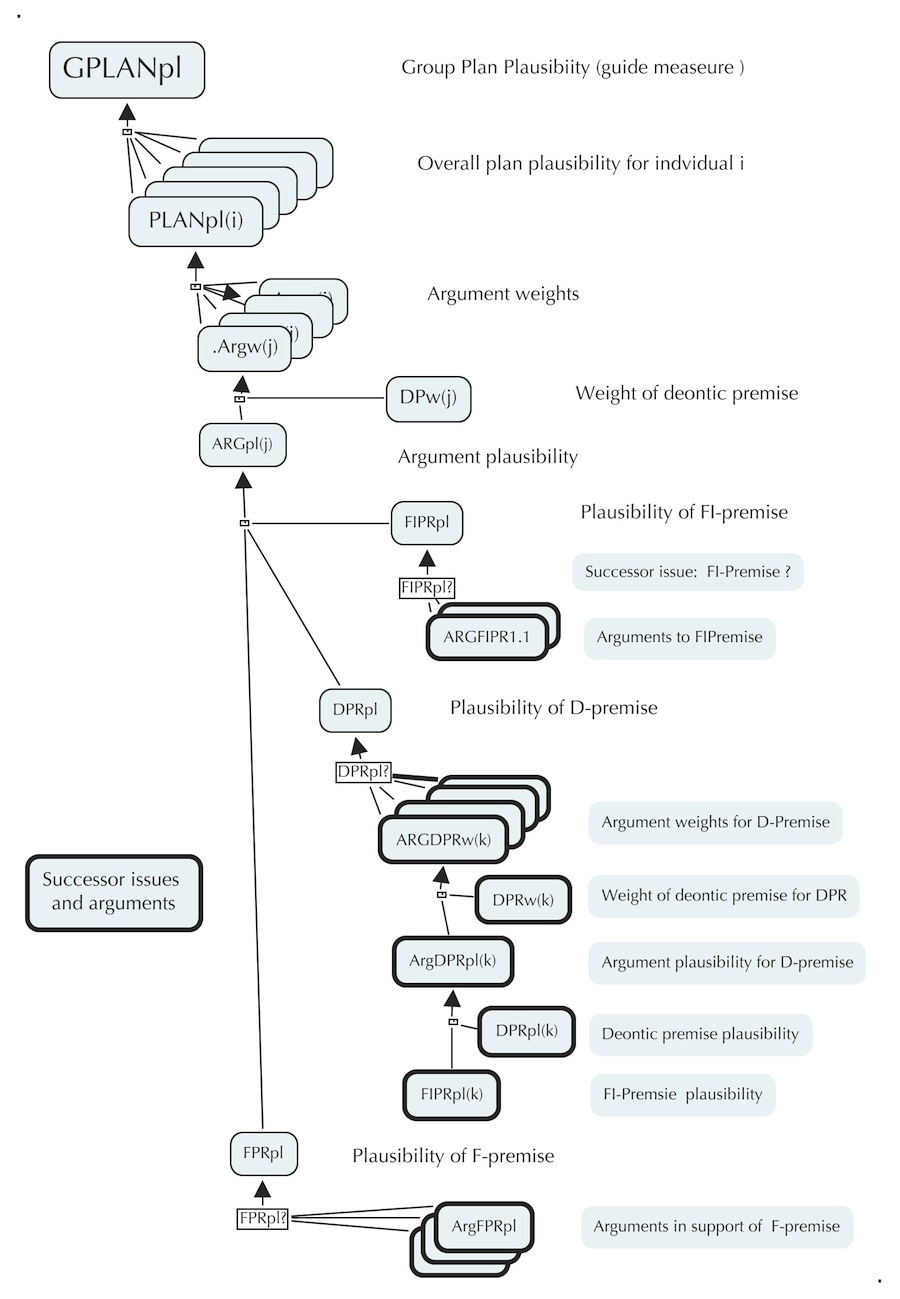
Hierarchy map of argument evaluation judgments, with successor issues

e. An example of a map of first level arguments for a selected mapping issuesArgument map
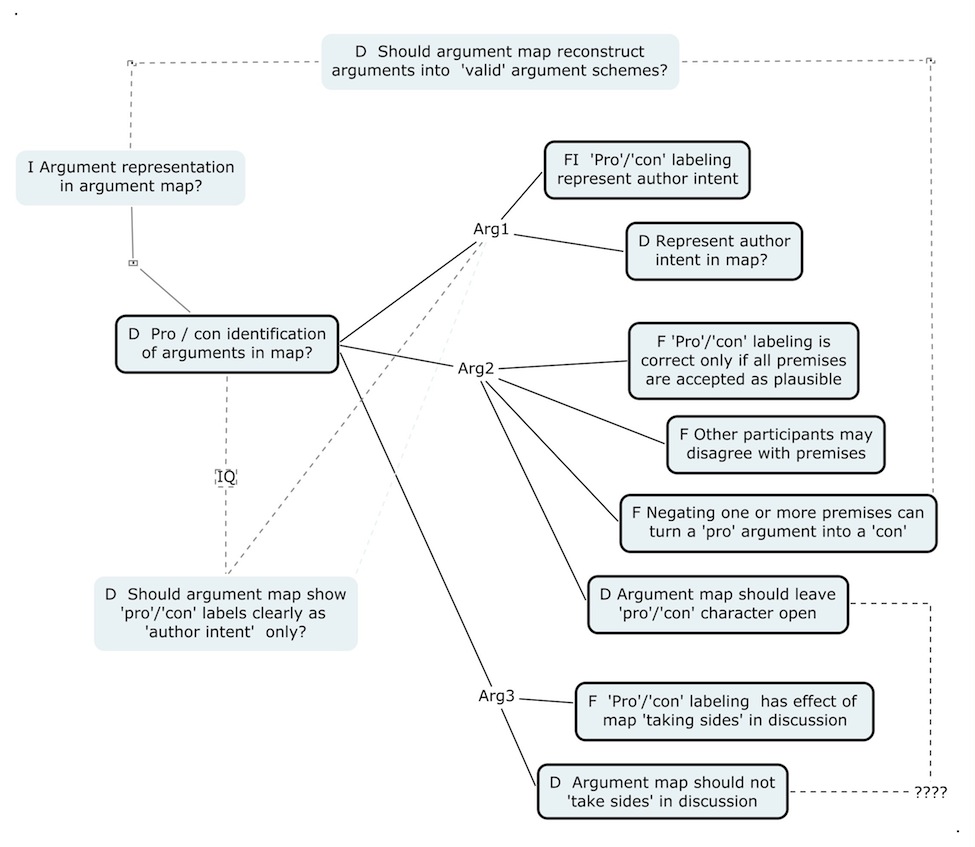
Argument map for mapping issue ‘Should argument map show ‘pro’ and ‘con’ labels?

References

Mann, T.       (2010)  “The Structure and Evaluation of Planning Arguments”  Informal Logic, Dec. 2010.

Rittel, H.             (1972)  “On the Planning Crisis: Systems Analysis of the ‘First and Second Generations’.” BedriftsØkonomen. #8, 1972.

–      (1977) “Structure and Usefulness of Planning Information Systems”, Working Paper  S-77-8, Institut für Grundlagen der Planung, Universität Stuttgart.

–      (1980) “APIS: A Concept for an Argumentative Planning Information System’. Working Paper No. 324. Berkeley: Institute of Urban and Regional Development, University of California.

–      (1989)  “Issue-Based Information Systems for Design”. Working Paper No. 492. Berkeley: Institute of Urban and Regional Development, University of California.

—-

Some speculations regarding the possibility of a moral code without religion.

On a Linked-In forum, the question was raised whether a moral code without religion could be developed. My effort to look into ways to achieve better decisions for planning, design, policy-making issues suggests that it is indeed possible to develop at least a partial system of agreements — for which ‘moral code’ would be an unnecessarily pretentious term — but which has some of the same features. For problems, conflicts of interest or proposed actions or projects that require the consent and cooperation of more than one individual, (this does not cover all situations in which moral codes apply), as soon as parties realize that ‘resolutions’ based on coercion of any kind either will not really improve the situation or are fraught with unacceptable risks (the other guy might have a bigger club… or even one’s own nuclear weapon would be so damaging to even one’s own side that its use would be counterproductive) the basic situation becomes one of negotiation or, as I call it, ‘planning discourse’. Such situations can be sustained and brought to success only on the basis of the expectation that parties will accept and behave according to some agreements. The set of such agreements can be seen as (part of) an ethical or moral code. For the planning discourse, a rough sketch of first underlying ‘agreements’ or code elements are the following:

**1 Instead of attempting to resolve the problem by coercion — imposing one side’s preferred solution over those of other parties — let us talk, discuss the situation.

**2 The discussion will consist of each side describing that side’s preferred outcome, and attempting to convince the other side (other parties) of the advantages –or disadvantages — of the proposal.

**3 All sides will have the opportunity to do this, and all sides implicitly promise to listen to the other’s description and arguments before making a decision.

**4 The decision will (should) be based on the arguments brought forward in the discussion.

*4.1 The description of proposals should be truthful and avoid deception — all its relevant features should be described, none hidden; no pertinent aspects omitted.

*4.2 The arguments should equally truthful, avoiding deception and exaggeration, and be open to scrutiny and challenge, which means that participants should be willing to answer questions for further support of the claims made in the descriptions and arguments.

Simplified ‘planning arguments’ consist of three types of claims:
a) the factual-instrumental claim
‘proposal A will bring about Result B, given conditions C’
b) the factual claim ‘
‘Conditions C are (or will be) given’;
c) the ‘deontic’ or ‘ought-claim’
‘Consequence B of the proposal ought to be pursued’;
and also
d) the ‘pattern’ or inference rule of the argument (that is, the specific constellation of assertions, negation of claims and relations between A and B) is ‘plausible’.
While such arguments (just like the ‘inductive’ reasoning that plays such a significant role in science) are not ‘valid’ from a formal logic point of view, they are nevertheless used and considered all the time, their plausibility deranging from their particular constellation of claims, and the ‘fit’ to the specific situation.
The plan proposal A is itself a ‘deontic’ (ought-) claim.

*4.3 The support for claims of type (a) and (b) takes the form of ‘evidence’ provided and bolstered by what we might loosely call the ‘scientific’ perspective and method.

*4.4 Support for claims of type c) will take further arguments of the ‘planning argument’ kind and pattern, containing further factual and deontic claims in support of the desirability of B.
The deontic claims of such further support arguments can refer to previous agreements, accepted laws or treaties that imply acceptance of a disputed claim, claims of desirability or undesirability for any party affected by the proposed plan, even moral rules derived from religious domains.

**5 Individual participants’ (preliminary) decision should be based on that participant’s individual assessment of the plausibility of all the arguments pro and con that have been brought up in the discussion.
That assessment should not be superseded by considerations extraneous to the plan proposal discussion itself — such as party voting discipline — but be a function of the plausibility and weights assigned by the individual to the arguments and their supporting claims.

**6 A collective decision will be based on the overall ‘decisions’ or opinions of individual participants.
(The current predominant ‘majority voting’ methods for reaching decisions do not meet the expectation #4 above of guaranteeing that the decision be based on due consideration of all expressed concerns: here, a new method is sorely needed).

A decision to adopt a plan by the participants (parties affected by the proposed plan) in such a discussion should only be taken (agreed upon) if all participants’ assessment of the plan is positive or at least ‘not worse’ than the existing problem situation that precipitated the discussion.

**7    Discussion should be continued until all parties feel that all relevant concerns have been voiced. Ideally, the discussion would lead to consensus regarding acceptance or rejection of the proposed plan. If this is the case, a decision can be taken and the plan accepted for implementation.
Realistically, there may be differences of opinion: some parties will support, others oppose the plan. The options for this case are either to abandon the process (to do nothing), to attempt to modify the plan to remove specific features that cause opponents’ concerns; or to prepare a different proposal altogether and start a new discussion about it.

**8    Individual parties’ ‘decision’ (e.g. vote) contribution to the common decision should be matching the party’s expressed assessment of the arguments and argument premises.
For example: if a participant agrees with all the ‘pro’ arguments and disagrees with the ‘con’ arguments (or expressed lesser weigh of the ‘con’ arguments) the participant’s overall vote should be positive. Conversely, if the participant’s assessment of arguments is negative, the overall ‘vote’ should be negative. Participants should be expected to offer additional explanations of a discrepancy between argument assessment and overall decision.

**9 A common decision to accept a proposed plan implies obligations (specified in the plan) for all parties to contribute to implementation and adherence to the decision provisions.

**10 The plan may include provisions to ensure adherence and contributions by the parties. Such provisions may include ‘sanctions’, understood as (punitive) measures taken against parties guilty of violating plan agreements.
There undoubtedly might be more agreements needed for a viable planning ‘ethic’. It is clear that some of the above provisions are not easy to ‘live up to’ — but what moral system has ever been? And for some provisions, the necessary tools for their successful application are still not available. For many societal decisions, access to the discussion (to be able to voice concerns) is lacking even in so-called advanced democracies. Some expectations may sound like wishful thinking: The expectation of transparent linkage between argument assessment and overall (individual) decision and even more the linkage between arguments and collective decision are still not available. The approach for systematic and transparent argument assessment (My article in the Dec 2010 issue of “Informal Logic” on ‘The structure and Evaluation of Planning Arguments’) suggests that such a link would be feasible and practical, if somewhat more cumbersome that current voting and opinion polling practices. However, its application would require some changes in the organization of the planning discourse and support system, as well as decision-making methods.

These observations were mainly done in response to the question whether a ‘moral’ not based on religious tenets would be possible (and meaningful?). That question may ultimately be taken to hinge on item # 10 above — the sanction issue. The practical difficulties of specifying and imposing effective sanctions to ensure adherence to moral rules may lead many to the necessity of accepting or postulating sanctions and rewards to be administered by an entity in the hereafter. But it would seem reasonable to continue to explore such agreement systems including sanctions in the ‘here and now’ beyond current practices, since both non-religious and religion-based systems arguably have not been successful enough reducing the level of violations of their rules.

On the role of feelings in argumentative discourse

– Are you neglecting your civic duty to sustain the customary atmosphere of comfortable if meaningless small talk in the Fog Island Tavern, Bog-Hubert? Scribbling notes in your crumpled notebook like a real coffee house intellectual — or have you actually gotten over your writers’ block to get back into some serious writing?

– Sorry, nothing so encouraging. I’m just writing down come complaints of Abbé Boulah’s about people’s lack of comprehension of his and his buddy’s ideas glorious ideas about argumentative planning. We were walking along the beach, and he seemed quite disappointed by some reactions he got from some experiment. So I need to write some things down before I forget them.

– Reactions to what?

– It seems they were trying out some of those ideas about structured planning discourse including the argument assessment approach, in a distance learning project of some kind. And the participants on the other end either didn’t understand what they were trying to do at all, or else hadn’t even studied the background material they had prepared and sent over there. They totally screwed up the exercise, and finally blamed the disaster on his buddy, alleging that he didn’t allow for the role of emotions and feelings in the discourse, didn’t understand emotions at all; something like that.

– That’s a problem with those online and distance projects: you never know whether the folks at the other end really are doing their part of the deal. But I can see where they picked a plausible excuse, at least.

– Plausible, huh? In what way, Vodçek? How is ignorance and laziness ‘plausible’?

– Well, doesn’t the very word ‘argument’ invite a number of misunderstandings that then can be used as excuses? You can’t really blame misunderstanding only on the party that doesn’t understand, can you?

– What kinds of misunderstandings?

– Well, many people understand ‘argument’ as something disagreeable, adversarial, quarrelsome — that can easily end up into a more serious fight — not very nice nor cooperative.

– I can’t argue with that: we’ve had a lot of that kind of reaction.

– Right. And even for those who do understand ‘argument’ as a set of statements that aim to support some claim, that notion is flavored by the association with formal logic, rationality, scientific ‘objectivity’, in short, a kind of discourse in which the ‘truth’ of issues is to be established. Truth that is independent or overriding of how people feel about it. Scientific, ‘objective’ truth. That kind of inquiry that almost by definition excludes feelings. And of course that bothers people who are concerned with issues about which they do have strong feelings. Where the ‘truth’ about what IS the case is less the point of the discussion than what OUGHT to be, and theta patently isn’t true YET. So they understandably resent the impression that those feelings are slighted and ignored.

– But that’s precisely Abbé Boulah’s point — talking about ‘planning arguments’ or ‘design arguments’ — the ones in which one of the key premises, the ‘ought’-claim — is exactly the one that deals with feelings! The kinds of arguments that are not susceptible to formal logic analysis because they have to do with what people want, desire, in short, with how they feel about things.

– Sure, Bog-Hubert: you and I, and some of our friends know that. But for somebody who just hears ‘argument’ and does not examine the planning argument story carefully enough, the impression is still that those ‘feelings’ issues just don’t count in argumentation. So maybe the story needs to be told more clearly and understandably?

– I thought the difference between the ‘formal’ and ‘deductive’ kind of arguments and those planning arguments was clear enough. But you may be on to something there. What do you think are the key points that should be made more clear?

– Let’s see. A first problem might be the frequent impression that people who go on about argumentation appear to take a position of superiority: if they have an argument — one that’s sanctioned by ‘logic’ as ‘valid’ and that therefore has a true conclusion, they are seen as putting down other opinions as ill-informed or stupid. I know what you are going to say: the process we are proposing as ‘argumentative planning’ is explicitly inviting all kinds of concerns, arguments, as ‘legitimate’ and deserving of being given ‘due consideration’ — since all planning arguments after all are ‘inconclusive’ from a formal logic point of view. But I have a hunch that using the word ‘argument’ makes it difficult for people to see that difference. Is there a different way of talking about that?

– Coming to think about it, we did discuss that issue some time go. In such discussions, many issues are raised and expressed as questions, not arguments — whose answers or conclusions could become significant premises of arguments for or against planning proposals. And we saw the problem as one of getting people to put those claims together into complete arguments so that they can be evaluated properly, according the the approach our friend has developed. But maybe the invitation should be to just raise such questions, not stating them as explicit pro or con arguments?

– I can see why you kept going in that direction: how the argument evaluation process might become more difficult with an approach of inviting questions rather than arguments. You’d have to get somebody to put the arguments together in some way in the end. Perhaps you could get a program to do that, using the plausibility assessments of the answers (by the participants) as premises for pro and con arguments. We should look into that. But that very issue brings up a different problem: one that has caused some trouble in the past .

– I think I know what you are referring to; we touched upon that very briefly a moment ago but didn’t go into it? If you focus on raising questions whose answers may become argument premises, many people in the past — mainly technical-oriented folks — have often tended to focus on the factual and factual-instrumental premises of planning arguments. The deontic premises — the ‘ought’ -issues — were either taken for granted, assumed to be given by overriding social policies, even legal precedents or regulations, or simply swept under the rug because they couldn’t be settled by ‘scientific’, logical means. Often, technocrats acted as if, because they had the expertise regarding the technical fact and instrumental questions, they should also have the authority to determine the ‘ought’ questions. Maybe it never occurred to them that there might be people who did not share their vision of the ‘common good’, and that different visions could be legitimate. And such attitudes of course looked to many ordinary folks as arrogant usurpation of powers for which the political process had not provided legitimacy.

– Right. Thereby casting those legitimacy questions both onto the technical-scientific expertocracy and the political process, as well as the role of argument in the ‘planning and political process. But isn’t that inevitably leading to the opposite fallacy, if you will: that planning issues should be decided predominantly or only on the basis of the deontic premises? What ‘the people’ want or desire — blithely assuming that ‘the people’ are indeed of one mind about what they desire. And then the very discrediting of the argumentative process now precluded a meaningful discussion of the plausibility of either kind of premise: what ought to be, and what to do to achieve it.

– A veritable tragedy of argumentation; i agree. Especially for those of us who finally have tried to show a way for both kinds of premises to be discussed and evaluated with equal legitimacy. So how should that question be dealt with?

– I think one main task is to make it more clear that the call for decisions to be made on the basis of arguments does not mean that there is anybody ‘official’ or ‘running the process’ or even a ‘system’ or machine, who determines the ‘truth’ or plausibility and the weight of arguments. No ‘little man behind the curtain’ or on the big screen calling the shots. Make it more clear that the planning arguments are all NOT deductively and objectively ‘valid’ and their conclusions true or false regardless how people feel about them. But precisely that no ‘absolute’ knowledge about the truth of any claims is assumed, and that decisions are made on the basis of the assessments of the people participating in the process.

– If the argument assessment results are to be used in making decisions at all. That has been raised as a possibility, as a much needed alternative to the standard decision-making rule of majority voting which doesn’t really require that any of the concerns expressed in the discussion are given ‘due consideration’. But the details for alternative decision-making methods based more explicitly on argument evaluation results need more discussion and agreement. We may very well all be wrong in the end — but we are trying to pool or knowledge and beliefs about the information we collectively bring into the process to arrive at a decision we can all support, with what is just the best of currently available knowledge.

– So what about the role of feelings, specifically, in this process?

– Thanks for getting us back to that question, Vodçek. You are asking about how to deal with the problem of people insisting that because they have raised valid questions about the legitimacy of the expert, and the predominance of the technical-scientific ‘rationality’, public issues should therefore be decided o the basis of their feelings out the issues?

– I guess that’s one way to put it.

– Okay. Can we agree on the principle that whatever the basis of people’s individual position on issues: so-called scientific rationality and logic, or their feelings, their judgment is to be accepted as their rightful and legitimate stance?

– No argument there. But I sense a ‘but’ coming… and I don’t think it has to do with all the authors of learned books on logic and critical thinking that try to tel all of us how to think properly?

– Right. The ‘but’ arises when people start demanding that the judgment resulting from their ‘feeling’ or emotional assessment should be accepted by others as a legitimate basis for their decision as well — even if they are not able to provide any further support or explanation for their judgments. My ‘gut feeling’ telling me that plan A is a good idea (or a bad one) cannot possibly be a valid reason for me to expect that others should adopt the same judgment, if I can’t explain and get across w h y I feel this way. Just as someone else whose gut feeling tells him the opposite of mine can’t expect to sway me just on the basis of him having that gut feeling.

– You are talking about issues of shared or public interest of course, not issues that are our personal matter only and don’t affect anybody else.

– Right. For any common, cooperative decision, perhaps we can tentatively state two rules:
1) The method or rule for arriving at a final common decision should accept everybody’s individual judgment regardless of how the individual arrives at it. And
2) Whenever, and to the extent that an individual or party tries to persuade others to adopt an individual position on an issue (through argumentation), that party is responsible for supplying reasons, evidence, supporting arguments, for a l l premises of the arguments, the factual-instrumental premises, the factual premises, and the deontic (‘ought’) premises, upon request. No request for further support of a premise can be rejected on the grounds that it is a personal value judgment or feeling; such a rejection will be a valid reason for anyone else to reject the demand that the position be adopted by others. (However, of course the person will still be able to ‘cast his vote’ on the basis of his personal convictions even if he cannot supply reasons to sway others).

– Does that mean that we have to accept such votes even if they are based on obviously false information or flawed — fallacious — reasoning?

– No. But if you think that somebody is making such mistakes, it is your responsibility to offer your reasons to sway that person. Remember that your premises may be less supportable and certain than they appear to you. The fact that somebody’s argument appears to you as a fallacy does not entitle you to use your authority as a connoisseur of fallacies to reject the entire argument with all its premises, and this the right of the person to have a say in the decision.

– Isn’t that a main difference between this approach and, say, the logic rule books? It does not — as an approach — try to tell anybody how to think, but just encourages all participants to examine their reasons — yes, even challenge and test them — but then accepts whatever judgment people bring into the process as legitimate contributions, right or wrong, to the final decision.

– And I would insist on something else: the support for an ‘ought’-premise can take the form of a story laying out the vision a person considers desirable, not just another set of ‘formalized’ arguments. But parts of the story should again be open to questioning.

– Agreed, Vodçek. So how do we make this more clear and understandable? How do we avoid the potential misunderstanding arising out of the term ‘argument’?

– Would it be meaningful to avoid the word ‘argument’ altogether, and to just ask people to refrain from making arguments, but only to raise questions?

– What do you mean?

– Well, take the three types of premises of a planning argument about a proposal A:
“Yes, A should be adopted
because
A will lead to B given conditions C,
and
B ought to be pursued or aimed for,
and
conditions C are given.”

Instead of this whole (‘adversarial’) argument, can we instead just ask the questions
“Does A really lead to B?”
and “Should B be aimed for?”
and
“Are conditions C really present?”

And invite participants to discuss those? Perhaps not even in the same sequence, so as to further avoid the argumentative flavor? And avoid presenting the argument at the outset as a ‘pro’ or con’ argument?

– Why should we avoid that?

– Think about it: If the proposed action really leads to result B, and a person P1 considers B desirable, the resulting argument is a ‘pro’ argument for that person, right? But if another person P2 sees consequence B as undesirable, the same argument becomes a ‘con’ argument for that person, doesn’t it? Or if P2 feels that while the goal B is worthwhile, the proposal A is not an effective way to achieve it — or if P2 grants both of the above two premises, but has information that the conditions C aren’t present to make the proposed action effective: in all these cases the same set of claims become counterarguments for P2. So why should it be labeled as one or the other from the outset, if it really depends on people’s assessment of each of the premises?

– Now I realize why all those debate programs on the market always gave me a weird sense of ‘already taking sides’ in the debates they try to facilitate: By explicitly labeling and mapping any argument as a ‘pro’ or ‘con’ argument — the way it was intended by the person making the argument — it already slightly distorted the judgment process. I agree, the ‘system’ keeping track, displaying and mapping all the contributions in such discussions should refrain from that kind of labeling; just present the claims that make up the argument premises.

– Well, in order to evaluate how all those bits of information support or not support a decision, do they not have to be put together as complete arguments, in the end ?

– Yes, I think you are right — unless we can get people to assess the plausibility of all those claims separately, and have the ‘system’ put them together as arguments and then calculate their arguments weights etc. But then the system must also make such assessments as whether a specific argument pattern really ‘applies’ to the case at hand — which people might want to make themselves. And they can’t do that unless they see the complete argument, can they?

– You devious fellow. You are once again raising more questions than we started out with, my friend. But do you agree that we can see the task and direction more clearly now? I think we need to run some experiments with various ways to treat these issues, and then write a short, concise ‘game manual’ that makes it very clear what the approach is doing, including the legitimate role of feelings and emotions in the process. You’ll tell Abbé Boulah when he comes in, Vodçek?

– You really think he’ll be able to raise the funds for those experiments?

Some consideration on the role of systems modeling in planning discourse


Suggestions made by proponents of ‘systems thinking’ or systems analysis to discussions we might call ‘planning or policy discourse’ often take the form of recommendations to construct models of the ‘whole system’ in question, and to use these to guide policy decisions.

A crude explanation of what such system models are and how they are used might be the following: The ‘model’ is represented as a network of all the parts (variables, components; e.g. ‘stocks’) in the ‘whole’ system. What counts as the whole system is the number of such parts that have some significant relationship (for example, ‘flows’) to one another — such that changes in the state or properties of some part will produce changes in other parts. Of particular interest to system model builders are the ‘loops’ of positive or negative ‘feedback’ in the system — such that changes in part A will produce changes in part B, but those changes will, after a small or large circle of further changes, come back to influence A. Over time, these changes will produce behaviors of the system that would be impossible to track with simple assumptions e.g. about causal relationships between individual pairs of variables such as A and B.

The usefulness of such system models — which simply means the degree of reliability with which simulation runs of those changes over time will produce predictions that would come true if the ‘real system’ that is represented by the model could be made to run according to the same assumptions. The confidence in the trustworthiness of model predictions thus relies on a number of assumptions (equally simplistically described):

– the number of ‘parts’ (variables, components, forces, ‘(stocks’) included;
– the nature and strength of relationships between the system variables;
– the magnitudes (values) of the initial system variables, e.g. stocks.

System models are presented as ‘decision-making tools’ that allow the examination of the effects of various possible interventions in the system (that is, introduction of changes in systems variables that can be influenced by human decision-makers) given various combinations of conditions in variables that cannot be influenced but must be predicted, as well as assumptions about the strength of interactions. All in order to achieve certain desirable states or system behaviors (the ‘goals’ or objectives measures by performance criteria of the system). System modelers usually refrain from positing goals but either assume them as ‘given’ by assumed social consensus or directives by authorities who are funding the study (a habit having come in for considerable criticism) or leaving it up to decision-maker ‘users’ of the system to define the goals, and use the simulations to experiment with different action variables until the desired results are achieved.

Demonstrations of the usefulness or reliability of a model rest on simulation runs for past system states (for which the data about context and past action conditions can be determined): the model is deemed reliable and valid if it can produce results that match observable ‘current’ conditions. If the needed data for this can be produced and the relationships can be adjusted with sufficient accuracy to actually produce matching outcomes, the degree of confidence we are invited to invest in such models can be quite high: very close to 100% (with qualifications such as ‘a few percentage point plus or minus’.

The usual planning discourse — that is, discussion about what actions to take to deal with situations or developments deemed undesirable by some (‘problems’) or desirable improvements of current conditions (‘goals’) — unfortunately uses arguments that are far from acknowledging such ‘whole system’ complexity. Especially in the context of citizen or user participation currently called for, the arguments mostly take a form that can be represented (simplified) by the following pattern, say, about a proposal X put forward for discussion and decision:

(1) “Yes, proposal X ought to be implemented,
because
implementing X will produce effect (consequence) Y
and
Y ought to be aimed for.”

(This is of course a ‘pro’ argument; a counterargument might sound like:

(2) ” No, X should NOT be implemented
because
Implementing X will produce effect Z
and
Z ought to be avoided.”

Of course, there are other forms of ‘con’ arguments possible, targeting either the claim that X will produce Y granted that Y is desirable; or the claim that Y is desirable, granting that X will indeed produce Y…)

A more ‘sophisticated’ version of this typical (‘standard’) planning argument would perhaps include consideration of some conditions under which the relationship X — Y holds:

(3) “Yes, X ought to be implemented,
because
Implementing X will produce Y if conditions c are present;
and
Y ought to be aimed for;
and
conditions c are present.”

While ‘conditions C’ are mostly thought of as simple, one-variable phenomena, the systems thinker will recognize that ‘conditions C’ should include all the assumptions about the state of the whole system in which action X is one variable that can indeed be manipulated by decision-makers (while many others are context conditions that cannot be influenced). So from this point of view, the argument should be modified to include the entire set of assumptions of the whole system. The question of how a meaningful discourse should be organized to take this expectation into account while still accommodating participation by citizens — non-experts — is a challenge that has yet to be recognized and taken on.

Meanwhile, however, the efforts to improve the planning discourse consisting of the simpler pro and con arguments might shed some interesting lights on the issue of the reliability of system models for predicting outcomes of proposed plans over time.

The improvements of the planning discourse in question have to do with the proposals I have made for a more systematic and transparent assessment of the planning argument — in response to the common claim of having public interest decisions made ‘on the merit of arguments’. The approach I developed implies that the plausibility of a planning argument of the types 1,2,3 above (in the mind of an individual evaluator) will be a function of the plausibility of all the premises. I am using the term ‘plausibility’ to apply both to the ‘factual’ premises claiming the relationship X –>Y and the presence of conditions C (which traditionally are represented as ‘probability’ or degree of confidence) as well as the to the deontic premise ‘Y ought to be aimed for’ that is not adequately characterized by ‘probability’ much less ‘truth’ or ‘falsity’ that is the stuff of traditional argument assessment. The scale on which such plausibility assessment is expressed must be one ranging from an agreed-upon value such as -1 (meaning ‘totally implausible) to +1 (meaning totally plausible, entirely certain) with a midpoint of zero (meaning ‘don’t know’; ‘can’t tell’ or even ‘don’t care’).

The plausibility of such an argument, I suggest, will be some function of the plausibilities assigned to each of the premises, arguably also to the implied claim that the argument pattern itself (the inference rule

“D(X)
because
FI(X –> Y) | C
and
D(Y)
and
F (C )”

applies meaningfully to the situation at hand. (D prefixes denote deontic claims, FI factual-instrumental claims, F factual claims)

(The weight of each argument among the many pro and con arguments is one step later: it will be a function of its plausibility and weight of relative importance of the goals, concerns, objectives referred to in the deontic premise.)

This means that the argument plausibility will decrease quite rapidly as the plausibilities for each of these premises deviate from 100% certainty. Experiments with a plausibility function that consists of the simple product of those plausibilities have shown that the resulting overall argument plausibility often shrinks to a value much closer to zero that to +1; and the overall proposal plausibility (e.g. a sum of all the weighted argument plausibilities) will also be far away from the comfortable certainty (decisively ‘pro’ or decisively ‘con’) hoped for by many decision-makers.

These points will require some further study and discussion in the proposed approach to systematic argument assessment. For the moment, the implication of this effect of argument plausibility tending towards zero on the issue of enhancing arguments with the proper recognition of ‘all’ the system condition assumptions of the ‘whole’ system deserve some comment.

For even when a model can be claimed to represent past system behavior with reasonable degree of certainty plausibility close to 1, the projection of those assumptions into the future must always be done with a prudent dose of qualification: all predictions are only more or less probable (plausible), none are 100% certain. The deontic premises as well are less than totally plausible — indeed usually express legitimate opposing claims by people affected in different ways by a proposed plan, differences we are asked to acknowledge and consider instead of insisting that ‘our’ interests are to be pursued with total certainty. We might even be quite mistaken about what we ask for… So when the argument plausibility function must include the uncertainty-laden plausibility assessments of all the assumptions about relationships and variable values over time in the future, the results (with the functions used thus far, for which there are plausible justification but which are admittedly still up for discussion) must be expected to decline towards zero even faster than for the simple arguments examined in previous studies.

So as the systems views of the problem situation becomes more detailed, holistic, and sophisticated, the degree of confidence in our plan proposals that we can derive from arguments including those whole system insights is likely getting lower, not higher. This nudge towards humility even about the degree of confidence we might derive from honest, careful and systematic argument assessment may be a disappointment to leaders whose success in leading depends to some extent on such degree of confidence. Then again, this may not be a bad thing.

A dirty dozen world-wide wicked problems related to the global sustainability crisis – and some solutions?

O V E R V I E W

1 The global sustainability crisis

2 The dreaded big brother top-down imposed solution problem

3 The fox in the henhouse problem

4 The babylonic confusion problem

5 The problem of information overload in the unfinished global forum

6 The perplexing participation paradox

7 The problem of the missing link between discussion and decision

8 The neglected planning argument (‘weighing the pros & cons’) problem

9 The virtues to vices problem (the vicious cycle of virtue to vice)

10 The problem of the control of power

11 The problem of ensuring adherence to agreed-upon solutions: sanctions

12 The problem of nonperforming measures of performance

P R O B L E M   D E T A I L S

1 The global sustainability crisis

This is the problem that led UN Secretary General Ban Ki-Moon to issue his call for ‘revolutionary thinking and action to ensure an economic model for survival’ at the 2011 Wold Economic Forum in Davos: itself a nest of related problems:
– dwindling resources, food, water, energy
for a growing world population;
– climate change, environmental degradation
– hunger, poverty, inequality; human rights
– disasters
– corruption, government mismanagement
etc.

The following problems are a subset of problem facets related to the global sustainability crisis. The list is not an exhaustive account of all problems that make up the global crisis; they are selected because they are seen as key interconnected factors, and to show how some solution ideas can address this network of problems.

2   The dreaded ‘big brother’ top-down imposed solution problem

The intent or mere perception that such a ‘model for survival’ might be a one-size-fits all overall solution imposed top-down by some global authority, ignoring local, regional, cultural conditions — and therefore causing new problems, conflicts, and resistance. There are both social and logical reasons for the position that global solutions must instead emerge from a global discourse with wide and easily accessible participation. This is also true with respite to the next issue:

3    The ‘fox in the henhouse’ problem

The problem (reinforced by the very nature of the audience to which the Secretary General addressed his call) that the entities called upon and commanding the resources for developing and implementing any global solutions might be the very ones responsible
for generating many of the problems — and therefore being justly or unjustly suspected of pursuing their agenda more than the common good.

4    The babylonic confusion problem

There are already many impressive efforts underway to address these problems — mostly at the small and local level. But coordination and communication between these efforts is severely hampered by the differences not only between natural languages, but also between different cultural mindsets, ‘ways of talking’ about problems, approaches and solutions, between the specialized vocabulary of different disciplines (even between different schools of thought within the same fields) and their arcane acronyms.

5    The problem of information overload in the unfinished global forum

While it might seem that new information technology is in the process of vastly improving global communication, it can be argued that it has led to an almost insurmountable overload of disorganized information. This is making it difficult to keep adequate overview of developments even about very specific issues, establish and maintain a constructive discourse leading to meaningful agreements and decisions: The development of an adequate forum and platform for the global participatory discourse is still a very much unfinished project.

6   The perplexing participation paradox

In the face of the call for more participation in planning, policy-making, and political decisions is the evidence that public participation even in the form of voting in elections, let alone true constructive discourse and dialog, deplored as lacking: ‘voter apathy’. This is true even in societies where technological infrastructure, education and information would seem sufficiently advanced. Already Bertrand Russell (in his 1938 book on Power) observed that participation decreases as the social unit increases in size because in larger units, the impact of individual votes and contributions is perceived as so negligible as to render the individual vote or participation utterly insignificant and not worth the effort: participation is related to perceived possibility of ‘making a difference’.

7    The problem of the missing link between discussion and decision

Part of the participation problem is the fact that the decision-making method even in advanced ‘democratic’ systems, majority voting, has little or no perceptible (‘transparent’) connection between the value and merit of discussion contributions and the decision outcome. Phenomena such as ‘party discipline’ or the fact that filibusters can delay decisions but not influence them (because nobody is listening) are proof of this missing link: votes can entirely disregard or even go against the result of deliberative discourse.

8    The neglected planning argument (‘weighing the pros & cons’) problem

In spite of the tremendous amount of work done in logic and, increasingly, in ‘critical thinking’, the kinds of arguments we use in design, planning, policy-making — the ‘pros and cons’ for or against proposals — have not been given enough attention; coherent approaches for their systematic and transparent evaluation have not been developed.

9    The virtues to vices problem (the vicious cycle of virtue to vice)

Discussions about how to overcome the problems and crises are full of recriminations about human vices that are held to be responsible for the problems: greed, pursuit of power, the ‘win-lose’ attitudes in economic and political matters, the lack of empathy with ‘losing’ groups, the preoccupation with profit and growth. The result is an increasing polarization between groups that have achieved success with such attitudes, and their critics. The latter tend to forget or downplay the fact that these attitudes have often been taught to children as virtues. Now demonizing the people and groups who have learned these lessons well — as compliant learners, following societal concepts of virtue — can hardly be a successful strategy for a more cooperative, win-win- oriented, compassionate form of socio-economic society.

10    The problem of the control of power

Significant efforts have been made to establish reliable arrangements for the control of power in government. It is not clear whether these controls are inherently sufficient, and just have not been applied properly in the many instances in past and recent history where government powers have turned abusive and destructive. But it is evident that similar controls have not been developed and applied in the private sector. As a result, certain forces in the private sector have become so powerful that they have significant — and largely uncontrolled — influence over governments. This problem calls for increased attention, study and creative solutions.

The problem of control of power becomes critical at the level of global relationships: the issue of ‘world government’. The concern of a global, more powerful that any other entity is a serious concern if its power cannot be effectively controlled. This problem is related to the following ‘sanctions’ problem:

11    The problem of ensuring adherence to agreed-upon solutions: sanctions

Even if governance systems could be developed in which societal arrangements, laws, treaties etc. were negotiated and refined until they become acceptable to all affected parties (ideally: by consensus); the question remains of how to ensure adherence to the agreement s and laws: how to deal with instances of noncompliance or violation. Traditionally, compliance has been ‘enforced’ through the threat of imposing sanctions, penalties, by an enforcement agency that necessarily must be stronger, more powerful, than any potential violator. Inevitably, this raises the question of how to control such power: how to prevent that enforcement agency from violating the very laws it is supposed to enforce? The means of enforcement through sanctions of the same kind is logically impossible, if there is no ‘bigger’, more powerful agency. Again, this problem becomes critical at the global level: how can a ‘world enforcement agency’ more powerful than any other entity be effectively kept from abusing its power?

12     The problem of nonperforming measures of performance

Control and effective management of any complex process requires adequate measures of performance. Many social and economic problems are blamed on the use of measures of performance that are counterproductive to sustainability, social equity, fairness, and responsive stewardship of the environment; such as gross domestic product, profit, or growth. While this problem has been widely recognized and has led to calls for alternative measures, no convincing solutions have been proposed that are both widely acceptable and also can be smoothly introduced into economic systems operating on traditional principles: the transition problem to a system operating on different assumptions has not been adequately discussed nor solved.

Wicked problems of the global sustainability crisis

S O M E   P R O P O S A L S    T O   A D D R E S S   T H E S E  P RO B L E M S

These ideas are selected not because they solve all problem areas of the global sustainability crisis, but to highlight how solutions can aim at several issues.

OVERVIEW:

a. A global framework for coordination of projects,  participatory discourse and negotiation,  research support,  education and information

b. The discourse framework based on the argumentative model of planning

c. Evaluation of planning arguments and discussion contributions

d. Rewards for discourse participation

e. The argumentative planning game

f. ‘Civic credit points’

g. Automatically triggered sanctions

h. Innovation zones in areas damaged by disasters

i. Quality of life measures based on the value of occasions (experiences) and image

SOLUTION DETAILS:

a. A global framework for  coordination of projects,  participatory discourse and negotiation,  research support,  education and information

A global communication framework is needed for the coordination of many diverse, small local action projects and initiatives that should be encouraged and supported both as innovation laboratories for experiments with new approaches in all areas of societal organization and opportunities for people to pursue their visions, within a global framework of agreements for cooperation and conflict resolution. Its main components, besides the various action projects, are the coordination component, the discourse component, the research support component, and the education / information component.

b.    The discourse framework based on the argumentative model of planning

A key innovative feature of the proposal is the structure of the discourse component, which is based on the argumentative model of planning and policy-making (spearheaded by H. Rittel). The elements of the information support system for the discourse are issues (controversial questions) and the answers and argument to those issues.

c. Evaluation of planning arguments and discussion contributions

The argumentative model of the discourse component is enhanced by the provisions for systematic evaluation of the planning arguments (and other discussion contributions). The aim of this feature is to develop a measure of support for plan or policy proposals based on the merit of arguments: a measure of the merit of the discourse. The resulting measures can then provide the missing link between discourse merit and to decisions to be made — a link not adequately ensured by the current majority voting method.

d.    Rewards for discourse participation

The measures of merit of discourse contributions can be used to provide meaningful ‘rewards’ for participation, countering the problem of voter apathy even for large projects and constituencies.

e.   The argumentative planning game

To familiarize citizens with the tools of the argumentative discourse — faster than would be possible through the current system of public education — it is proposed to develop an ‘argumentative planning game (including the evaluation component discussed in items c and d above). The game aims at promoting (and rewarding) cooperation (rewarding win-win outcomes), critical thinking and evaluation; and should be developed both for ‘live’ applications and for wide participation in large planning discussions via videogame, cellphone and internet technology.

f.    ‘Civic credit points’

The measures of discussion contribution merit creates the possibility of establishing ‘civic credit point’ accounts for citizens, which provide legitimation / authorization for public decision-making (i.e. power) positions. Decisions require a ‘performance bond’ or ‘investment’ of credit points, used up with each decision, but with the possibility of earning further credit with successful decisions. This can provide a form of control of power: Power decisions can only be activated with adequate credit.

g.    Automatically triggered sanctions

Instead of traditional sanctions to ensure adherence to agreements and laws that have to be enforced by ‘enforcement’ agencies with greater power than any potential violator, forms of sanctions should be developed that are automatically triggered by the attempt at violation. Such provisions — perhaps involving the ‘civic credit points’ idea outlined in item f — would help solve the problem of controlling / constraining the power of global ‘enforcement’ entities.

h.    Innovation zones in areas damaged by disasters

Innovation efforts (and funding for these) are often resisted by existing structures that see these as competition and unwarranted ‘unfair’ expenditures. The proposal to encourage the establishment of ‘innovation zones’ for experiments with alternative organization of social and economic practices in areas damaged or destroyed by disasters sidesteps this problem. Emergency aid that will be spent in such areas might be devoted to innovative infrastructure and organization instead of mere re-construction of traditional structures. Successful experiments will encourage adjacent areas to adopt new practices and solutions; less successful efforts will gradually be replaced by improved traditional solutions — but will have produced valuable information about what works and what does not work.

i.    Quality of life measures based on value of occasions (human experiences) and image

While governments everywhere are beginning to follow the initiative of the kingdom of Bhutan in introducing quality of life or citizen happiness measures, to complement and perhaps eventually replace traditional economic measures such as growth or Gross Domestic Product, the indices adopted are usually quite general and therefore not very helpful in developing policies for improvement. An approach growing out of work to develop better measures of the value of built environment suggests an alternative set of measures of the quality of human experiences (‘occasions’) and the imagery evoked by the settings for these experiences. The resulting measures would be much more detailed, allow pinpointing the specific features of the environment or life conditions influencing citizens’ value assessments, and would therefore be more helpful in suggesting projects and policies for improvement.

Some solutions for the global sustainability problems

—-

A conversation in the Fog Island Tavern: Abbé Boulah and Bog-Hubert discussing answers to the UN Secretary General’s Call for ‘Revolutionary thinking and action to ensure an economic model for survival’ at the World Economic Forum 2011.

Another evening to forget about in the Fog Island Tavern, eh, Abbé Boulah?
Ah, Bog-Hubert, good to see you — I’ve been waiting for you. An evening to forget about? Well, it depends.
Depends on what?
On whatever we’re going to make of it, of course.
Oh? You’ve got some devious plans?
Devious, as in interesting excitement? No, sorry to disappoint you. But there are always possibilities, don’t you think?
Well, my friend, I did hear your sigh just when I came in. So that was about something other than another wasted evening?
Well, yes.
Well?
Internet…
Good grief — you’ve got yourself dragged into another one of those online discussions? You ought to get out some more, meet some people…
To waste entire evenings with useless small talk with?
Like tonight, eh? Alright, so what’s the trouble with your online discussion?
Long story.
We’ve got some time; I don’t see any better temptations around. Come on, tell me.
Let me get Vodçek to let the air out of this glass — the usual for you as well? Cheers. Okay. Maybe you remember, last January at the World Economic Forum in that mountain resort in Switzerland, the UN Secretary General gave a speech in which he called for ‘revolutionary thinking and action to secure an economic model for survival’. To save the world — not only from natural disasters but also from disasters caused by humanity itself. [1]
Revolutionary thinking and action? — and that from the UN Secretary General himself? Isn’t that like a captain on the high seas calling for a mutiny?
You could look at it that way, sure. At any rate, it seems to indicate that there are some serious problems ahead, that are recognized even by the UN and that illustrious assembly in Davos.
Are you saying that he — Ban Ki-Moon — thinks that those people in Davos are the ones who will come up with the needed revolutionary ideas — the very ones that caused our economic problems?
I don’t think he said it quite that way. He put it more diplomatically: “We… have been exploiting resources …” and so on. And he probably used the opportunity to get his message out to a larger audience.
Sure, isn’t that what he’s getting paid for? To promote the evolution of the UN to a world government? And isn’t that too one of the problems?
What do you mean?
Well, isn’t the UN itself a strange beast made up of questionable and obsolete entities — nations? Fossils, with their territorial interests, their power structures, their proven record of violent conflict resolution, their crazy decision-making methods, their corruption and their consistent tendencies to exploit not only other peoples but even their own citizens? And, as many people suspect, the UN desire to evolve into a world government of sorts, the ultimate superpower?
Calm down already — I am perfectly aware of the flaws and misdeeds of nations. But isn’t the institution of the UN itself a feeble sign of reason, of some insight that we, humanity as a whole, have to at least talk about the nonviolent resolution of all our differences and problems? Do you see another possibility for that, than a forum like the UN?
Sure. Aren’t there already a number of organizations that carry on discussions and activities across the conventional structure of nations? I agree, some good, some bad ones…
Bad ones too? You mean those damn terrorists?
Those too, but the international finance system, the big corporations as well: aren’t they already operating pretty much outside of the little boxes of national rules and regulations? Not even to speak of international crime, the drug cartels, modern slave trade. Not necessarily very appealing models of future world order, but in themselves successful examples of global organizations not based on nations and their territories.
I see what you mean. But there are some others that look more positive — I’d like to find out more about the World Social Forum, for example, an alternative movement to the World Economic Forum, based mainly in Latin America but spreading to other places, though the major media don’t give it much coverage…
Gee, I wonder why? Its meetings are coinciding with the Davos forum — which soaks up all the flashy media interest.
Right. The media themselves are an example of global organization. Just like religions, which are essentially focused on universal acceptance — in spite of the old compromise with the state, the ‘cuius regio, eius religio’ maxim. There are many other such interest groups with global focus. But most of them obediently arrange themselves within existing national structures, and as a result suffer from the same structural conditions as those structures. Quite a pessimistic analysis, I see you frowning.
Okay, I don’t want to start arguing about it for now. So what conclusions do you draw from it?
Well. Let me think. The first thing would be to examine those structural conditions — that apply to nations as well as large corporations –, to put them on the list of problems or challenges to survival, put them on the agenda for discussion and revolutionary thought.
No revolutionary action yet?
I am all for taking action. But revolutionary action has all too often been associated with a certain lack of thought — just replacing one power group with another, without really changing those conditions.
Remind me: what conditions did you have in mind?
The question of non-territorial social organization, for one. The question of how to control power — again, power in all organizations, governmental and others — especially large corporations and financial service systems. This is closely related to the problem of corruption. The issue of nonviolent conflict resolution — continually invoked as a principle, but in reality ‘violations’ of laws, treaties, agreements are always answered by violence or other forms of coercion by the stronger party — because nobody has seriously thought about other forms of sanctions…
I can’t argue with that; we have talked about those issues before. And the first step would have to be to talk about them. More specifically, talk on a global level, right? But in what kind of forum? On whose agenda should those issues be dealt with? And how do we get them on that agenda, who is listening to us?
Good question. Now, the call by the UN Secretary General was seen by some people not just as a thing for the WEF to do in preparation for the 2012 RIO conference, but as a more general invitation to start working on those issues, that was picked up by other groups. For example by this internet group I’ve been following, a forum on Linked-In called Systems Thinking World, where a discussion was started by a lady named Helene Finidori on ‘how to make this work’. Since February 2011 this discussion has generated more than 4000 posts. [2]
So you got mixed up in that crowd? System Thinkers? Aren’t those precisely the people who have helped governments and corporations make their dubious machinations more efficient? Sounds like putting the fox in charge of the hen house?
My impression is that there aren’t that many of those people in this particular group. Of course there are such people. But in this group there are many participants who argue forcefully against the use of system models for just profit and market share and dominance purposes — come to think of it, maybe that’s why there aren’t that many ‘real’ systems professionals — I mean people who are working for governments and corporations — among the contributors. The people in the group are discussing the problems from the systems thinking point of view that all components of the system of human society and environment are connected and influencing each other. They therefore see the systems tools such as mathematical models and simulations as tools that can also be used for the common good.
Ah. The common good. How is that defined, by whom?
These people — except some who seem to participate more from a perspective of criticism and suspicion of the entire scientific / systems view and would like to see a moral / ethical re-awakening first — seem to believe that these tools can serve to gain a better understanding of the behavior of systems such as the ecological systems of which society is a part, and then bring this understanding to the attention of a wider public so as to nudge people’s behavior into the direction of sustainability, coexistence with natural environment rather than dominance, nonviolent conflict resolution and cooperation, and so on.
Sounds beautiful. Did something useful come out of all that discussion? Or what was the reason for the pitiful sigh I heard very clearly when I came in to disturb your systems thinking?
What came of it? Well, let’s start with the positive results. The participants in that discussion researched — googled, I guess — an incredible number of ideas, experiments, projects and approaches to new practices and behaviors, that can be seen as small scale answers to the UN Secretary’s challenge. I have always been interested in these issues, have always been distrustful of the growth mania of the economy, of the logical flaws of modern democracies, of the influence of corporations and financial institutions on governments, of the manner in which the so-called blessings of technology, globalization, agribusiness are foisted upon developing countries. I saw myself as reasonably well informed about alternative approaches and ideas,but I confess I was hugely surprised at the number of such ideas and projects that are already out there.
For example?
Well, just look at the number of links and references in that thread. Somewhere halfway through the discussion, the moderator Helene Finidori  compiled a summary of all these links and ideas — she put that on a different platform [3] because of the limitations of the Linked-In forum — mainly the allowable length of posts. But the contributions and links kept pouring in. I don’t know whether she is still working on including all those in her summary or has given up, buried under the avalanche of links. It may be more useful to set up a list of topics that were touched upon in the discussion, to identify the main concerns of discussion contributions — as well as the topics that were not so well covered — in that list.
Do you have such a list handy?
Well, there is a list of topics in a kind of working IBIS [4] that already has about 80 topics.
Where do those come from?
Good question. It’s quite simple: a topic is a general subject any participant brings up in the discussion; as a problem, question, an answer, and argument or argument premise, which gets picked up and debated by others. Of course they are not equally important, and some were raised precisely as reminders to start thinking about issues that had been neglected in the discussion. I can give you a short overview of the most important ones, as judged by my impression of the number of posts contributed to them — but I didn’t even count them so it’s a very unscientific perspective.
A large number of contributions had to do with agriculture and gardening.The basic problem of provision of food and water for survival, that is claimed to be endangered precisely by the big agribusiness corporations. Most contributions urged a move away from the practices of large agribusiness corporations, away from their monocultures, their dependence of chemical fertilizers, their genetically modified crops and their destruction of small family-owned farms. Instead, they argued for more sustainable forms of agriculture: ‘permaculture’, preserving diversity of species, small family or community farms. But also reintroduction of food production in the cities: rooftop gardens, community gardens, and the principle of reducing the distance food products have to be transported from farm to consumer, by adjusting food consumption to available crops grown nearby.
I bet the likes of Monsanto and the fertilizer industry are less than happy about that…
Right; there was a lot of loud and sustained sentiment against those. Talking about sustainability in general, there were of course a lot of posts about other aspects of sustainability, especially regarding energy. Moving away from fossil and nuclear fuels and towards wind, solar, and geothermal, in part again favoring small production plants, even family size, rather than large plants and networks. This especially in rural developing areas. Here too, there was an abundance of innovative experiments, some already in use, others almost ready to go.
Anything from the corporations, government and industry, the main audience in Davos?
Good question. There were reports about efficiency improvement programs in those camps, to reduce their CO2 footprints, to streamline their operation and production toward using less energy, resources and labor — naturally, in order to become more competitive. And this is where the contributions of system technicians and the use of mathematical optimization and simulation models was most noticeable. But many of the systems specialists in the group were suggesting that these tools could be applied to new approaches and ideas as well, for example to identify the ‘leverage points’ in the overall economic and ecological systems: the points where targeted action might most easily be applied to achieve meaningful changes.
Were there some good examples of such models from the corporate or government perspective?
Not really: As I said before, there were few systems guys from corporations and governments in that group. It may have something to do with the purpose of such models for corporations: to make the firm more competitive (among other things) and the corporations therefore are not eager to share them with potential competitors.
Aha. Understandable…
Now there were a number of participants who were rather critical about these efforts, mainly from a point of view that these tools were things that had to be applied ‘top-down’ fashion and therefore remaining under the control of the big players and serving primarily their interests. They argued that real change could only be achieved ‘bottom-up’ on the basis of a new awareness and a radical re-awakening and renewal of a moral and ethical conscience of humanity. New values, a new relationship between society and nature. Specifically, as a pre-condition for actual initiatives — it seemed that some of these participants didn’t even want to begin thinking about and discussing actual proposals and actions before such a re-orientation had taken hold. It seemed that this was based on an assumption that real changes of behaviors, real solutions would then ‘emerge’ automatically, as a consequence of individuals’ new attitude and values.
Right, they might argue that even any ‘solutions’ thought up by this group of inspired system thinkers would be seen as not really ‘theirs’, as something again foisted upon them by someone else.
You’ve got a point there. In fact, some people were actually mentioning this ‘NIH’ attitude of resistance against anything ‘Not Invented Here’. But somebody has to start talking about different possibilities as a take-off point for the attitude adjustment, don’t you think? Of course there were some who thought that even with serious efforts to induce new awareness and ethics, what it would really take to get people to change would be a real crisis or disaster. Anyway — there was a systems theory basis for this position: the idea of the ‘tipping point’: the notion that massive societal changes only occur once about ten percent of the people have accepted the respective ideas and attitudes: at that point, the rest of the population will be carried along, drawn into the movement at a rapid rate. Including, I guess, the folks and institutions who have been responsible for bringing about the problems in the first place. Therefore, according to the strategy, it is necessary to first focus on ‘spreading the word’ — about the problems and shortcomings and crimes of the current behaviors and the need for a new moral awareness — until the tipping point is reached.
My, my. Haven’t the philosophers and the religions tried their best to change the moral makeup of humanity for thousands of years already — so how come we are still in this mess?
We have to keep trying, don’t we? Even though already the ancient Greeks had a mythical poster child for such efforts..
You mean ol’ Sisyphus? Ah well. But another question: What if there are several such movements, — perhaps somewhat incompatible — that each reach their tipping point? There could be ten of those ten percent competing tipping points, if my math is still up to coping with these challenges, and then what will happen? But I’m sorry, you weren’t finished with your overview, were you?
Well, those were pretty much the main themes. Of course there were demands for better regulation of the financial systems; to revise the habits of governments in view of their economic policies; to get a handle on corruption, to fight social inequality — which seems to have gotten so much worse in recent times even in the western so-called democracies — to have governments adjust their policies according to the well-being of citizens rather than Gross National Product or economic growth. To start using new measures of citizens’ quality of life. But here, there were few specific proposals and ideas. As far as I could see, — I think I mentioned that already — there were few if any real politicians or economic and financing experts in the group. So many posts about these themes amounted to little more than wishful thinking or the usual grumbling about the government, the problems, and the usual evildoers.
Well, that all sounds like a lot of good intentions, but nothing really new and revolutionary. And you said many of the specific initiatives and ideas are already being implemented in various places? So that giant discussion didn’t really result in any revolutionary thoughts? As is ‘not having been thought of before’ to turn things around?
You are right. That was the reason for my sigh. Of course the discussion, the compilation of all the ideas and initiatives was extremely useful. At least I learned a lot from it. But I was somewhat disappointed, on the one hand, that many of the problem areas were not really covered, hardly even mentioned. That includes many of the key themes in the Secretary General’s call: the reckless use of resources and their predictable shortages, climate change, the world’s rapidly growing population and the challenges of providing food, water, shelter, energy, health care and education for all those people. On the other hand…
Ah, I see: the problems you mentioned earlier, the things to put on the agenda: the questions about the nation-based social order of the global society, whether the forms of governance are up to the challenges we are seeing — or even causing the problems — whether we need alternative forms of governance and what those would look like; the problem of control of power in government and private enterprise, the problem of better sanctions for non-compliance with laws and treaties and agreements, and the need for better decision-making rules for governance entities to replace voting; if I remember correctly: All that was not discussed?
Sorry, only marginally. Though I may not have caught all the material that was linked. There were some suggestions, a few are listed in the IBIS I mentioned. But not much discussion. It seemed as if ideas that didn’t come with an url, a link to a web site or other documentation, that were actually produced by participants in the discussion ‘on the spot’ were so unexpected that they weren’t taken seriously. As if creative ideas sparked by the discussion itself were seen as so undeveloped and unqualified, that they couldn’t even be discussed as ‘revolutionary’ ideas. Ideas which arguably, in my book, means ideas that have n o t already been published and reviewed by the accepted gatekeepers of opinion.
It seems that your systems thinkers, at least those in that discussion, were not a particularly original and creative crowd?
Well, at least they seemed more interested in googling other people’s ideas: yes, that is my impression. And yes, somewhat disappointing. One kind of justification that was hinted at was that we first had to ‘understand the system’ before we should begin to tinker with it and make revolutionary noises. The revolutionary a c t i o n aspect, by the way, was almost unanimously rejected in favor of a more evolutionary approach.
I suspect your disappointment has something to do with the fact that some of those undocumented, un-urled ideas were some of our favorite issues and proposals, eh?
Touché. Yes, there were some of the ideas we have been talking about and put out for discussion. [5] But then there was the proposal by some participants to pull together some kind of summary report for presenting to the UN or some other entity, from the material assembled in the discussion. That looked like a good opportunity to bring those ideas of ours into a larger concrete perspective. But I guess the notion of pulling all that together into a coherent strategy proposal for organizations like the UN was a bit over-ambitious.
Coherent strategy: sounds ambitious all right. But now you’ve made me curious, spill the beans! What in the world would you — based on all that material — put on the agenda of the UN to deal with the challenges of the Secretary General? Or of any other agency, if the UN isn’t the one to do that?
Wait. Slow down a bit. You are right in that the reservations many people have about the UN or any other global government should be taken seriously. For the UN, it’s not only because it’s seen as such a would-be world government, — (and I suspect that many people in the U.S. are merely worried about the U.S. losing its de facto status as a world superpower), but because it’s composed of nations, and because it has not even begun to sincerely discuss let alone solve the problems of its decision methods (voting) and control of power and corruption. So all of that is up for discussion; but for the time being, it looks as if the UN is just about the only plausible mechanism we have to get the discussion started and organized, for example with the so-called UN Global Compact the Secretary General mentioned in his speech.
A mechanism that is supposed to question its own legitimacy and existence? That would be a hard one to swallow for many people.
Well, it doesn’t have to be on the top of the agenda. But it should be somewhere on there, don’t you think?
I’d have to think about that. Meanwhile: what else do you see on the agenda?

You might get an overview in this diagram — a proposed framework for the overall project, with several major components. It integrates both the ‘top-down’ and the ‘bottom-up’ functions.
I see. Why are the bottom-up functions on the top of the diagram?
To emphasize the importance of the ‘top’ and ‘bottom’ in relation to each other. So the many small projects — ‘Action projects’, the mostly local, still small scale initiatives by people trying out something new: those are seen as the most important source of innovation and energy towards the needed transformation. Even if they follow different principles and do not conform to one consistent overall plan. Those initiatives should be encouraged and supported. We need the diversity of these experiments — if for no other reason than to find out what works and what doesn’t work.
I can think of some other reasons — but do go on with your explanation. For example, are you saying that all such projects should be supported, indiscriminately? With whose funds?
I’m not sure you are understanding these projects right. Many if not most of them are run by people who want to realize and demonstrate their independence from traditional structures of power, organization, administration — their own empowerment. So it’s not always about funding, but more about enabling, removing bureaucratic obstacles; about recognition and encouragement; and information-sharing about similar projects. But I do think a shift of ‘top-down’ funding from large projects towards small local initiatives would be useful. If you are asking me about setting priorities among such projects, I’d say we should favor projects that don’t just focus on one single aspect or objective but try to pursue several aims simultaneously.
For example?
Well, a rather modest example is the ‘Cart-mart’ idea we have discussed, if I remember correctly. To help revitalize downtown areas that have become monoculture office districts and in the process have driven out both residents and the small scale shops and businesses that supported them — so that these areas are deserted — and dangerous — after business hours. And all the people working there but have moved to the suburbs have to commute there, increasing traffic, but mostly individual automobile traffic since the suburbs are too low-density to support efficient and affordable mass transit; using fossil fuels, creating pollution, noise, traffic jams. So many cities are desperately trying to reverse that process — but having trouble doing so because economics and regulations are making it too difficult for ‘regular’ small shops.
That doesn’t surprise me — they are not attacking the problem where it matters — with the regulations about what uses should be allowed at the sidewalk level, for example.
Right. The Cart-mart idea could help initiate a transition process. Instead of regular shops, assemble a fleet of small carts or vans into a kind of bazaar, say, on an empty lot or on the ground floor of a larger building; provide common support facilities. The carts offer daytime-specific wares, and things that attract a high frequency of visitors — tax them inversely to their visitor-per square-foot-hour — but only for several hours at a time. The same space is used by several carts throughout the day. Opportunities for part-time, independent businesses. Local universities can run experimental businesses, support graduate students with part-time employment in actually running a business. These vans could begin selling locally grown produce; others could be supported by ‘Big Box’ stores outside the inner city. ‘Full time’ vans might travel to the suburbs and set up ‘instant markets for a few hours at a time to serve residents there — people who can’t drive, or who now don’t need to drive to the nearest supermarket for small purchases — which helps traffic and neighborhood cohesion — people having an opportunity to meet and chat. So the scheme serves several purposes at the same time.
I see what you mean.
Another project that came up in the discussion was the ‘OASIS’ project. It’s a proposal to use the fact that the oil tankers transporting oil from arid and desert places to the refineries in industrialized regions need ballast for the return trip. Instead of ocean or river water, the proposal is to use partially treated wastewater — ‘grey water’ — from those areas, and deliver it to desert areas to restore vegetation there: forests, agriculture. This reduces the wastewater problem in the industrialized places — water that is usually quite expensive to treat, and / or damaging to the rivers and waterways where they are often released. It reduces the problem of the release of the ballast water in the oil countries — introducing pollution and foreign species into those water. It helps restoring forests and agriculture in desert areas — not only developing food and forestry good production, but also, and perhaps even more importantly, improving the climate in those areas, increasing rainfall and absorbing CO2. Multiple benefits — get the idea?
Yes. In fact, it reminds me of the proposal somebody made some time ago — weren’t you involved in that one? — to grow crops on all the highway medians and right-of-ways that could be used to make biofuel and also could be irrigated with grey water. Using the highway maintenance equipment that’s already there to grow, cut and dispose of the useless grass they usually grow there. And reduce the pressure to use food crops for biofuel production, which makes food more expensive… Getting several flies with one swatter there too.
Right. Another, somewhat more involved example of such multi-purpose projects is the idea of encouraging the development of the kind of alternative innovation experiment projects we talked about a while ago, in areas that have been destroyed or damaged by natural of man-made disasters.They need — and usually get — considerable funding for reconstruction which is not always done in a very orderly and effective manner, — and if just restoring the previous state of affairs just provides fodder for the next disaster. Instead, the fact that new infrastructure and organization in such areas does not have to compete with existing systems — that perceive and often resist new, alternative approaches as competition — should be seen as opportunities for new ways of organizing and running communities — the kind of experiments we said we need. If successful, these systems could then begin to spur and accelerate the transformation of adjacent, undamaged areas. And if unsuccessful, the current systems could gradually take over those projects again — but we have the information about those experiments.
Well, I get the idea. Plenty of projects to support and to explore. But we got a little caught up in the details here — didn’t you want to explain your overall scheme first?
Thanks for getting me back on track. Well, to make the most of all these initiatives and projects, I’d say we need a global Coordination service or component. To share information and experiences: there is a need for compiling all that information. It involves translation — not only between real languages, but also from discipline jargon to language a wider audience can understand and interact with, discuss. That is not a local task but work for a global organization such as the UN, if we don’t have anything better. Note that ‘coordination’ does not mean top-down management or direction according to some imposed overall scheme into some specific direction — always a danger even for the most well-intentioned initiatives — but simply to keep up with the various initiatives, monitor what’s going on, facilitate the sharing of information.
You mean just documentation, reporting, information-networking?
I get your drift. Of course there will be tasks and problems, even conflicts, which can’t be settled just on the local level but for which global agreements, treaties, contracts will be needed.
Ah: top-down decisions, after all?
You can’t tear yourself away from this kind of thinking, can you? No, these agreements can’t be decisions made by some global authority remote from local concerns of affected people. It looks like many of the problems within the EU and UN are related to the failure of these institutions to provide a workable connection between these concerns and the decision-making level. Or if there is that connection, to make that sufficiently clear to everybody.
I agree, there is a distinct perception of a significant disconnect. Just some formal provision of ‘representation’ of different groups– nations – based on majority-based ‘elections’ organized along party lines doesn’t seem to overcome that perception.
Right. So the problem will be to organize a workable global framework for bringing those concerns to the decision-making level. This means a dialogue, a discourse framework or forum. This might be best understood as a global ‘constitution’ for collective planning and policy-making. This too must be supported by a suitable information system — and in my opinion that systems should be based on the late Professor Rittel’s ideas for ‘issue based information systems’ (IBIS) and ‘argumentative planning information systems’ (APIS) [8]. The argumentative model of planning, understanding it as a process in which opinions about proposed plans — not merely ‘facts’ — are brought in by the concerned parties. The opposing opinions are supported by answers and — essentially — arguments.
Now, how is this different from the venerable parliamentary tradition — the principle of ‘let’s leave our weapons outside and discuss our differences, maybe work out a compromise we can all live with, and then decide’? That has been around for some time — but doesn’t seem to have really solved the problems?
Good question. There was an important link missing: the methods and criteria by which the decisions are reached are not linked effectively to whatever information and insight was achieved in the discussion: the merit of arguments and ideas does not influence the decisions made by majority voting in any transparent and meaningful manner, even in any of the so-called democratic forms of governance of that parliamentary tradition. So the proposed framework tries to provide that missing link by including a systematic and transparent method of argument evaluation [5,9] that can at least guide decisions and point out more clearly where decisions are blatantly ignoring the results of the discussion. Yeah, yeah, I hear your question: how is that different from what all the opinion polls are doing? The polls are — in the overwhelming majority of cases — merely reporting on people’s positions on issues, regardless of whether these are uninformed, offhand opinions and prejudices, or the result of careful discussion and critical analysis of arguments and information. And even then, the votes in decision-making bodies can ignore polling results…
That does begin to sound somewhat revolutionary, though I’m not sure how easy it will be to implement, especially on a global scale.
Yes, that is why the development of some globally organized forum or framework is such an important task. And that would properly be the responsibility of a global institution such as the UN. Let’s not forget another important task of that framework: just like the coordination component, the translation of all discussion contributions into all the other languages will be an absolute necessity to guarantee equal access and participation. And that includes the translation of disciplinary jargon into common language. Even in the discussion on the Systems Thinking forum, which was carried on in English only! — it became apparent that within the field of systems thinking, there are several different schools of thought, each with their own specialized vocabulary and acronyms, that made constructive communication difficult, even within that small group of people one might have assumed to be working from a common basis of understanding.
Yes I can see that. So what kind of issues would these mammoth global discussions be about? What are the topics?
That is an important question, one about which people will have very different attitudes. In principle, all proposals and agreements that cannot be settled on a purely local community level must be brought into a larger discourse forum. The rules for international air and sea traffic are examples of issues that must be settled on a global level. Some such rules might be trivial and the decision arbitrary: look at the rules for driving on public roads. There is no intrinsic reason that says driving on the right side of the road is more ‘correct’ or better than driving on the left. But there has to be an agreement about a common rule: Would you want to negotiate with every oncoming vehicle whether you are going to pass on this or that side, on the noble principle of anti-globalization and limited government? Good luck. Chaos. So such decisions have to be made on a large, even global scale.
Well, I have seen my share of chaos even in strictly regulated right-hand-driving traffic… But how many such global rules do we need?
There is a whole list of urgent problems that belong on such a global agenda. Problems for which we need not only workable agreements but even just better solutions and tools about which to decide. There are issues about the control of power, the development of better decision-making rules and criteria that we mentioned a while ago, the development of better means for ensuring that agreements and treaties and laws are adhered to and not broken — sanctions that don’t have to be ‘enforced’ by some entity (‘enforcement agency’) that is able to coerce people to comply through the application — or threat of application — of greater force than any potential violator.
Why do we need that?
Simple: if adherence to agreements is achieved by the threat of applying greater force, how do you achieve adherence to agreements by that enforcement agency itself, since by definition there is no greater, stronger power? So as long as any powerful agency or individual can be tempted to break the rules, to abuse its power, the establishment of ‘biggest’, strongest enforcement powers is a very dangerous thing. Who will hold the strongest power to the laws? The traditional safeguards — time limits, re-election, balance of powers — are reaching the limit if their effectiveness, and at the level of global governance have not been successfully established yet. So the solution would have to be to develop sanctions that don’t have to be ‘enforced’ but that will be triggered automatically by the very attempt of violation, wouldn’t you say?
I’m not sure that would take care of the entire problem of power, but I agree that it would reduce the excuses and extent of power agencies that can be abused. But I don’t see how it can be done: how would you do that?
The principle is very simple — the model is the old Watts steam engine regulator: as the rotating weights rise with increasing speed, the lever on which they are attached closes the steam valve. Or the idea of the car ignition key that is connected to a breath alcohol sensor and simply won’t start the engine when the driver is inebriated. But I agree, simple as the idea is, the tools for application to the power control issue will require some R&D. The point is that this task must be put on the agenda and given some priority in the research component of this overall framework that you can see in the diagram. There are many such issues that such a research program should investigate to support both the various experimental projects and the discourse, as well as the education component that we still have to talk about.
I can see that this will take some effort of coordination and funding too. Just take the problem of ‘intellectual property’ and patents, given that research isn’t being done just in universities like in the good old days, but increasingly by private companies, industry, the military, agencies like NASA, think tanks, governments, — all with varying motivations and priorities driven by their funding.
Right: the need to coordinate all that so that it can be meaningfully brought into the global discourse runs smack into problems like that of industrial espionage — the desire of industry to keep its most advanced research secret and hidden from potential competitors. Hammering out adequate global adequate agreements for this will be a considerable effort. But it is clear that for precisely those reasons, it can’t just be left to private enterprise, as some people are demanding, people who see government or other public agencies as the problem and not as the solution. Yes, this will not be a small and easy task.
Will the arrangements for the education component in that diagram be any easier? Or are there already grand solutions for that problem?
Sorry, no great ready-made solutions for that one either. But some basic guidelines and principles can be sketched out, at least as they concern the role of education in the overall framework here.
Explain: what principles? I don’t think you can be talking about a grand scheme to revamp all the school systems in all the world’s countries?
No, you are right. Not even considering anything like common standards for all those schools everywhere. Rather, the idea is to graft some tools onto the existing structure for some aspects that were not sufficiently well provided in traditional schooling — such as the whole issue of sustainability, and above all the treatment of ought-issues, planning, in other words. The perennial quarrel about what f a c t s should be offered in the curricula is consistently missing this problem of how humanity can fashion meaningful and mutually acceptable plans for its own future: how we all o u g h t to live. Even the discussion and selection of ‘facts’ of scientific research — that are themselves constantly changing due to new investigations and theories — that is causing so much controversy and discord in education, is pushing this planning and policy-making issue aside, even as the compromises that are painfully negotiated just keep lowering overall quality…
And that gordic knot is supposed to be hacked through within this project? Lots of luck.
Hacked through? No, it’s not that ambitious. The problem is too big to be solved with some quick fixes. The idea is rather to introduce the aspects that have not been offered in the old curricula, step by step, using new media and technology. Take for example the discourse component with its supporting information system and argument evaluation approach: that is not in any syllabus of any traditional school system anywhere. If even logic is part of any general education program anymore, it does not include the study of the kind of arguments we always use in planning and policy-making discussions, — because those are not ‘valid’, from a formal logic point of view, like the good old syllogisms of Socrates and Aristotle — at best ‘inconclusive’, and thus disregarded by logicians. So that is an example of new content, content that is urgently needed, that should be prepared and offered with new tools within this overall framework.
And what are those tools you are talking about?
Internet, cellphones, video-games, for example. Cellphones are spreading fast even into the poorest countries and slums everywhere — and young people are catching on even faster than adults to their new possibilities. So things like the argumentative planning game that we are just trying to develop, could be used to introduce these new ideas and familiarize people with their use — via cellphones and internet. [9] The key, I think, will be to link the game rewards to cooperative and meaningful contributions to the discussion. Players get basic points for making any contributions, on the one hand — points that can be modified by all participants’ assessment of their merit –importance and plausibility. But on the other hand, part of the reward is based on the overall plausibility and quality of the final plan solution they are working out and negotiating — in a win-win rather than win-lose pattern of most other games. But that is just one example; other possibilities would be to adapt system simulation models (that are developed in the research component), of ecological, social, economic systems, to achieve successful sustainable strategies, to such games and teaching tools.
I understand: you think that if people get sufficiently familiar with the new approaches through games, they might begin to apply these approaches to real problems? And get them into the official planning institutions through the back door, as it were? Sneaky. And almost revolutionary, I agree. Do you think all this has a chance of being realized?
Honestly, I don’t know. Though I see it as more evolutionary than revolutionary. Because, after all, these proposals don’t call for wholesale abolition and revolutionary change of existing structures, but are building on those — or I should say, aim at growing new solutions in the cracks and blind spots of traditional structures. Is that revolutionary? Only if one insists on leaving the current systems entirely untouched to muddle through as before. But even the WEF and UN people have understood that business as usual won’t work anymore. And with these proposals, one can begin to actually do meaningful things on a small scale, as well as grow a global framework  to discuss overall agreements and solutions — a framework that does not lead to or require a big brother world government but aims at step-by-step minimal agreements that can open existing structures and transform traditional unsustainable practice to create opportunities for the creative development of many sustainable societal arrangements within an overall framework for peaceful and cooperative coexistence.do meaningful things on a small scale, as well as grow a global framework to discuss overall agreements and solutions — a framework that does not lead to or require a big brother world government but aims at step-by-step minimal agreements that can open existing structures and transform traditional unsustainable practice to create opportunities for the creative development of many sustainable societal arrangements within an overall framework for peaceful and cooperative coexistence.
I agree that it’s a desirable vision, and yes, a necessary one — but a big task. Is humanity ready for such a project yet?
I really don’t know. Some wise guy once said that it looks like humanity keeps coming up with problems that are always just a little beyond its ability to solve. And if they can’t be solved, they are just forgotten and replaced with other, new problems…
Ah — forgotten — like another night at the Fog Island Tavern? Cheers…
=====


References:

[1] Speech of UN Secretary General Ban Ki-Moon at the World Economic Forum 2011 in Davos:
http://www.un.org/apps/sg/sgstats.asp?nid=5056
[2] Discussion “UN call for revolutionary thinking and action to ensure an economic model for survival… How to make this happen?”
Warning for global suicide and time running out, Ban Ki-Moon called last Friday at Davos for revolutionary thinking and action to ensure an economic model for survival. What is needed to take a global interconnected perspective on the issues and threats our planet is facing and start action? How can this gain traction and produce the desired effect?
Moderator: Helene Finidori [Giraud] . http://www.linkedin.com/groupAnswers?viewQuestionAndAnswers=&discussionID=41977268&gid=2639211&commentID=51569978&trk=view_disc&ut=3Wjqeb1uY3FQU1
[3] Summary H. Finidori: UN call for revolutionary thinking and action to ensure an economic model for survival… How to make this happen?
The question below is an on-going discussion that started on the LinkedIn Systems Wiki Group in February 2011. After 1100 posts, we felt the need to start a summary to refine the discussion on particular issue and collaborate on some tools and models to help bring more sustainable practices to life. The various sections of the summary can be accessed through the link below. Do not hesitate to comment. If you wish to comment on the question itself in more general terms and participate in the discussion, please join us on the LinkedIn thread.
http://www.systemswiki.org/blog/?p=285&cpage=1#comment-155
[4] Working IBIS TM: Draft available upon request: thormann@nettally.com
[5] Work on evaluation of planning arguments:
Mann, Thorbjoern: Argument Assessment for Design Decisions, Dissertation, Department of Architecture, University of California, Berkeley, 1977.

– “Some Limitations of the Argumentative Model of Design” in: Design Methods and Theories, Vol. 14, No. 1, 1980. Also published in Polish in the yearbook of the Department of Praxiology, Polish Academy of Sciences, Warsaw, Poland 1983.

– “Procedural Building Blocks: The Interface Between Argumentative Discourse and Formal Evaluation Procedures in Design” Proceedings, Eighth European Conference. on Cybernetics and Systems, Vienna, 1986.

– “Linking Argumentative Discourse with Formal Objectification Procedures” Chapter 8 in: Knowledge Based Systems for Multiple Environments, Cohort, Anderson, Bandler, eds. Ashgate, Gower,UK.1992.

– “Application of the Argumentative Model of Design to an Issue of Local Government” Proceedings, Eleventh European Meeting on Cybernetics and Systems, Vienna 1994.

– “Expert Systems for Design and Planning: Requirements and Expectations”, (Poster presentation) Proceedings, International Conference on Engineering Design, Prague, 1995.

– “Development and Evolution of the Argumentative Model of Design” Presentation, Gesellschaft für Mathematik und DatenVerarbeitung, Bonn 1999.

– “The Fog Island Argument” XLibris 2007. In German: “Das Planungsargument” (E-book: CIANDO 2008)

– “Das Internet und der politische Diskurs aus der Sicht der Planung: Gedanken und Vorschläge”
(E-book: Nordmarketing) 2008

– “The Fog Island Tavern” — chapter 20: “The Commissioner’s New Expert System” and chapter 21 “Expert System Morphing into Design Participant” Unpubl. manuscript 2009

– “The Structure and Evaluation of Planning Arguments” (Informal Logic Journal) Dec. 2010)
[6] OASIS: http://operationoasis.com
[7] Proposal World organization: on the Linked-In discussion: http://lnkd.in/vF_PtP
http://participedia.net/wiki/ International_Organization_of_Citizens_for_the_Sustainable_Management_of_Societies
[8] Horst Rittel publications on Issue Based Information Systems and related matters:
Kunz, W. und Horst Rittel: “Issues as Elements of Information Systems’ Working paper 131, Institute for Urban and Regional STudies, University of California, Berkeley 1970.
– Rittel, H. and M. Webber (1974): “Dilemmas in a General Theory of Planning” in Policy Sciences 4, 1974.
– Rittel, H. et al. (1972): Intensivere Nutzung der räumlichen Kapazität im Hochschul-bereich, Project for the German Bundesministeriums für Bildung und Wissenschaft, Bonn, Project report. Heidelberg: Studiengruppe für Systemforschung.
– Rittel, H. (1972) “On the Planning Crisis: Systems Analysis of the ‘First and Second Generations’.” BedriftsØkonomen. #8, 1972.
– (1977) “Structure and Usefulness of Planning Information Systems”, Working Paper S-77-8, Institut für Grundlagen der Planung, Universität Stuttgart.
– (1980) “APIS: A Concept for an Argumentative Planning Information System’. Working Paper No. 324. Berkeley: Institute of Urban and Regional Development, University of California.
– (1989) “Issue-Based Information Systems for Design”. Working Paper No. 492. Berkeley: Institute of Urban and Regional Development, University of California.
[9] Draft paper: The Argument Evaluation Game. (unpubl. 2012) Available upon request: thormann@nettally.com.
—–

Notes on Democracy, Government Size, and Control of Power

I The problem: democracy, government size: wrong issue?

The clamor for decentralization and smaller government is becoming so insistent that one gets suspicious. Who might be so interested in this — other than the poor citizens who feel so oppressed by the heavy hand of government that they don’t even begin to question the mantra? Voices from antiquity seem forgotten: “Divide et impera…” (‘Divide and conquer”) Who might be so intent on this, to rule by dividing us?

For all the problems of big government and the current manifestations of democracy (the very superiority of which is being called onto question by people who suffer from the incessant efforts of the big ‘democracies’ who are so heavy-handedly trying to introduce it in ‘developing’ regions), is it possible that it is all a wrong question, even deliberate smokescreen?

The arguments in favor of democracy are based on the ideal concept and aim: to ensure that all concerns and worries of all the people are being duly considered and met by ‘government’ decisions that affect them all (albeit in different ways). It is hard to argue with this ideal and with the view that there is no better concept of governance than democracy to achieve this, for all its flaws. It is the flaws that arguments against democracy are focused on: its cost, its cumbersome procedures, the size of resulting governments (whether or not this is due to democracy itself), the vulnerability to temptations of corruption, the ‘tyranny of the majority’ resulting from the majority-rule decision criteria, resulting in decisions that quite often end up hurting a lot of people, the appearance of government ending up working more for its own interests than for the people, in spite of the arrangements to rein in it power.

Does the fact that all other known forms of government tend to suffer from the same flaws suggest that there may be some key issues that are being consistently missed in this discussion? If so — rather than just jumping on the ‘smaller government’ bandwagon — it may be helpful to look at the basic underlying requirements for getting closer to the ideals mentioned above: to appropriately meet the concerns of all parties affected by governmental decisions as well as other influences in society.

Some suggestions for this:

1) The forum for communication and articulation of the concerns, desires, ideas. Such a ‘forum’ (the ‘marketplace’ for public discourse) must be accessible to all to voice concerns, problems, proposals, questions, arguments. It should effectively make the contributions accessible (visible) to all, in a way that allows convenient overview and forming judgments that in the end will support decisions — even in the form of ‘learning’ that is, revising judgments from their original ‘offhand’ position to more ‘deliberated’ opinions.
The larger the scope of problems and needed decisions become, the more this framework will need to include ‘translation’ functions to ensure full understanding: translation not only from one language to another (i.e. all languages involved into each other) but also the ‘languages’ of different disciplines contributing to the discourse, (that have developed their own ‘jargon’ in analyzing problems) to become understandable to people a outside those disciplines.

2) Linking the outcome of discourse to the eventual decisions. Discussions and all the information they generate are useless (in view of the democratic ideals) if they cannot meaningfully influence the decisions made in the end.
In practical terms, this requires two things:
2a): A meaningful measurement of the merit of that information
(specifically. the merit of arguments pro / con policy proposals); and
2b): A meaningful, transparent approach to linking the measure of argument merit to the criteria used in reaching decisions.

3) Ensuring adherence to agreements and decisions: the problem of sanctions. To the extent societal decisions involve agreements (also called ‘treaties’ or ‘contracts’ for decisions involving separate sovereign entities, or ‘laws’ involving agreements that apply to identifiable classes of similar behavior or phenomena, that are agreed upon to avoid having to re-negotiate agreements for each occurrence of such incidents ) there will have to be appropriate means to ensure that agreements, treaties, contracts, laws are adhered to and honored. This is usually discussed in terms of ‘sanctions’ imposed for the violation of such agreements and laws that must be ‘enforced’ — a principle which frequently breaks down at the top of all levels of government but becomes supremely critical at the highest global levels of power because there is no greater power to ensure adherence.

4) Control of power. To the extent that implementation of actions, programs, projects agreed upon, and the enforcement of adherence to the decisions is assigned to special persons or entities in society that are thereby given the power to carry out these responsibilities, there will have to be arrangements for the control of such powers, to prevent them from abusing their power to serve their own interests rather than the common interest: the phenomenon occurring in all known forms of government known as ‘corruption’.

II Requirements for improvement

These aspects call for some explanation of their significance — and the way they apply to most if not all forms of government — and of the dilemmas and problems involved in current forms of addressing them. It is, however, my opinion that better alternative means of addressing these problems are not only very much needed but also available or within reach. They will be discussed as they apply to each of the above items.

Aspect (1): Forum for communication.

Traditional forms of democratic / republican government have relied on the tool of representation. In very small communities, representation is achieved by actual presence of the affected parties — in ‘town hall’ meetings and assemblies. For any larger forms, where time (away from regular day-to-day activities) and travel to the place of governance prohibits ordinary citizens from attending, this concern is met in approximated form through election of ‘representatives’ charged with conveying the concerns and desires of the people to the forum and decision-makers. The larger the governmental structures, the more difficult it becomes to ensure that this ‘representation’ is adequate (i.e. matching the actual concerns and views of the people represented). Especially, when representatives are ‘elected’ on the basis of their platform (determined by political parties) on the basis of majority-rule election results in which significant percentage of the population does not participate, for whatever reason. The concerns about conveying to citizens an adequate overview of the discourse, the concerns of other affected parties, and of everybody ‘learning’ from all that information also become less convincingly served.

Modern media and technology of communication could improve on these problems, but currently suffer from several serious problems: the information available quickly leads to ‘information overload’ that ordinary citizens have little chance to overcome; Current means of reporting on the discourse lack the vital aspect of condensed overview; and to the extent actual discussion is being carried on in internet fora, blogs, networks, the discussion is fragmented, beset by repetition, incompleteness (because each forum often already is aligned with one ‘side’ or the other of an issue, in addition to a certain systemic incompleteness of pro/con argumentation) and sliding into personal attacks and mudslinging removed form the actual issue at hand.

The potential of new information technology for facilitating even large scale (up to global) discourse requires introduction of adequate translation functions, as well as a structure that organizes the information, eliminates repetition and provides overview. While there is currently no single ‘platform’ that offers a good solution to this set of expectations, these needed improvements are entirely within reach with available technology and software. Suggestions for such solutions will be sketched in part III.

Aspect (2): Linking the outcome of the discourse to decisions.

In addition to the tool of electing representatives and government officials on the basis of their campaign ‘platforms’ (the description of the kinds of decisions and policies they pledge to implement) this is currently being attempted by means of public accounts of ‘voting records’ and matching decisions (e.g. legislature votes) to public polls. These tools are becoming increasingly ineffective, and do not apply to decisions that were not part of the election campaign discussions — for example, officials that were elected on the basis of their stance towards abortion or sexual preference policies cannot easily be held to account for their votes on financial systems regulation. The specific requirements for 2a and 2b must therefore be examined, almost from scratch:

2a) A measure of the merit of the information produced in the discourse. If the discourse can be somewhat better organized and structured, it is also possible to have discussion participants engage in more systematic and in-depth assessment e.g. of the pro/con arguments, resulting in measures of plausibility (as perceived by the participants) of action and policy proposals. Suggestions for such provisions have been made; the methodological basis for such solutions is articulated for discussion and can be implemented with current technology, but requires testing, fine-tuning, and education to familiarize people with the approach.

2b) Current decision procedures and criteria — at all levels — fall woefully short of meeting the expectations for truly democratic decision-making. This begins with the election of representatives on the basis of majority rule, which systematically excludes the minority from having its concerns represented. Even where proportional representation ensures that at least all parties achieving a minimum voting support level (e.g. the 5% rule) will have a voice in the legislature, the practice of making the eventual decision based on the majority voting criterion is not only a quite unsatisfactory crutch or ‘shortcut’ for the admittedly desirable concern of reaching a decision at all. It also tends to make the discussion itself a moot issue: if the majority party ‘has’ the votes, no discussion is needed, and will therefore be merely perfunctory. And of course, the interests of the minority will as easily be ignored, to the point of not even attempting to modify the proposed policy to become more acceptable to all concerned.

In response to this deficiency, it may be tempting to use any measures resulting from solutions to the problem of (2a) directly as decision measures or at least guides for decisions. This is possible but not advocated for various reasons — mainly the systemic incompleteness of discourse (it will never uncover all concerns and motivations), and the resulting measures of proposal support (plausibility) and their ranges — degree of consensus or disagreement — that can be derived from the argument assessment may also be subject to manipulation. But the availability of such measures will at least encourage negotiation towards proposal modification (compromise as well as actual creative improvement) and discourage final votes that entirely ignore valid concerns of affected parties. Some improvements may also be achieved by considering alternative responses to the following aspect (3) of sanctions to ensure adherence to agreements and laws and (4): control of power.

Aspect (3): The problem of ensuring adherence to agreed-upon governance decisions — treaties, laws, contracts — is related to that of the control of power. But it should be examined on its own because there may be remedies that are independent of the power aspect, though it has traditionally almost always been addressed by the tool of ‘enforcement’ by an agency endowed with greater power (ability to credibly threaten and if necessary impose sanctions) than any party to an agreement or contract, or any transgressor of laws. The basic idea is that of ensuring adherence by means of the threat of coercion: of inflicting pain, disadvantages, punishments greater than the advantages expected from breaching the agreement: these threats must of course be ‘enforced’ by an entity bigger and stronger that any prospective transgressor.

The very presence of such an enforcement entity is of course a problem in that it will have and pursue its own interests — interests that at times will be at odds with those of other members or segments of the community. It may then be tempted to pursue those interests simply by the explicit or unspoken hint at its own unmatched power. This can generate resentment — deserved or undeserved — that can itself grow to the attempt at resisting the enforcement power by either greater power (open rebellion) or subversive ‘guerilla’ tactics — either one usually not resulting in significant improvements overall, but often merely replacing one big enforcement power with another.

While the problem exists at even the smallest size governments, at village, county or county level, it becomes critical at the global or ‘world government’ level. For if the agreements reached by any form of governance model at the global level have to be enforced by an enforcement agency more powerful than any other institution, this agency itself will be tempted by abusing its power to further its own interests, without fearing any interference by other powers. The control of power by other means that the traditional tools then beams critical, and it requires the invention and introduction of new forms of sanctions for breaking laws, agreements and treaties — sanctions that do not require coercive enforcement by a bigger power.

The requirement calls for sanctions that are triggered ‘automatically’ by the very attempt at violation. There are technically feasible solutions at small scale for such measures — the Watts steam engine regulator being the original conceptual model. For example, the attempt to breach the contract with society in which we engage at the act of acquiring a drivers license, to not drive while intoxicated, may be less ‘punished’ than prevented by a device that senses whether a driver is intoxicated and immediately blocks the ignition of the vehicle: the contract is temporarily disabled, without the involvement of any enforcement agency. This is an example of a sanction ‘automatically triggered by the attempt at violation’. The development of such solutions for wider application and even for international / global affairs is arguably an extremely urgent necessity.

Aspect (4) The control of power has traditionally been dealt with in various ways: In ‘democracies’: time limits for officials and representatives and the necessity of re-election, the possibility of recall or impeachment, the separation and provisions for appropriate balance of powers among the governmental branches, public scrutiny, exposure and ‘shaming’ through the media. In other cultural settings, having decisions made by ‘patriarchs’ (who will listen to polite but noncommittal ‘what-if’ questions in the ‘family council’ that does not require any participant to commit themselves to a firm position before the decision). Patriarchs, at the end of their lives, are assumed to have acquired some wisdom and experience and be less concerned about personal gains and consequences of the decision (less likely to be influenced by temptations than younger people) and therefore likely to pay more attention to the common good of the community. They will make a decision that all participants can then embrace and implement (not having ‘lost face’ by being seen as the losing party like the minority voters in western democracies) and accept the responsibility. Other exempts of conflict resolution by non-coercive means are ‘divine judgments’: for example tossing a coin — though these shave often been elaborated in various dramatic and often also bloody ways.

It is becoming increasingly obvious that not only are these traditional tools for the control of power reaching the boundary of their effectiveness — not only because of the size of governments — but also because governments at any size and level are susceptible to the corrupting influence of powers outside government: corporations, religious entities, financial institutions, the media, the military, unions, and other entities that are lobbying legislators and government officials with increasing amounts of financial support. This has reached the absurd level of lobbyists actually writing laws cleverly hiding provisions favorable to their sponsors, that the legislators vote in without even reading all the details. It is therefore necessary to look for alternative and better forms of control of power, not only with regard to the specter of ‘world government’ and any larger size governmental institution — but for any entity endowed with power. A possibly fatal neglect — in honoring the principle of separating government and private business as wells religious institutions — has been that of allowing such entities to grow almost without constraints to amass power — power that has begun to illegitimately influence governments even to the point mentioned, of writing the laws favoring its interests (at the expense of others) which government then is asked to enforce on behalf of those powers.

The task to develop new and more effective forms of power controls is the most challenging one, mainly because funding for research, testing and implementation for such tools would have to be allocated by power entities that naturally are not interested in arrangements that would reduce their power. Taken together with the issue of replacing enforcement-type sanctions, it is arguably the most urgently needed, because the ‘enforcement’ tools available today to would-be global powers– the modern military weaponry — are dangerous and destructive enough to threaten human civilization on a global scale.

However, some principles can be sketched that can help point the way to better power controls.

The first is the recognition that power itself is a kind of human need — in its basic form of ’empowerment’, the condition for realizing ‘freedom’ which is considered a human right. (The issue of ‘rights’ is one also deserving re-thinking, but this is a separate topic.) ‘Freedoms’ without the resources and ability — power — to take advantage of them are nonexistent. Freedom as human right is usually thought of as the ability to pursue one’s own life survival needs and ‘happiness’ — provided they are not interfering with anyone else’s interests. But people perceive freedom both ways: a) as the ability to do or refrain from doing as they please and b) as the ability to prevent or induce others to do or refrain from doing things. Increased power to do (b) is — perhaps perversely and ‘sinfully’ — but most certainly perceived as just as much an increase in one’s ‘freedom’ as that of doing (a). This could mean that effective reduction of the power to do (b) might be achieved through the increase in more appealing opportunities for doing (a), not just constraints on (b).

A second aspect is the principle mentioned under aspect (3) above — the possibility of sanctions triggered automatically by the attempt at violation of rules and agreements, instead of coercive sanctions enforced by a bigger power. If such ‘sanctions’ to prevent power abuse were aimed less at punitive effects than at removal of the resources and authority needed to exercise and implement the necessary actions for the violation, this would obviate the need for a superior enforcement power. At the level of global treaties and agreements (laws) the availability of such sanctions would remove the objections to ‘world government’ institutions that are based on the concern of the temptations to power abuse by such a global enforcement agency.

A third consideration goes back to the view of power as a human need. While much rhetoric is aimed at the moral obligation to meet human needs most such needs will have to be ‘paid for’ — in one currency or another, by the recipient or somebody else. So this principle might be applied to the need for power as well, and thereby form a constraint on its abuse. This might require a different kind of ‘currency’ — for example, a currency consisting both of elements having to do with competency (as in competency tests for a drivers license, for example) and things like public trust that has to be ‘earned’ through service and performance in activities similar to those required for positions of power. A kind of ‘civic credit’ points currency. The credit points could then be required as up-front performance bond or ‘ante’ — that will be lost in case of power abuse or poor performance — or as the ‘release’ currency for the person in power to obtain the resources needed for a decision. While the account will be ‘used up’ with each decision and its total depletion reducing the person’s power to zero, successful decisions will ‘earn’ more points. Power points may also be transferred from supporters’ accounts to leaders (to the limit of those supporters’ accounts of credit points) to be depleted with each decision, lost for unsuccessful decisions, or regained with successful performance, and ‘repaid’ to supporters. The accounting problems for such schemes may still look prohibitively complicated but are entirely within the capability of available technology, technology familiar from credit cards, credit scows, driving violations records etc.

III Examples of solutions

Meeting the challenges sketched out above will require considerable research and development, discussion, testing, education to familiarize people with the application of solutions. Some such solutions are still entirely at the conceptual stage; for others there are existing examples of techniques that can illustrate what the solutions might look like. In the following, some such examples will be explained in more detail. The examples should be seen as offering demonstration for discussion that solutions are possible and within reach, not yet as readily applicable tools.

The first example is the idea of a discourse framework or platform for information sharing and discussion of action or policy proposals. It is based on the ‘argumentative model of planning’ proposed by Rittel [1]. It views the design and planning process as an argumentative process during which questions and ‘issues’ are thrown up, to which people adopt positions (such as ‘for’ or ‘against’ a proposal) and support / defend those positions with answers and arguments.

The information system supporting such a process will be structured not in the traditional way with ‘documents’ as the constituting elements, but according to ‘topics’ and ‘issues’. New information technology makes it possible to construct a framework organized in this manner, to which anybody can contribute questions, issues, answers and arguments, and thus become a truly ‘democratic’ tool for citizen participation in public decision-making at small or large scale.

For large scale application, a ‘translation’ service component will become increasingly important — not only to translate contributions from one natural language into all others, but also to translate the ‘scientific’ or technical jargon from various disciplines (even from various schools of thought within individual disciplines) into commonly understandable language.

Further essential components will be the following:

– The compilation of contributions — especially the pro and con arguments about plan or policy proposals — into concise, condensed displays that show the bare-bones content of contributions (without the elaborate rhetorical ballast oft accompanying discussion contributions — but each entry will be stored in a ‘verbatim’ file for reference);

– Displays of ‘maps’ — topic maps, issue maps, argument maps — linked to the various contributions, that provide a convenient visual overview of the discourse and of the relationships between the topics, issues, and arguments;

– The ‘evaluation’ component where participants can enter their assessment of the merit of questions, answers, and arguments. This component can be based on the approach developed by T. Mann [2] for the assessment of planning arguments. In contrast to common opinion polls which only gather support or opposition ‘votes’ from surveyed citizens, this approach provides much more detailed information by asking participants to evaluate individual argument premises according to their plausibility and importance. It thereby helps pinpoint much more accurately the specific aspects of concern by various participants: which features of a proposed plan are perceived as damaging or unacceptable by some, what claims are insufficiently supported by evidence, which issues require more discussion, and encourages the modification of proposals in response to voiced concerns to achieve outcomes more acceptable to most affected parties.

This component will be the critical tool providing a measure of the merit of discussion contributions, which can be linked to the decisions taken by whatever decision-making authority in the end. Various statistical measures derived from the individual evaluations can be used to guide decisions, such as the mean plausibility value for a proposal, each plausibility value calculated from the argument weights which in turn depend on the plausibilities and importance weights of individual premises; the range and variance of results as an indication of the degree of consensus or disagreement in the group of participants. (The approach does not propose to replace conventional decision criteria such as voting by designated decision-making bodies, but provides a tool matching those decisions against the evaluation results, moving the process closer to one in which decisions are appropriately based on the merit of the arguments and other information contributed by participants.)

Another tool that can support public decision-making is the approach to measuring the value of built environment developed by T. Mann [3] that can be expanded into more general ‘quality of life’ indicators of the kind that are increasingly discussed as replacements or at least complements to traditional measures of economic performance guiding government decisions — such as growth rates or Gross Domestic Product. The approach is based on assessments of the value (quality) of the occasions offered in an environment, (the occasions constituting the lives of residents) as modified by the functionality of the environment for each specific occasion, and the appropriateness (inspirational value) of the images evoked by the environment. Using such a tool, the expected ‘performance’ of a proposed plan can be assessed in terms of how well it adds to the quality and value of the occasions (e.g. occasion opportunity value) of residents’ lives, considering both ‘new’ occasions added as well as familiar occasions deleted from the basket of opportunities.

In comparison with the ‘almost ready for application’ ideas for the discourse framework and measures for merit of arguments discussed in the preceding sections, the solutions for ‘automatically triggered sanctions’ eliminating the need for enforcement agencies, as well as those for better power controls require much more research and discussion. For the sake of better understanding by means of a kind of ideal sci-fi vision, the following scenario might be considered.

Each citizen carries a device — a kind of ID card — on which the personal identification information is stored, as well as financial accounts, educational and other ‘competence’ information (that entitles the holder e.g. to operate equipment of hold decision-making positions in society. This could include ‘credit points’ earned not only through acquisition of knowledge, experience, and skills, but also by civic service entitling the holder to public ‘trust’ and holding public office. It could include medical information for use in medical emergencies. Such information will only be stored on this device, nowhere else, to prohibit misuse. The basic information to establish identity is the only part that will be stored in a public registry.

Part of this device could also be used to hold information such as the merit of contributions to public discourse (as evaluated by the entire body of participants) — information that can be used to demonstrate competence for public decision-making positions. This ‘currency’ will be used to activate the resources required for the implementation of decisions of the particular office — that will therefore be ‘used up’ with each additional decision, and only be replenished with ‘new’ credit points earned on the basis of the performance of the decisions taken.

Supporters of a political candidate or official may contribute to that candidate’s decision-making credit power by transferring some of their own credit points to that person — thereby assuming responsibility for the decisions made by that official (which can also be seen as a kind of ‘investment’ in the candidate’s policies). The points earned from the performance of the each decision will have to be ‘paid back’ to supporters. (Supporters may ‘recall’ their credit points if they perceive that their support is being used for inappropriate purposes — such as abuse of power.)

The same device of ‘credit point accounts’ required to activate resources for any kind of official action can then also be used as ‘security deposit’ for agreements and treaties among larger entities — and instantaneously ‘lost’ or ‘frozen’ upon attempts of violation, so that any implementation of violation activities will be prohibited — as in the simple example of the ignition device sensing whether a driver is inebriated, and preventing the drunk driver from starting the car.

These speculations are made in the hope of impressing upon readers both the necessity of developing these tools, and their feasibility — even if actual fine-tuning and implementation will still require much work.

IV References

[1] Kunz, W. and H. Rittel: (1970) “Issues as Elements of Information Systems.” Working Paper No. 131, Institute of Urban and Regional Development, University of California, Berkeley.
Also:
Rittel, H. (1972) “On the Planning Crisis: Systems Analysis of the ‘First and Second Generations’.” BedriftsØkonomen. #8, 1972.
– (1977) “Structure and Usefulness of Planning Information Systems”, Working Paper S-77-8, Institut für Grundlagen der Planung, Universität Stuttgart.
– (1980) “APIS: A Concept for an Argumentative Planning Information System’. Working Paper No. 324. Berkeley: Institute of Urban and Regional Development, University of California.
– (1989) “Issue-Based Information Systems for Design”. Working Paper No. 492. Berkeley: Institute of Urban and Regional Development, University of California.

[2] Mann, Thorbjoern (1977) Argument Assessment for Design Decisions, Dissertation, University of California, Berkeley.
– (2007) The Fog Island Argument, XLibris, (In German: Das Planungsargument, E-book, Ciando, 2008)
– “The Structure and Evaluation of Planning Arguments” in Informal Logic Vol. 30. No. 4, December 2010

[3]  Mann, Thorbjoern (2011):  “Value of Built Environment Based on Occasion and Image” (unpublished)

‘Free speech’ versus ‘censorship’

A proposal for a solution to the controversy ‘Free speech’ versus ‘censorship’: posting rules on internet discussion sites.

There is hardly any discussion forum I have stumbled upon on the internet that has not had a problem with participants that are posting irrelevant, and otherwise objectionable, sometimes outright destructive and malicious contributions. This led to the establishment of ‘posting rules’, whose violation will trigger deletion of posts by its ‘moderator’, and — inevitably — the equally time-consuming and unproductive controversy about ‘free speech’ versus ‘censorship’.

There is a solution to this problem that will require some extra effort but in the long run, I suggest, improve the quality of such discussions. It is a provision I have long advocated in my proposals for planning and policy-making discourse platforms designed to encourage and facilitate public participation but also display the essence of the discussion, so as to meaningfully support decisions based on the concerns brought up by discussion participants.

Any discussion site will have (at least) two main components — there may be other parts providing supporting overview maps, for example, or facilitating some systematic evaluation of the information by participants.

The first is a ‘verbatim’ file where all contributions are filed for reference in their original, un-edited version.

Then there is a condensed ‘formal argument’ file which only posts the essential content of a comment, meeting certain criteria — criteria of argument coherence. The argument must visibly state a position relative to the original issue or question, state all premises (even the ‘implied’ premises taken for granted) and have terms that link the premises with one another (aka ‘middle term’) and with the position discussed. For arguments pro or con planning or policy proposals, there is a general pattern that may serve as the guideline for posts:

“Proposed plan x ought to be adopted (‘conclusion, position up for discussion)
because
“X will lead to (or relate to) consequence Y” (Factual-instrumental premise)
and
“Goal/consequence Y ought to be pursued” (deontic or ought-premise)

The pattern can be varied by affirmation or negation of claims, and expanded by adding clauses specifying the conditions C under which the factual-instrumental premise is claimed to hold, and then another — factual — claim to the effect that those conditions are or are not present.

This will automatically screen out any ad hominem attacks, mudslinging, name-calling etc. as well as posts not pertaining to the subject being discussed.
It would be nice to have an automated program to do this, but lacking this, there will be some work by human staff to do. The editing can be checked back with original authors to ensure their meaning is preserved before including it in the formal argument file. If the entire forum discussion is intended to have some public impact (other than providing a place for people to rant or make fools of themselves, both of which which are legitimate needs and should be allowed), the display of pertinent content in a concise format should be worth some effort. Ideally, with time, contributors themselves will start to post their content in the concise format.

For posts exceeding length limitations and causing storage space problems, authors will be asked to provide a link to their own website or blog instead; then the link will be posted in the verbatim file.

Sustainable cities

Sustainable cities
This post was triggered by a call for papers for a conference on sustainable cities. The conference, to be held in Spain, suggested a very viable menu of topics — but the conference fee alone, before even considering travel and accommodation — was listed as over 1000 Euros (almost $1500.-) which would seem to make it rather unsustainable for even members of public universities let alone retirees to attend. If it is acknowledged that even such oldtimers might have some useful ideas about problems like this, some other means for inviting and communicating about them ought to be considered.
Here is one small idea for helping cities achieve a smoother transformation to a more sustainable future.

The problem of sustainability of cities is already a formidable one and will become more urgent. The proposals for what to do to diminish the impact seem to focus mainly on application of new technology to new building construction. The bulk of new development will, however, tent to occur — as it has in the past — at the periphery of existing cities. This will not only leave the existing structure with its inefficiencies largely intact, it is also debatable whether the gains in sustainability will be significant enough, given the obvious negative impact of any new construction as compared to existing builidngs, regardless of their efficiency gains in the long run. In addition, the application of new technology for better sustainability tends to be at least perceived if not actually incur increased initial costs that act as a deterrent slowing down the pace of transition. The question therefore must be, in my opinion, less about how to make new construction more sustainable (not to discourage such efforts at all however), but to look for ways on which necessary new elements can be used to gradually turn tendencies, habits, and patterns of urban life around. The patterns that contribute to sustainability problems are many; but they can be grouped under a few headings: segregation not only of functions but also of socio-economic and ethnic strata, all of which lead to transportation problems; density — or the lack of it as it applies e.g. to the suburbs, which increases the resources that must be devoted to infrastructure (roads, utilities, and other services); and widely shared perceptions regarding independence, privacy and the like that seem to guide consumer preference for detached suburban dwellings in spite of the conformity constraints reigning in such developments that all but negate those desired freedoms.

I suggest that part of a meaningful sustainability strategy for cities should include the deliberate use of new urban elements to provide the initial catalyst for changing those trends. One example is the need for cities to develop better services related to emergencies such as those caused by natural disasters such as hurricanes, floods, earthquakes. In such situations, there will be a need for immediate short-term shelter for a large number of people. Such shelters must then have various services: food and water, sanitation, health services, power supply, protection, and communication. This suggests that any facilities developed for such purposes must provide not only space but adequately planned components for each of these services, which of course does not match prevalent concepts of what temporary shelter facilities should look like, and more importantly, what they should cost.

The question is whether such shelters should be regarded as merely temporary (with the above-mentioned services housed in their regular headquarters elsewhere and only establishing a temporary presence in the shelter).

While the plausible expectation is that most of the people requiring shelter during an emergency will be able to return to their homes after the emergency has passed, experience shows that many disasters lead to the destruction of homes, making their owners homeless and requiring alternate shelter for an extended period of time, before their residences can be repaired or rebuilt. This has traditionally been done, for example following the hurricanes Katrina and Rita, by either relocating people in motels up to hundreds of miles away, or in ‘temporary’ settlements of trailers that soon become new forms of ghettoes, requiring services that now had to be provided in the respective locations, all of which is not only expensive but — because ‘expected’ to be temporary and thus ‘cheap ‘ — usually quite substandard and troubled by new problems.

An alternative kind of response to this urgent task of planning for emergencies — which many cities only have begun to consider in earnest — would be the following:

An emergency shelter would be planned not only for short term accommodation of large numbers of evacuees, but as a potential nucleus or catalyst for a new form of urban settlement. It would provide for the possibility of people requiring extended stay, to begin to ‘expand’ and convert their crowded temporary accommodations into regular, full-service residences. The municipal services of police protection, health care, utility services, plus shopping, day care, schools, transportation, financial services, and even increasingly: employment, for example in branch offices of established firms (for example services for repairs and remodeling construction, and supplies for the expansion of shelter accommodations) merely setting up their own emergency operation in or near the shelter facilities, whose coordination during an emergency is critical, would be permanently located in the facility. The building or buildings themselves would have to be built not only to survive hurricanes, floods, or earthquakes, but would of course would have their own power and water supply independently of public infrastructure that might be incapacitated by the emergency. This means that they could and should be built as model or demonstration sustainability projects, utilizing available technology, possibilities and resources for energy generation, from the very beginning (rather than having to rely on emergency generators for which the supply of fuel might well be jeopardized by the very emergency).

The need of some evacuees for extended stay in shelter facilities will now result in a new housing supply in a well integrated and serviced urban setting providing essential services ‘within walking distance’. It is arguably only a matter of careful design to plan these facilities in such a way that they can become attractive, convenient places for ‘regular’ urban life. They might not only provide a new market for housing for ‘startup’ households, but even entice some of the evacuated residents to stay in these new quarters, and thereby contribute to the eventual transformation of parts of urban life in a gradual, step-by-step fashion. The financing of such facilities could be achieved by combining resources and funds now devoted separately to emergency response, and to efforts to improve sustainability: each done separately will likely run into obstacles of funding, but if both are acknowledged as necessary, their combination can make such projects eminently feasible. It could even be part of a perennial effort to ‘revitalize’ parts of cities in or near downtown that have fallen victim to urban blight, crime, and abandonment.

A case for such a project was made in response to a City of Tallahassee call for citizen ideas to improve the community. It was one of four such ideas ‘selected’ for implementation — or at least consideration — out of a total of some 35 submissions. But strangely and perversely, the site selected for the project was one far outside the city center, on a major artery but far away from any employment, shopping or even nearby residential areas; a location that missed the opportunity for such a project to help transform the current urban patterns towards greater sustainability. The call for proposals was not inviting any detailed description or design solutions — visual tools that might help clarify the potential of such ideas. This is a task that perhaps should be taken up in the form of design projects in local architecture and planning schools (in cooperation with official planning authorities), or through public competitions inviting local architects, developers, and planners to devote part of the time of waiting for economic recovery to contribute their creativity and skill to such overarching community projects.

Robots and Emotions

Designing robots with true emotions — a topic I ran into on a different forum —
may be a matter of quibbling about semantics and definitions — e.g. if ‘true’ emotions are understood as reactions to attempts to satisfy human needs (success or failures to such attempts) then robots wouldn’t fall within that realm. I don’t want to enter that controversy, nor do I have anything to contribute from a programming / AI point of view, my programming competence being quite rudimentary as well as outdated. I feel that I can add some useful contributions from a design or planning perspective, however, that may help in overcoming one impoortant limitation of focus I have noticed there. That is the focus on emotions as reactions to events or processes related to physiological and survival needs. I am not denying the pertinence of that perspective, and am sure that pursuing it will produce interesting results. However, as an architect concerned about how the built environment produces not only satisfactory physiological conditions for survival and functioning of the human body but also emotions that seem unrelated to mere physiological mechanisms at least at first glance. Further investigations might clarify how proportions, rhythm, scale, composition of building form etc. produce physiological responses that contribute to our sense of well-being or displeasure, and therefore emotions. But I am convinced that there are additional factors involved that can only be classified as survival mechanisms with some procrustean difficulty. I see humans endowed with a need for defining themselves as individuals — that is, basically, being ‘different’ from others. This can include adopting some archetypal or culturally defined identity, a social role, a group identity based on age, work or career, philosophy, even fashion, life style, hobbies etc. I call this ‘image’ — of who we want to be. But the desire for ‘difference’ essentially ends up in a tendency or need for designing an identity — a ‘different’ one from any we have known before. And the images we humans adopt (the concept of ‘role model’ aims at this but misses the ‘design’ aspect of the need in presupposing a ‘model’ to imitate) can be quite contrary to the rationality of mere survival of body or species: it can include aspects of asceticism, of service to others, self-sacrifice, for example. Other criteria come into play here: criteria of ‘nobility’, of friendship, the good, beauty, for instance, that may appear ‘irrational’ to the survival-focused warrior.

The role of the built environment in this now becomes more clear: it can ‘match’ or reinforce that image of who we are or want to be. Or it can fail to do so: mismatch, conflict with our desired image. And that sense of match or mismatch is arguably an emotion that we as designers are crucially interested in. More importantly: If we recognize this human tendency or desire to ‘design’ / redesign ourselves according to a new image, to become individuals of our own choice, as a human right, we must ask ourselves how our building designs can help, assist people in this quest. This becomes the supreme responsibility of the architect. It cannot consist of merely expressing, asserting the creativity of the architect / designer (making design creativity a consumer item and thereby arguably cheapening it, even as we are asked to pay for fashionable design…) but should ask how it can help the user design, create that new identity, that new image. One might imagine that the image will first appear as a mental construct in the users’ mind, and then entices the person to actions that define the life that goes with it. That process may in reality be more interactive: the building may invite users to engage in occasions, activities, that define or are more in tune with a new image, which only becomes defined and recognized over time through the activities and design forms with which it is associated.

The pleasure or displeasure of this ‘matching’ or mismatching of built environment form and the imagery it evokes in users’ minds, with the images those users might want to adopt as their desired ‘way of life’ — something not just ‘chosen’ from a pre-established menu of societal options or opportunities, but actually created by the individual emerging as such in the very process of creating: those are the emotions we should be concerned about.

The question I have for the robot designers arising from this would be: How can robots be given an internal representation of such images against which to match external messages conveying (attempting to evoke) imagery? Can they be given image preferences for themselves, which would then be the basis for the emotions derived from the match or mismatch of internal image with external image messages? Can they ‘have’ their own image preferences? I assume they can be programmed with preferences if these can be adequately represented), but whose preferences would they be? Can they be programmed to ‘design’ new imagery against which to evaluate their environment? How? According to what criteria? And finally, should it not be clear that any robot lacking such capabilities but acting in the environment IS representing an image? Which may just be so ‘poor’ (in the sense of undefined) that we don’t even want to acknowledge it as such?

A related, equally interesting and potentially controversial issue is that of power. Being able to act according to a chosen ‘different’ image requires some degree of power: empowerment; the ability to creatively design and act upon new images guiding life even more so. The plans and activities arising from such efforts will likely influence, get in the way of the plans of other entities — human or otherwise. What provisions should be built into a being (human or otherwise) to ‘responsibly’ deal with the resulting conflicts? Just giving robots abilities commensurate with their mechanical power (that exceeds those of humans, which is the reason for their being designed) may not be enough. Is responsibility an emotion?