Archive Page 11

About Dr. Keating’s $10,000 challenge to prove that man-made climate change is not occurring

I foolishly accepted a chore that turned out to be more work than anticipated: to follow a discussion about Dr. Keating’s $10,000 Challenge and to put together an IBIS as well as a few Issue and Argument maps about it. Physicist Dr. Keating has offered $10,000 to anyone who can produce, via scientific method, a proof that man-made climate change is not occurring. He invited such submissions to be entered on a blog, and to offer his reasons as to whether and why he would accept or reject a submission. There were some such submissions, some of which were quickly rejected, others still awaiting judgment, but a flood of posts offering a variety of opinions — about the challenge and about submitted entries.

Taking a break from slogging through this material to ferret out essential information for the IBIS and maps, some thoughts occurred to me that I just have to write about, ‘to get them out of my system’.

These thoughts amount to not only raising some questions about the challenge as it was presented, but also about the nature of many of the responses offered. Many have to do with the concept of ‘proof’ Dr. Keating invited. He defends the choice of terms by referring to claims by ‘deniers’ of man-made climate change that such proof exists and is easy to provide. Perhaps his certainty in offering the reward stems form the knowledge that ‘proof’ is not appropriate term for evidence in favor of scientific hypotheses, especially for issues involving matters of degrees of several different sources contributions to an effect. The argument of offering evidence in support of a hypothesis is an inductive kind, not a deductively valid one that deserves the label of ‘proof’.

So while the ‘deniers’ should perhaps not have used the term (he did not cite any such claim specifically), in the larger interest of the controversy his use of the word ‘proof’ in his challenge is not really helpful either. Not because, as some of the posts claim, ‘it is not possible to prove a negative’. Isn’t it the scientific way to disprove a hypothesis by showing, by valid ‘scientific means (experiments, observations verified by repeatability, measurement etc.) that a piece of evidence that constitutes a necessary consequence of the hypothesis is NOT true, is indeed a deductively valid one (known as ‘modus tollens’) that can be accepted as proof? But because if the issue is one involving matters of degrees, acceptance or rejection of a hypothesis hinges on the degree of certainty — for example, of the probability that the ‘null hypothesis’ (the negation of the hypothesis) could have occurred under the conditions of the evidence data or arguments provided is too small to be believable. So this would have required specification of that level of confidence.

The choice of ‘weight of evidence’ or ‘argument’ instead of ‘proof’ may have been avoided for several reasons: the difficulty of ‘weighing’ the evidence, or because ‘argument’ is perceived as something unduly (unscientifically?) adversarial. like a brawl, with win-lose outcomes not necessarily based on the merit of the arguments. The significance of the overall issue (at least as seen by Dr. Keating and his laudable effort to get it ‘settled’) should suggest that such a win-lose outcome is not in the best interest of humanity.

It is no wonder that many posts therefore tried to represent the challenge as ‘meaningless’. But they also did not acknowledge the elephant in the room: the question of what should be done about the problem — if it is indeed a problem serious enough to worry about, and if ‘we’ (humanity) actually can do something about it. Getting ‘the right thing’ done is NOT the likely result of a win/lose brawl.

Getting the right thing done would require re-framing the understanding of ‘argument’ as the mutual attempt to
a) identify and acknowledge the ‘real’ underlying issue;
b) identify possible solutions (‘what should be done’)
c) reaching into each others’ minds to show how one’s proposed ‘solution (conclusion to the argument) really follows plausibly from beliefs the other already holds, or that the other would accept as plausible upon being shown the arguments or evidence (validated ‘scientifically?) for it;
or
d) changing the proposed solution to the point that it becomes acceptable to the other — ideally of course ‘better’, but at the very least ‘not worse’ than before, or if nothing is done.

So the question becomes one of determining what is ‘acceptable’. That includes not only the plausibility of the scientific data presented as evidence in the pro and con arguments — which of course are important, — but also the consequences of whatever action or inaction is chosen as a result of the allegedly ‘basic’ issue, in this case whether and to what degree man-made climate change is occurring. Specifically: does ‘acceptability’ include such aspects as whether some parties will lose income, property, security, property, respect, ‘face’?

As long as proponents on either side of the issue feel that they can legitimately suggest that the other side is not entirely without ‘hidden agenda’ interests (funding, reputation, payments from certain industry segments, political entities etc…?) in order to influence public assessment of the purity of the scientific arguments offered, would it be appropriate and helpful is all such could be brought up and discussed? For example: re-framing the challenge to explore what actions ‘we’ ought to take depending on the various outcomes of the ‘scientific issue: what if MMCC IS occurring? what if it is NOT occurring? and what if it does occur, but to some degree (to be estimated..) — such that the respective actions will have ‘acceptable’ outcomes for all affected parties even if the resolution of the scientific issue were NOT as expected?

As long as these issues are kept off the discussion table, I am afraid it will not only prevent a proposed ‘proof’ or hesitancy of people to present it to Dr. Keating’s exclusive judgment, from ‘settling’ the issue and allow humanity to proceed towards working out feasible and acceptable action solutions; it will poison the entire discourse in a way that not even the most complete and representative argument maps of its contributions will be able to clarify let alone remedy.

Some explorations of emergence

Image

Starting from square 1

Image

Lean Cuboids Dancing at Sunset

Image

Untitleable III

Image

Tristeps II

Image

Labyrandalah 3

====

Planning discourse: Integration of argumentation into systems models or systems modeling information into argumentative discourse.

Various discussions about how complex societal problems and crises can be dealt with have revealed, among other things, a mutual shortcoming of two conceptual ‘models’ held to carry the best promises for overcoming the challenges: ‘Systems Thinking’ on the one hand, and the Argumentative Model of Planning on the other. Briefly, systems modeling tools are considered the best available tools for the understanding and analysis of complex systems behavior, while a carefully orchestrated argumentative discourse with wide participation appears to offer the best – because most familiar and accessible – vehicle for assembling the ‘distributed’ information and connecting that information forward to acceptable agreements and decisions.

The problem or shortcoming is the following: The detailed information embodied in complex systems models is not accommodated in the familiar patterns of argumentative discourse, and thus difficult to adequately bring to bear on the decisions reached at the end of such discourse. On the other hand, the disagreements  (and thus conflicting, inconsistent information) that characterize argumentative discourse in the form of ‘pros’ and ‘cons’ are not accommodated in the typical systems models whose assumptions regarding variables, parameters, and their values and relationships have the appearance of being either valid on the basis of scientific verification, or ‘settled’ by other means (e.g. as goals ‘given’  by the clients of analysis projects, or opinion surveys).

The consequences of decision processes adopting either ‘model’ can be equally defective:  decisions based on the output of model simulations, for example, run the risk of overriding critical disagreements and interests of parties whose information has not been included, or downplayed, in the model, and thus lead to future conflict. Decisions reached on the basis of argumentative discourse in which the complexity of the system in question has not been fully understood because it couldn’t be adequately represented in the tools of the discourse are equally likely to be flawed. This would be true even if the main shortcoming of the ‘parliamentary’ tradition were successfully resolved – that of the possibility of the final majority vote completely ignoring and overriding the concerns of the minority. (A possible solution for this problem has been suggested with the proposals for systematic and transparent argument assessment for planning arguments (Mann 2010),  it will be assumed to be adopted in some form in the following.)

The mutual difficulties of these two models to appropriately accommodate each other’s content is considered to be a main obstacle for the successful development of a viable framework for planning  / policy-making from the small scale, local level to the scale of global crises and conflicts. It has not, to my knowledge, received sufficient attention, analysis and discussion. The following two suggestions, exploring the possibility for each of the two models to be integrated into the other are intended as a starting point for this much needed discussion. The possibility for the emergence of a ‘third model’ that would resolve the difficulty is left open as a challenge for future thinking.

  1. A.   How can Argumentation be integrated into ST tools?


Possibility: (using the example of simulation models for clarity, and

i)            Starting with the model diagram:

ii)  Each variable and parameter in the model diagram is shown in a ‘box’ with attached expansion symbols:

E for explanatory information about item x:  What is x?  Also: description?

F  for factual information:  What is (the value of) x currently; evidence, data?

O  (instead of D) for deontic / ought information and arguments:  should x be set (as part e.g. of an intervention package)?

H  or I  for instrumental (‘How to’) information:  How can x be achieved?

Clicking on the symbol will open a discussion page where the question is stated and answers / arguments are listed.

Plan proposals are described as packages of variable and parameter values of the model that serve as the proposed ‘intervention’ settings whose performance will be simulated over time in the model.

Main menu symbols shown in the ‘legend’ box of the diagram show the links for the issues:

–        What should be the plan proposal? (Described as initial intervention settings of model); clicking should link to follow-up questions:

–             H- question:  plan proposals (alternatives)?

–            Evaluation work sheets for selected proposals. (To develop a pl-value for             the proposal based on the assessment argument weight, argument plausibility and plausibility of argument premises).

–      What is the critical performance variable that should be simulated with the model?

–        What additional variable / parameter should be included in the model?

Subsequent additional links for the follow-up question:

–            Should this item be included in the model?

–            What are the values and relationships?

This information can be ‘automatically’ extracted from the discussion and             shown in the model.

–            Should the proposed variable be part of the intervention (plan) package?

–            How can the initial / intervention variable setting be achieved (if not already in place…)

iii) These pages should have convenient ‘back’ links to the question from where they were accessed.

iv) The pages for these questions should be complemented or linked to issue maps showing the relationships between the various issues in the entire discussion, (with the ‘current issue from which the page was linked shown bold or highlighted).

v) These requirements imply that the different functions described:  model diagram, issue discussions, mapping, evaluation etc. must be part of one single integrated software program.

  1. B.    How can systems modeling information be integrated into argumentative discourse platforms and maps? 


Possibility:

Assuming, as a starting point, that there is a discussion about whether a plan proposal X should be decided upon for implementation. The discussion support documentation (drawn from the ‘live‘ or conventional online discussion) is organized along the principles of adapted planning discourse IBIS (‘issue based information system’) resp. APIS (‘argumentative planning information system’).

Arguments pro or con the proposal will be raised and displayed in the ‘standard’ format:

“Proposal X ought /ought not be implemented because it is/is not a fact that X with help achieve goal Y, given conditions C, and conditions C are/are not (or will be) present.” Formally:

“+/-O(X) <— (+/-FI((X–>Y)| C) & +/-O(Y) & +/- F(C)”

Here, ‘conditions C‘ stand for the set of assumed variable and parameter values of a simulation model; and the proposal X will be described as the package of such model assumptions that are under the control of planners as the starting ‘intervention‘ into the situation and for which the performance over time is to be simulated with the model.

Successor questions about C will be answered by displays of the entire model, listing all variables and parameters with their assumptions and relationships so that they can be discussed, within the regular format provisions of the argumentative discourse platform.

The platform will be structured according to the main considerations described e.g. in Mann (2010) including the components of the verbatim file of contributions, the topic and issue lists, the discussion files of each issue in a condensed / formalized manner, argument maps, and evaluation worksheets and analysis tools.

This requires that the platform be structured so as to

i)               allow discussion of each issue as a separate thread;

ii)             permit visual displays of not only issue and argument maps but also systems model diagrams  (and  ideally, running provisions) within the same platform;

iii) allow convenient forward and backward linking between all its components.

—-

For discussion

Updated Planning Discourse Positions

Re-examining various efforts and proposals on discourse support over time, I have tried to identify and address some key issues or problems that require attention and rethinking. Briefly, the list of issues includes the following (in no particular order of importance):

•        The question of the appropriate Conceptual Framework for the discourse support system;

•      The preparation and use of discourse, issue and argument maps,  ncluding the choice of map ‘elements’ (questions, issues, arguments, concepts or topics…);

•      The design of the organizational framework:  the ‘platform’;

•      The Software problem: Specifications for discourse support software;

•      Questions of appropriate process;

•        The role and design of discourse mapping;

•       The aspect of distributed information;

•      The problem of complexity of information  (complexity of linear verbal or written discussion, complex reports, systems model information);

•       The role of experts;

•      Negative associations with the term ‘argument’;

•      The problem of ‘framing’ the discourse;

•      Inappropriate focus on insignificant issues;

•       The role of media;

•      Appropriate Discussion representation;

•      Incentives / motivation for participation (‘Voter apathy’)

•      The ‘familiar’ (comfortable?) linear format of discussions versus the need (?) for structuring discourse contributions;

•      The need for overview of the number of issues / aspects of the problem and their relationships;

•      The effect of ‘last word’ contributions (e.g. speeches) on collective decisions; or mere ‘rhetorical brilliance’;

•      Linking discussion merit / argument merit with eventual decisions;

•      The issue of maps ‘taking sides’;

•      The problem of evaluation: of proposals, arguments, discussion contributions;

•      The role of ‘systems models’ information in common (verbal, linear, including ‘argumentative’) discourse

•      The question of argument reconstruction.

•      The appropriate formalization or condensation needed for concise map representation;

•      Differences between requirements for e.g. ‘argument maps’ as used in e.g. law or science versus planning;

•      The deliberate or inadvertent ‘authoritative’ effect of e.g. argument representation as ‘valid’; (i.e. the extent of evaluative content of maps);

•      The question of appropriate sequence of map generation and updating;

•    The question of representation of qualifiers in evaluation forms.


In previous work on the structure and evaluation of ‘planning arguments’ within the overall framework of the ‘Argumentative Model of Planning’ (as proposed by Rittel), I have been making various assumptions with regard to these questions — assumptions differing from those made in other studies and proposed discourse support tools. Such assumptions, for example regarding the conceptual framework, as manifested in the choice of vocabulary, — adopted as a mostly unquestioned matter of course in my proposals as well as in other’s work, — have significant implications on the development of such discourse support tools. They therefore should be raised as explicit issues for discussion and re-examination.

A first step in such a re-examination might begin with an attempt to explicitly state my current position, for discussion. This position is the result, to date, of experience with my own ideas as well as the study of others’ proposals. Not all of the issues listed above will be addressed in the following. Some position items still are, in my mind, more ‘questions’ than firm convictions, but I will try to state them as ‘provocatively’ as possible, for discussion and questioning.

1       The development of a global support framework for the discussion of global planning and policy agreements, based on wide participation and assessment of concerns, is a matter of increasingly critical concern; it should be pursued with high priority.

While no such system can be expected to achieve definitive universal validity and acceptance, and therefore many different efforts for further development of alternative approaches should be encouraged, there is a clear need for some global agreements and decisions that must be based on wide participation as well as thorough evaluation of concerns and information (evidence).

The design of a global framework will not be structurally different from the design of such systems for smaller entities, e.g. local governments. The differences would be mainly ones of scale. Therefore, experimental systems can be developed and tested at smaller scales to gain sufficient experience before engaging in the investments that will be needed for a global framework. By the same token, global systems for initially very narrow topics would serve the same purpose of incremental development and implementation.

2      The design of such a framework must be based on — and accommodate — currently familiar and comfortable habits and practices of collective discussion.

While there are analytical techniques and tools with plausible claims of greater effectiveness, ability to deal with the amount and complexity of data etc., the use of these tools in discourse situations with wide participation of people of different educational achievement levels would either be prohibitive of wide participation, or require implausibly massive information/education programs for which precisely the needed tools for reaching agreement on the selection of method / approach (among the many competing candidates) are currently not available.

3      Even with the growing use of new information technology tools, the currently most familiar and comfortable discourse pattern seems to be that of the traditional ‘linear discussion’ (sequential exchange of questions and answers or arguments) — the pattern that has been developed in e.g. the parliamentary tradition, the agreement of giving all parties a chance to speak, air their concerns, their pros and cons to proposed collective actions, before making a decision.

This form of discourse, originally based on the sequential exchange of verbal contributions, is of course complemented and represented by written documents, reports, books, and communications.

4      A first significant attempt to enhance the ‘parliamentary’ tradition with systematic information system, procedural and technology support was Rittel’s ‘Argumentative Model of Planning’. It is still a main candidate for the common framework.

Rittel’s main argument for the general acceptance of this model was the insight that its basic, general conceptual framework of ‘questions’, ‘issues’ (controversial questions), ‘answers’, and ‘arguments’ could in principle accommodate the content of any other framework or approach, and thus become a bridge or common forum for planning at all levels. This still seems to be a valid claim not matched by any other theoretical approach.

5      However, there are sufficiently worrisome ‘negative associations’ with the term ‘argument’ of Rittel’s model to suggest at least a different label and selection of more neutral key concepts and terms for the general framework

            The main options are to only refer to ‘questions’ and ‘responses’ and ‘claims’, and to avoid ‘argument’ as well as the concepts of ‘pro’s and ‘cons’ — arguments in favor and opposed to plan proposals or other propositions.

Argumentation can be seen as the mutually cooperative (positive) effort of discussion participants to point out premises that support their positions, but that also are already believed to true or plausible by the ‘opponent‘, (or will be accepted by the opponent upon presentation of evidence or further arguments). But the more common, apparently persistent view is that of argumentation as a ‘nasty’, adversarial, combative ‘win-lose’ endeavor. While undoubtedly discourse by ay other label will produce arguments, pros and cons etc., the question is whether these should be represented as such in support tools, or in a more neutral vocabulary.

Experiments should be carried out with representations of discourse contributions — in overview maps and evaluation forms — as ‘questions’ and ‘answers’.

6      Any re-formatting, reconstruction, condensing of discussion contributions carries the danger of changing the meaning of an entry as intended by its author.

Regardless of the choice of such formatting — which should be the subject of discussion — the framework must preserve all original entries in their ‘verbatim’ form for reference and clarification as needed. Ideally, any reformatting of an entry should be checked with its author to ensure that it represents its intended meaning. (Unfortunately, this is not possible for entries whose authors cannot be reached, e.g. because they are dead.)

7      The framework should provide for translation services not only for translation between natural languages, but also from specialized discipline ‘jargon’ entries to natural language.

8      While researchers in several disciplines are carrying out significant and useful efforts  towards the development of discourse support tools, and some of these efforts seem to claim to produce universally applicable tools, such claims are overly optimistic.

The requirements for different disciplines are different, and lead to different solutions that cannot comfortably be transferred to other realms. Specifically, the differences between scientific, legal, and planning reasoning are calling for quite different approaches. and discourse support systems. However, they are not independent: the planning discourse contains premises from all these realms that must be supported with the tools pertinent to those differences.  The diagram suggests how different discourse and argument systems are related to planning:

(Sorry, diagram will be added later)

9      Analysis and problem-solving approaches can be distinguished according to the criteria they recommend as the warrant for solution decisions:

–         Voting results (government, management decision systems, supported by experts);

–             ‘Backwards-looking’ criteria:  ‘Root cause’ (Root cause analysis, ‘Necessary conditions, contributing factors (‘Systematic Doubt’ analysis), historical data (Systems models);

–        ‘Process/Approach’ criteria (“the ‘right’ approach guarantees the solution”);

solutions legitimized by participation vote or authority position; or argument merit;

–        ‘Forward-looking’ criteria:  Expected result performance, Benefit-Cost Ratio, simulated performance of selected variables over time, or stability of the system, etc.

It should be clear that the framework must accommodate all these approaches, or preferably, be based on an approach that could integrate all these perspectives, as applicable to context and characteristics of the problem. There is, to my knowledge, currently no approach matching this expectation, though some are claiming to do so   (e.g. ‘Multi-level Systems Analysis’, which however is looking at only approaches deemed to fit within the realm of ‘Systems Thinking).

10        While the basic components of the overall framework should be as few, general, and simple as possible, — for example ‘topic’,  ‘question’ and ‘claim’ or ‘response’, — actual contributions in real discussions can be lengthy and complex, and must be accommodated as such (in ‘verbatim’ reference files). However, for the purposes of overview by means of visual relationship mapping, or systematic evaluation, some form of condensed formatting or formalization will be necessary.

The needed provisions for overview mapping and evaluation are slightly different, but should be as similar as possible for the sake of simplicity.

11      Provisions for mapping:

a.   Different detail levels of discourse maps should be distinguished:  ‘Topic maps’, ‘Issue maps’ (or ‘question maps’), and ‘argument maps’ or ‘reasoning maps’.

–      Topic maps merely show the general topics or concepts and their relationship as linked by discussion entries.  Topics are conceptually linked (simple line) if they are connected by a relationship claim in a discussion entry.

–      Issue or question maps show the relationships between specific questions raised about topics. Questions can be identified by type: e.g. factual, deontic, explanatory, instrumental questions. There are two main kinds of relationships: one is the ‘topic family’ relation (all questions raised about a specific topic); the other is the relationship of a question (a ‘successor’ question) having been raised as a result of challenging or query for clarification of an element (premise) of another (‘predecessor‘) question.

–       Argument or reasoning maps show the individual claims (premises) making up an answer or argument about an issue (question), and the questions or issues having been raised as a result of questioning any such element (e.g. challenging or clarifying, calling for additional support for an argument premise.

b.  Reasoning maps (argument maps) should show all the claims making up an argument, including claims left not expressed in the original ‘verbatim’ entry as assumed to be ‘taken for granted’ and understood by the audience.

Reasoning maps aiming at encouraging critical examination and thinking about a controversial subject might show ‘potential’ questions (for example the entire ‘family of issues for a topic) that could or should be raised about an answer or argument. These might be shown in gray or faint shades, or a different color from actually raised questions.

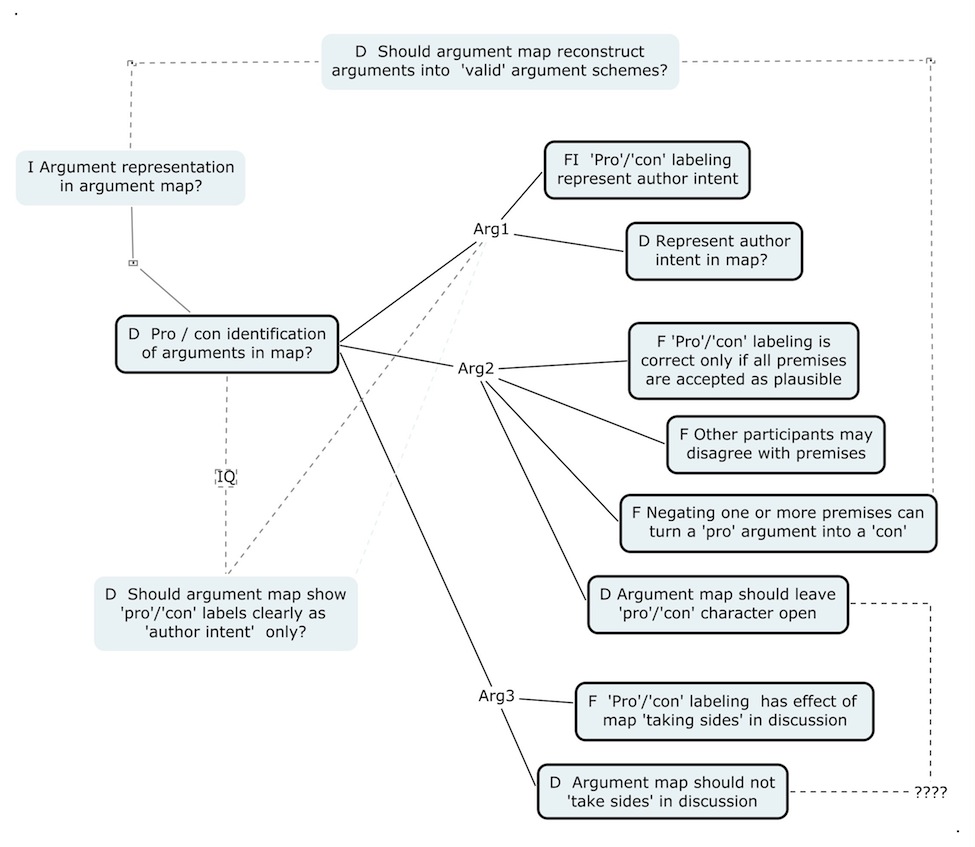
c.   Reasoning maps should not identify answers or arguments as ‘pro’ and ‘con’ a proposal or position (unless it is made very clear that these are only the author’s intended function.)

The reason is that other participants might disagree with one or several of the premises of an intended ‘pro’ argument, in which case the set of premises (not with the respective participant’s negation) can constitute a ‘con’ argument — but the map showing it as ‘pro’ would in fact be ‘taking sides’ in the assessment. This would violate the principle of the map serving as a neutral, ‘impartial’ support tool.

d.  For the same reason, reasoning maps should not attempt to identify and state the reasoning pattern (e.g. ‘modus ponens’ or modus tollens’ etc.) of the argument. Nor should they ‘reconstruct’ arguments into such (presumably more ‘logical’, even ‘deductively valid’) forms.

Again, if in a participant’s opinion, one of the premises of such an argument should be negated, the pattern (reasoning rule) of the set of claims will become a different one. Showing the pattern as the originally intended one by the author, (however justified by its inherent nature and validity of premises it may seem to map preparers), the map would inadvertently or deliberately be ‘taking sides’ in the assessment of the argument.

e.   Topic, issue and reasoning maps should link to the respective elements in the verbatim and any formalized records of the discussion, including to source documents, and illustrations (pictures, diagrams, tables).

d.      The ‘rich image’ fashion (fad?) of adding icons and symbols (thumbs up or down, plus or minus signs) or other decorative features to the maps — moving bubbles, background imagery, etc. serve as distracting elements more than as well-intended user-friendly devices, and should be avoided.

12      Current discourse-based decision approaches exhibit a significant shortcoming in that there is no clear, transparent, visible link between the ‘merit’ of discussion contributions and the decision.

Voting blatantly permits disregarding discussion results entirely. Other approaches (e.g. Benefit-Cost Analysis, or systems modeling) claim to address all concerns voiced e.g. in preparatory surveys, but disregard any differences of opinion about the assumptions entering the analysis. (For example: some entities in society would consider the ‘cost’ of government project expenditures as ‘benefits’ if they lead to profits for those entities (e.g. industries) from government contracts).

The proposed expansion of the Argumentative Model with Argument Evaluation (TM 2010) provides an explicit link between the merit of arguments (as evaluated by discourse participants) and the decision, in the form of measures of plan proposal plausibility. This approach should be integrated into an approach dropping the ‘argumentative‘ label, even though it requires explicit or implicit evaluation of argument premises.

13      Provisions for evaluation.

In discussion-based planning processes, three main evaluation tasks should be distinguished: the comparative assessment of the merit of alternative plan proposals (if more than one); the evaluation of one plan proposal or proposition, as a function of the merit of arguments; and the evaluation of the merit of single contributions, (item of information, arguments) to the discussion.

For all three, the basic principle is that evaluation judgments must be understood as subjective judgments, by individual participants, about the quality, plausibility, goodness, validity desirability etc. While traditional assessments e.g. of truth of argument premises and conclusions were aiming at absolute, objective truth, the practical working assumption here is that while we all strive for such knowledge, we must acknowledge that we do not have any more than (utterly subjective) estimate judgments of it, and it is on the strength of those estimates we have to make our decisions. The discussion is a collective effort to share and hopefully improve the basis of those judgments.

The first task above is often approached by means of a ‘formal evaluation’ procedure developing ‘goodness’ or performance judgments about the quality of the plan alternatives, resulting on an overall judgment score as a function of partial judgments about the plans’ performance with respect to various aspects. sub-aspects etc. Such procedures are well documented; the discourse may be the source of the aspects, but more often, the aspects are assembled (by experts) by a different procedure.

The following suggestions are exploring the approach of developing a plausibility score for a plan proposal based on the plausibility and weight assessments of the (pro and con) arguments and argument premises. (following TM 2010 with some adaptations).

a.  Judgment criterion: Plausibility.

All elements to be ‘evaluated’ are assessed with the common criterion of ‘plausibility’, on an agreed-upon scale of +n  (‘completely plausible’) to -n (‘completely implausible’), the midpoint score of zero meaning ‘don’t know’ or ‘neither plausible nor implausible’.

While many argument assessment approaches aim at establishing the (binary) truth or falsity of claims, ‘truth’, (not even ‘degree of certainty’ or probability about the truth of a claim), does not properly apply to deontic (ought-) claims and desirability of goals etc. The plausibility criterion or judgment type applies to all types of claims, factual, deontic, explanatory etc.

b.   Weights of relative importance

Deontic claims (goals, objectives) are not equally important to people. To express these differences in importance, individuals assign ‘weight of relative importance) judgments to deontics in the arguments, on an agreed upon scale of zero to 1 such that all weights relative to an overall judgment add up to 1.

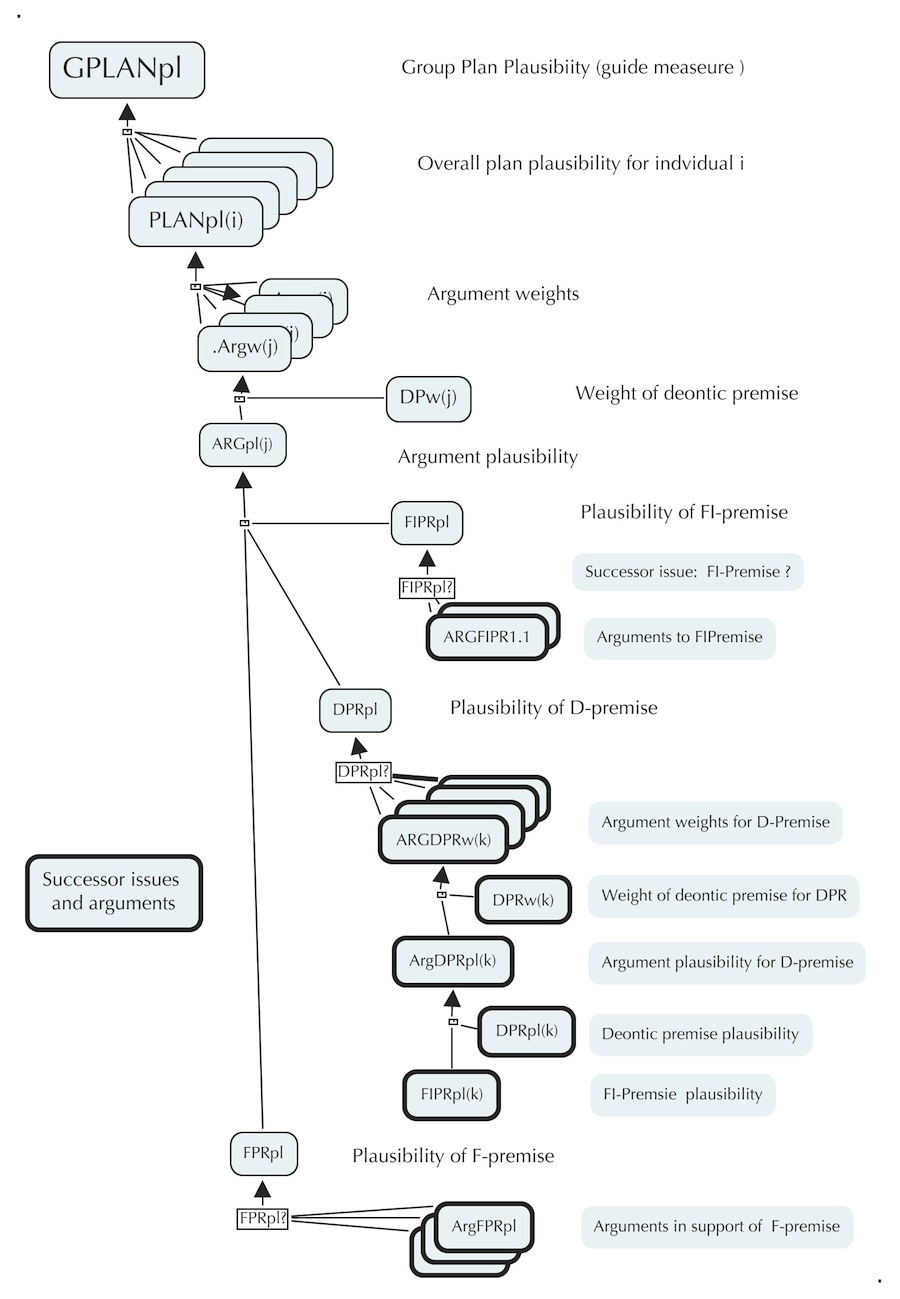
c.       All premises of an argument are assigned premise plausibility judgments ppl; the deontic premises are also assigned their weight of relative importance pw.

d.       The argument plausibility argpl of an argument is a function of the plausibility values of all its premises.

e.       Argument weight argw is a function of argument plausibility argpl and the weight ppw of its deontic premise.

f.      Individual Plan or Proposal plausibility PLANpl is a function of all argument weights.

g.  ‘Group’ assessments or indicators of plan plausibility GPLANpl can be expressed as some function of all individual PLANpl scores.

However, ‘group scores’ should only be used as a decision guide, together with added consideration of degrees of disagreement (range, variance), not as a direct decision criterion. The decision may have to be taken by traditional means e.g. voting. But the  correspondence or difference between deliberated plausibility scores and the final vote adds an ‘accountability’ provision: a participant having assigned a deliberated positive plausbility score for a plan but voting against it will face strong demands for explanation.

h.   A potential ‘by-product’ of such an evaluation component of a collective deliberation process is the possibility of rewarding participants for discussion contributions not only with reward points for making contributions — and making such contributions speedily, (since only the ‘first’ argument making the same point will be included in the evaluation) — but modifying these contribution points with the collective assessments of their plausibility. Thus, participants will have an incentive — and be rewarded for — making plausible and meritorious contributions.

14      The process for deliberative planning discourse with evaluation of arguments and other discourse contributions will be somewhat different from current forms of participatory planning, especially if much or all of it is to be carried out online.

            The main provisions for the design of the process pose no great problems, and small experimental projects can be carried out with current tools ‘by hand’ with human facilitators and support staff using currently available software packages.  But for larger applications adequate integrated software tools will first have to be developed.

15      The development of  ‘civic merit accounts’ based on the evaluated contributions to public deliberation projects may help the problem of citizen reluctance (often referred to as the problem of ‘voter apathy’) to participate in such discourse.

However, such rewards will only be effective incentives if they can become a fungible ‘currency’ for other exchanges in society.  One possibility is to use the built-up account of such ‘civic merit points’ as one part of qualification for public office — positions of power to make decisions that do not need or cannot wait for lengthy public deliberation. At the same time, the legitimization for power decisions must be ‘paid for’ with appropriate sums of credit points — a much-needed additional form of control of power.

16      An important, yet unresolved ‘open question’ is the role of complex ‘systems modeling’ information in any form of argumentative planning discourse with the kind of evaluation sketched above.

Just as disagreement and argumentation about model assumptions are currently not adequately accommodated in systems models, the information of complex systems models and e.g. simulation results is difficult to present in coherent form in traditional arguments, and almost impossible to represent in argument maps and evaluation tools. Since systems models arguably are currently the most important available tools for detailed and systematic analysis and understanding of problems and system behavior, the integration of these tools in the discourse framework for wide public participation must be seen as a task of urgent and high priority.

17      Another unresolved question regarding argument evaluation (and perhaps also mapping) is the role of statement qualifiers. 

Whether arguments that are stated with qualifiers (‘possibly’, ‘perhaps’; ‘tend to’ etc.) in the original ‘verbatim’ version should show such qualifiers in the statements (premises) to be evaluated. Arguably, qualifiers can be seen as statements about how an unqualified, categorical claim should be evaluated; the proponent of a claim qualified with a ‘possible’ does not ask for a complete 100% plausibility score. This means that the qualifier belongs to a separate argument about how the main categorical claim should be assessed, and thus should not be included in the ‘first-level’ argument to be evaluated.  The problem is that the qualified claim can be evaluated — as qualified — as quite, even 100% plausible — but that plausibility can (in the aggregation function) be counted as 100% for the unqualified claim. Unless the author can be persuaded to add an actual suggested plausibility value in lieu of the verbal qualifier, one that other evaluators can view and perhaps modify according to their own judgment (unlikely and probably impractical), it would seem better to just enter unqualified claims in the evaluation forms, even though this may be seen as misrepresenting the author’s real intended meaning.

18       Examples of topic, issue, and argument maps according to the preceding suggestions.

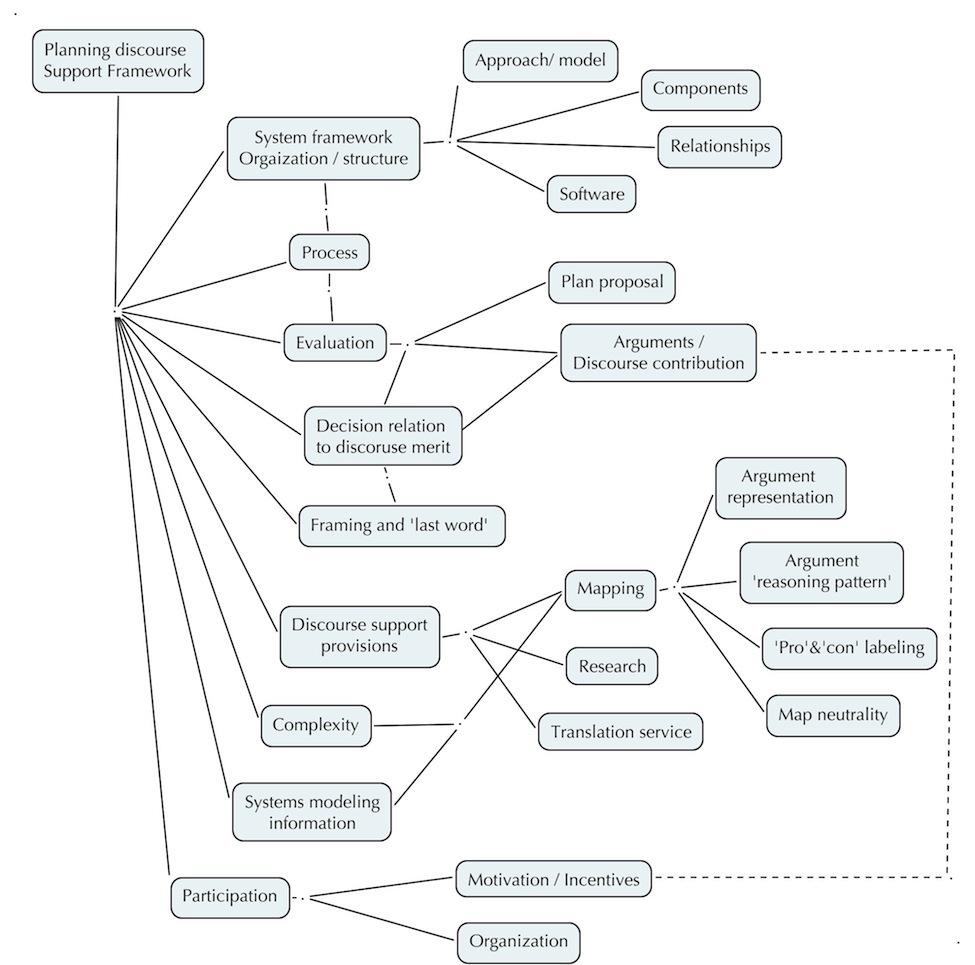
a.  A ‘topic map’ of the main topics addressed in this article:
Topic map

Map of topics discussed

b.  An issue map for one of the topics:
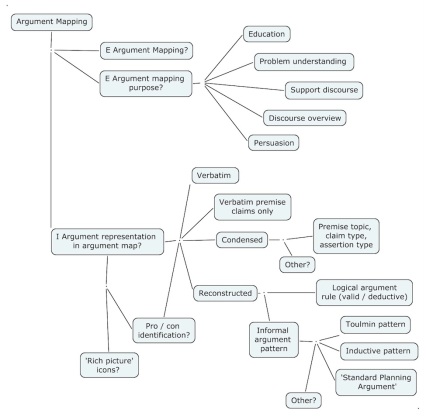
Mapping issues

Argument mapping issues

c.  A map of the ‘first level’ arguments in a planning discourse: the overall plan plausibility as a function of plausibility and weight assessments of the planning arguments (pro and con) that were raised about the plan.Plan plausibility
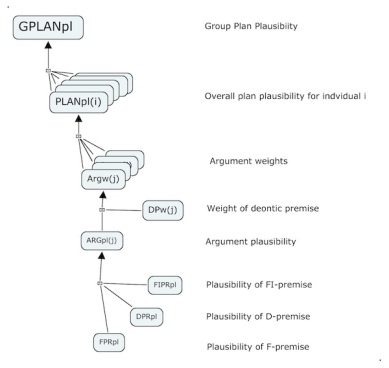
The overall hierarchy of plan plausibility judgments

      d.  The preceding diagram with ‘successor’ issues and respective arguments added.Successor issues
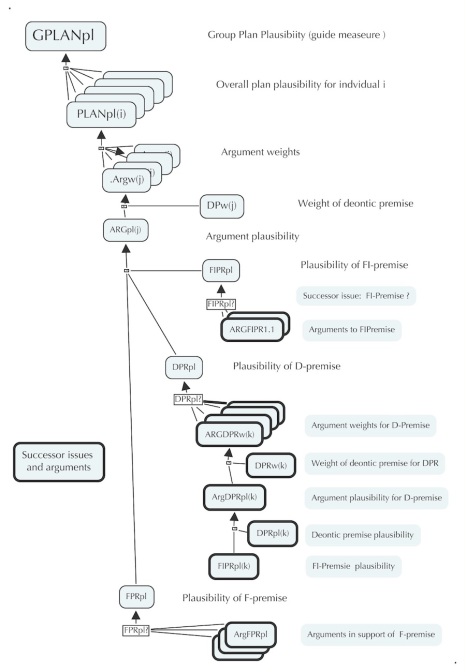
Hierarchy map of argument evaluation judgments, with successor issues

e. An example of a map of first level arguments for a selected mapping issuesArgument map
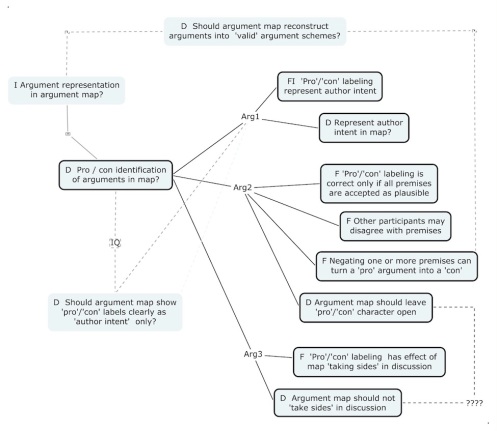
Argument map for mapping issue ‘Should argument map show ‘pro’ and ‘con’ labels?

References

Mann, T.       (2010)  “The Structure and Evaluation of Planning Arguments”  Informal Logic, Dec. 2010.

Rittel, H.             (1972)  “On the Planning Crisis: Systems Analysis of the ‘First and Second Generations’.” BedriftsØkonomen. #8, 1972.

–      (1977) “Structure and Usefulness of Planning Information Systems”, Working Paper  S-77-8, Institut für Grundlagen der Planung, Universität Stuttgart.

–      (1980) “APIS: A Concept for an Argumentative Planning Information System’. Working Paper No. 324. Berkeley: Institute of Urban and Regional Development, University of California.

–      (1989)  “Issue-Based Information Systems for Design”. Working Paper No. 492. Berkeley: Institute of Urban and Regional Development, University of California.

—-

A topic map for a systems thinking discussion on participatory democracy

The discussion “Participatory democracy through systems thinking’ on the Systems Thinking in Action’ network on LinkedIn raises a number of issues that merit discussion. This applies even to the assumptions (taken for granted?) that Improved participatory democracy is desirable, and that Systems thinking is the best approach for achieving it. These assumptions may not be universally shared and at least some rationale for them might be addressed. The rationale or justification for these assumptions would have to address the expected efficiency or quality with which the tools of systems thinking (that still need to be determined; the discussion did not reach a clear consensus on this, and left the question whether ‘new’ ST tools would have to be developed to achieve the expected effect) would address the task in comparison with other approaches. These issues have to do with the criteria that determine ‘better participatory democracy’, as judged by whom, according to what method. The results of the evaluation would then, presumably, support a process of decisions, actions to be taken, by what agents and what methods.

The discussion arguably did not explore all of these questions yet, nor establish a decisive agenda about how systems thinking people would or should go about the project of improving participatory democracy. (The issues, incidentally, apply both to the process of working towards the stated aim, as well as to the workings of the resulting democratic governance system.) The discussion did focus more on the need for such improvement; some posts even pointed at available systems approaches and tools that have been developed and applied but did not achieve a convincing consensus about their appropriateness.

The issues raised and shown in the map below are not as trivial as they might seem (since they relate to matters describing any governance system). For example, is the assumption that systems thinkers – a species of experts presumably in possession of insights and skills not necessarily present in the average citizen – will be involved in many or most of the issues and decisions, itself somewhat at odds with the ‘democratic’ criterion that citizens rather than experts should have the determining say in those decision?

The map should be seen as a first tentative step towards helping to clarify the agenda for such a process. For each of the ‘end’ nodes of the map, further issues about whether the particular option should be chosen (deontic issues) and if so, how (by what means) the specific choice might be achieved and implemented (instrumental issues). One of the main advantages of systems models, the identification of the various conditions (context variables, parameters) under which interventions would be expected to perform, has not been adequately explored by the discussion this far. Unfortunately, the LinkedIn format does not accommodate visual material such as diagrams of the systems components and relationships; the necessity to divert participants to other sites for such material has been (as usual) a main obstacle to the systemic exploration of the topic.

The map shown below is still mostly a ‘topic’ map; only at the first level are different individual issues (deontic, instrumental, explanatory for the same topic) identified. More detailed ‘issue maps’ will have to be drawn for each of the main topics of this map.

democracy systems thinking3

A beautiful Wicked Problem

Here’s a Beautiful Wicked Problem:

The Government must decide how to react to the revelation about secret illegal espionage in the form of listening to phone conversations of citizens and foreigners. Where it isn’t clear whether listening to the phone conversations of foreigners is indeed illegal (there being no explicit law against it other than international courtesy)  and  not just impolite and — if there is no adequate provision against discovery — plain stupid. Just as stupid as any heads of government running their own similar surveillance programs but don’t make sure their own cellphones can’t be tampered with…?
For — the tame argument that ‘every country must try to gather information, and therefore it’s not a big deal’ aside as asinine  just like the unbelievable claim that ‘I didn’t know about it’  (why doing it at all if the information gathered isn’t used?)  — if such a surveillance program has been discovered, anybody having information to convey to others that he or she does not wish the government to know, will obviously not use cellphones to do so. It does not seem to occur to anybody that this (discovery) having indeed occurred — which could be interpreted as indisputable proof of incompetence and thus cause for immediate dismissal of those responsible — that the entire operation devoted to cellphone surveillance has  thereby become entirely useless and a humongous waste of money.  Psst, Obama (and  foreign colleagues) — there’s a bunch of money to be cut from the budget to reduce the debt… Just don’t tell anybody you did it. Why?  Because if you declare that you dropped that program, well, the evildoers might feel free to plot their evil deeds by phone again, wouldn’t you know.
 What does this tell us regular cellphone addicts? It tell us: we will never be told what the government is going to do about it. If such an announcement were to materialize, either way — which would have to be considered as either a blatant lie, or an incontrovertible sign of incompetence, it should not, repeat NOT, be believed. This should be clear to any thinking citizen. And given the confidence in government being what it is these days, any government providing another reason for not believing it must be out of its mind. Lets see… the obvious solution would be to shut down NSA to save the money but keep it secret. Can it be kept secret? Should it? This looks like a supremely delicious test of political and diplomatic competence. Abbé Boulah He say:  Invest in carrier pigeons.

A solution idea for the use of civic credit points for the control of power

In the Fog Island Tavern:

Hey Vodçek — what’s all the excitement over there about?

Hi Bog-Hubert. Some good news from Rigatopia — why don’t you go over to find out? Here’s your coffee.

Thanks. You can’t provide a quick summary? I’ll have to catch the ferry in a few minutes…

Okay. It looks like they have developed a new solution for the problem of power and accountability. You remember Abbé Boulah’s campaign for argument evaluation in policy-making?

Applying the ideas of our architect friend — to evaluate design and planning arguments — to more general policy discussions and decisions? Isn’t he developing some kind of game to get people used to the concept?

Yes. The game is a good starting point. So you know how people get points for any contributions they make to the discussion — but they get modified by everybody’s assessment of the plausibility and importance of those contributions, and by the overall quality (plausibility) of the solution they collectively work out.

I remember. So how does this get used to control power in real life?

It’s actually quite simple. People who participate in public discussions build up a credit points account based on the quality of their contributions. The participation in public discourse is of course free and open to all: the possibility to earn credits is an incentive to participate.

Yes — we have talked about how that might be used to actually get decisions made. There were some questions about how the plausibility assessments could be used to guide decisions. And about some kinds of public decisions that have to be made quickly so there’s no time to have a long discussion about them…

Right. So some people have to be appointed to positions where they are responsible for making such decisions. One part of the idea — the solution they are trying out on Rigatopia — is that a person’s credit account will play a significant part in the appointment to such positions: you have to show a certain level of creditable participation in public discourse to qualify for positions where you have the power to make decisions.

So how does that solve the problems with power in those positions? We don’t have to go through the entire litany of power addiction, temptations for corruption, etc?

No. The solution is that each decision must be ‘paid for’ — up-front — with a credit point ‘ante’. Which is lost if the decision is no good; but can be seen as an ‘investment’ to earn new points if the decision is successful. But eventually, the points are ‘used up’.

Makes sense: we often talked about how power — as ’empowerment’ to pursue your happiness — should be ‘paid for’ just like you have to pay for your food and clothes and car.

Yes — but not with the same currency. And here, the currency is credit points — something anybody can earn, but which must be earned, and which can be lost by making stupid decisions.

That finally gives some substance to the notion of ‘accountability’. I agree. What about public decisions for which there is — and should be — some thorough discussion before decisions are made?

You are asking about how we can realize the expectation that such decisions should be made on the basis of the merit of arguments, of the contributions people make to the discourse. And how to add this element of accountability to the basic idea of using some overall group measure of proposal plausibility as a guide to the collective decision.

Right. The argument evaluation approach has been worked out reasonably well to produce an individual judgment of overall proposal plausibility (as a function of argument plausibility and argument weight — that was described in the paper in the ‘Informal Logic’ journal). But we all had some reservations about how to fashion a group decision from those individual judgments, and whether traditional decision methods such as (majority) voting could easily be replaced.

Okay: here’s the answer to that. Whatever decision method is being used — say voting — will have to be assessed in relation to some such measure of collective proposal plausibility — the plausibility assessments of all the people who have contributed to the discourse and assessments. But somebody has to take some responsibility for the decision. And that must involve accountability — which brings us back to the civic credit accounts. If you wish to actually have some actual ‘say’ in such a decision, you have to commit some of your credit points — perhaps your traditional ‘vote’ or polling opinion is ‘weighted’ by the credit points you are willing to put up as ‘ante’ — and lose if your decision is flawed. Of course, if it’s a good decision, it will earn you point points back, with ‘interest’ depending on how good it is.

Makes sense. It sounds a bit complicated, but with all the new information technology we have, it shouldn’t be too difficult to implement. I assume that such decisions — if they are to apply (e.g. as ‘law’) to the entire community, city, state, or whatever entity — must be ‘announced’ in a format ‘validated’ by the credit points that are backing them up. I like the aspect that the currency for influencing decisions and making decision-makers ‘accountable’ has been shifted away from money to civic credits. But tell me: won’t there be decisions that are so important and consequential — and require vast resources such that no individual decision-maker alone can reasonably be accountable for them?

Sure. The provision for this is also quite simple: If there is such a momentous decision, requiring so much money or other resources that the responsibility for it must be shared by the community — or at least by the supporters in the community, — this can be achieved by people backing the decision transferring credit points from their own accounts to that of the ‘official’ in charge of actually ‘signing’ for the decision. If it’s a bad one, they all, including the official, will be ‘accountable’ by losing their points. If it’s successful and ‘earning’ new credits, the points will have to be paid back to the supporters — with ‘points interest’ according to the size of their respective investment.

Sounds interesting, even like a breakthrough, almost. Thanks for the summary; I guess they are still discussing quite a few of the details that must be worked out. Looking forward to hear more about it when I get back, gotta run.

Remember, you heard it here first, Bog-Hubert. Have a safe trip!

Some speculations regarding the possibility of a moral code without religion.

On a Linked-In forum, the question was raised whether a moral code without religion could be developed. My effort to look into ways to achieve better decisions for planning, design, policy-making issues suggests that it is indeed possible to develop at least a partial system of agreements — for which ‘moral code’ would be an unnecessarily pretentious term — but which has some of the same features. For problems, conflicts of interest or proposed actions or projects that require the consent and cooperation of more than one individual, (this does not cover all situations in which moral codes apply), as soon as parties realize that ‘resolutions’ based on coercion of any kind either will not really improve the situation or are fraught with unacceptable risks (the other guy might have a bigger club… or even one’s own nuclear weapon would be so damaging to even one’s own side that its use would be counterproductive) the basic situation becomes one of negotiation or, as I call it, ‘planning discourse’. Such situations can be sustained and brought to success only on the basis of the expectation that parties will accept and behave according to some agreements. The set of such agreements can be seen as (part of) an ethical or moral code. For the planning discourse, a rough sketch of first underlying ‘agreements’ or code elements are the following:

**1 Instead of attempting to resolve the problem by coercion — imposing one side’s preferred solution over those of other parties — let us talk, discuss the situation.

**2 The discussion will consist of each side describing that side’s preferred outcome, and attempting to convince the other side (other parties) of the advantages –or disadvantages — of the proposal.

**3 All sides will have the opportunity to do this, and all sides implicitly promise to listen to the other’s description and arguments before making a decision.

**4 The decision will (should) be based on the arguments brought forward in the discussion.

*4.1 The description of proposals should be truthful and avoid deception — all its relevant features should be described, none hidden; no pertinent aspects omitted.

*4.2 The arguments should equally truthful, avoiding deception and exaggeration, and be open to scrutiny and challenge, which means that participants should be willing to answer questions for further support of the claims made in the descriptions and arguments.

Simplified ‘planning arguments’ consist of three types of claims:
a) the factual-instrumental claim
‘proposal A will bring about Result B, given conditions C’
b) the factual claim ‘
‘Conditions C are (or will be) given’;
c) the ‘deontic’ or ‘ought-claim’
‘Consequence B of the proposal ought to be pursued’;
and also
d) the ‘pattern’ or inference rule of the argument (that is, the specific constellation of assertions, negation of claims and relations between A and B) is ‘plausible’.
While such arguments (just like the ‘inductive’ reasoning that plays such a significant role in science) are not ‘valid’ from a formal logic point of view, they are nevertheless used and considered all the time, their plausibility deranging from their particular constellation of claims, and the ‘fit’ to the specific situation.
The plan proposal A is itself a ‘deontic’ (ought-) claim.

*4.3 The support for claims of type (a) and (b) takes the form of ‘evidence’ provided and bolstered by what we might loosely call the ‘scientific’ perspective and method.

*4.4 Support for claims of type c) will take further arguments of the ‘planning argument’ kind and pattern, containing further factual and deontic claims in support of the desirability of B.
The deontic claims of such further support arguments can refer to previous agreements, accepted laws or treaties that imply acceptance of a disputed claim, claims of desirability or undesirability for any party affected by the proposed plan, even moral rules derived from religious domains.

**5 Individual participants’ (preliminary) decision should be based on that participant’s individual assessment of the plausibility of all the arguments pro and con that have been brought up in the discussion.
That assessment should not be superseded by considerations extraneous to the plan proposal discussion itself — such as party voting discipline — but be a function of the plausibility and weights assigned by the individual to the arguments and their supporting claims.

**6 A collective decision will be based on the overall ‘decisions’ or opinions of individual participants.
(The current predominant ‘majority voting’ methods for reaching decisions do not meet the expectation #4 above of guaranteeing that the decision be based on due consideration of all expressed concerns: here, a new method is sorely needed).

A decision to adopt a plan by the participants (parties affected by the proposed plan) in such a discussion should only be taken (agreed upon) if all participants’ assessment of the plan is positive or at least ‘not worse’ than the existing problem situation that precipitated the discussion.

**7    Discussion should be continued until all parties feel that all relevant concerns have been voiced. Ideally, the discussion would lead to consensus regarding acceptance or rejection of the proposed plan. If this is the case, a decision can be taken and the plan accepted for implementation.
Realistically, there may be differences of opinion: some parties will support, others oppose the plan. The options for this case are either to abandon the process (to do nothing), to attempt to modify the plan to remove specific features that cause opponents’ concerns; or to prepare a different proposal altogether and start a new discussion about it.

**8    Individual parties’ ‘decision’ (e.g. vote) contribution to the common decision should be matching the party’s expressed assessment of the arguments and argument premises.
For example: if a participant agrees with all the ‘pro’ arguments and disagrees with the ‘con’ arguments (or expressed lesser weigh of the ‘con’ arguments) the participant’s overall vote should be positive. Conversely, if the participant’s assessment of arguments is negative, the overall ‘vote’ should be negative. Participants should be expected to offer additional explanations of a discrepancy between argument assessment and overall decision.

**9 A common decision to accept a proposed plan implies obligations (specified in the plan) for all parties to contribute to implementation and adherence to the decision provisions.

**10 The plan may include provisions to ensure adherence and contributions by the parties. Such provisions may include ‘sanctions’, understood as (punitive) measures taken against parties guilty of violating plan agreements.
There undoubtedly might be more agreements needed for a viable planning ‘ethic’. It is clear that some of the above provisions are not easy to ‘live up to’ — but what moral system has ever been? And for some provisions, the necessary tools for their successful application are still not available. For many societal decisions, access to the discussion (to be able to voice concerns) is lacking even in so-called advanced democracies. Some expectations may sound like wishful thinking: The expectation of transparent linkage between argument assessment and overall (individual) decision and even more the linkage between arguments and collective decision are still not available. The approach for systematic and transparent argument assessment (My article in the Dec 2010 issue of “Informal Logic” on ‘The structure and Evaluation of Planning Arguments’) suggests that such a link would be feasible and practical, if somewhat more cumbersome that current voting and opinion polling practices. However, its application would require some changes in the organization of the planning discourse and support system, as well as decision-making methods.

These observations were mainly done in response to the question whether a ‘moral’ not based on religious tenets would be possible (and meaningful?). That question may ultimately be taken to hinge on item # 10 above — the sanction issue. The practical difficulties of specifying and imposing effective sanctions to ensure adherence to moral rules may lead many to the necessity of accepting or postulating sanctions and rewards to be administered by an entity in the hereafter. But it would seem reasonable to continue to explore such agreement systems including sanctions in the ‘here and now’ beyond current practices, since both non-religious and religion-based systems arguably have not been successful enough reducing the level of violations of their rules.

On the role of feelings in argumentative discourse

– Are you neglecting your civic duty to sustain the customary atmosphere of comfortable if meaningless small talk in the Fog Island Tavern, Bog-Hubert? Scribbling notes in your crumpled notebook like a real coffee house intellectual — or have you actually gotten over your writers’ block to get back into some serious writing?

– Sorry, nothing so encouraging. I’m just writing down come complaints of Abbé Boulah’s about people’s lack of comprehension of his and his buddy’s ideas glorious ideas about argumentative planning. We were walking along the beach, and he seemed quite disappointed by some reactions he got from some experiment. So I need to write some things down before I forget them.

– Reactions to what?

– It seems they were trying out some of those ideas about structured planning discourse including the argument assessment approach, in a distance learning project of some kind. And the participants on the other end either didn’t understand what they were trying to do at all, or else hadn’t even studied the background material they had prepared and sent over there. They totally screwed up the exercise, and finally blamed the disaster on his buddy, alleging that he didn’t allow for the role of emotions and feelings in the discourse, didn’t understand emotions at all; something like that.

– That’s a problem with those online and distance projects: you never know whether the folks at the other end really are doing their part of the deal. But I can see where they picked a plausible excuse, at least.

– Plausible, huh? In what way, Vodçek? How is ignorance and laziness ‘plausible’?

– Well, doesn’t the very word ‘argument’ invite a number of misunderstandings that then can be used as excuses? You can’t really blame misunderstanding only on the party that doesn’t understand, can you?

– What kinds of misunderstandings?

– Well, many people understand ‘argument’ as something disagreeable, adversarial, quarrelsome — that can easily end up into a more serious fight — not very nice nor cooperative.

– I can’t argue with that: we’ve had a lot of that kind of reaction.

– Right. And even for those who do understand ‘argument’ as a set of statements that aim to support some claim, that notion is flavored by the association with formal logic, rationality, scientific ‘objectivity’, in short, a kind of discourse in which the ‘truth’ of issues is to be established. Truth that is independent or overriding of how people feel about it. Scientific, ‘objective’ truth. That kind of inquiry that almost by definition excludes feelings. And of course that bothers people who are concerned with issues about which they do have strong feelings. Where the ‘truth’ about what IS the case is less the point of the discussion than what OUGHT to be, and theta patently isn’t true YET. So they understandably resent the impression that those feelings are slighted and ignored.

– But that’s precisely Abbé Boulah’s point — talking about ‘planning arguments’ or ‘design arguments’ — the ones in which one of the key premises, the ‘ought’-claim — is exactly the one that deals with feelings! The kinds of arguments that are not susceptible to formal logic analysis because they have to do with what people want, desire, in short, with how they feel about things.

– Sure, Bog-Hubert: you and I, and some of our friends know that. But for somebody who just hears ‘argument’ and does not examine the planning argument story carefully enough, the impression is still that those ‘feelings’ issues just don’t count in argumentation. So maybe the story needs to be told more clearly and understandably?

– I thought the difference between the ‘formal’ and ‘deductive’ kind of arguments and those planning arguments was clear enough. But you may be on to something there. What do you think are the key points that should be made more clear?

– Let’s see. A first problem might be the frequent impression that people who go on about argumentation appear to take a position of superiority: if they have an argument — one that’s sanctioned by ‘logic’ as ‘valid’ and that therefore has a true conclusion, they are seen as putting down other opinions as ill-informed or stupid. I know what you are going to say: the process we are proposing as ‘argumentative planning’ is explicitly inviting all kinds of concerns, arguments, as ‘legitimate’ and deserving of being given ‘due consideration’ — since all planning arguments after all are ‘inconclusive’ from a formal logic point of view. But I have a hunch that using the word ‘argument’ makes it difficult for people to see that difference. Is there a different way of talking about that?

– Coming to think about it, we did discuss that issue some time go. In such discussions, many issues are raised and expressed as questions, not arguments — whose answers or conclusions could become significant premises of arguments for or against planning proposals. And we saw the problem as one of getting people to put those claims together into complete arguments so that they can be evaluated properly, according the the approach our friend has developed. But maybe the invitation should be to just raise such questions, not stating them as explicit pro or con arguments?

– I can see why you kept going in that direction: how the argument evaluation process might become more difficult with an approach of inviting questions rather than arguments. You’d have to get somebody to put the arguments together in some way in the end. Perhaps you could get a program to do that, using the plausibility assessments of the answers (by the participants) as premises for pro and con arguments. We should look into that. But that very issue brings up a different problem: one that has caused some trouble in the past .

– I think I know what you are referring to; we touched upon that very briefly a moment ago but didn’t go into it? If you focus on raising questions whose answers may become argument premises, many people in the past — mainly technical-oriented folks — have often tended to focus on the factual and factual-instrumental premises of planning arguments. The deontic premises — the ‘ought’ -issues — were either taken for granted, assumed to be given by overriding social policies, even legal precedents or regulations, or simply swept under the rug because they couldn’t be settled by ‘scientific’, logical means. Often, technocrats acted as if, because they had the expertise regarding the technical fact and instrumental questions, they should also have the authority to determine the ‘ought’ questions. Maybe it never occurred to them that there might be people who did not share their vision of the ‘common good’, and that different visions could be legitimate. And such attitudes of course looked to many ordinary folks as arrogant usurpation of powers for which the political process had not provided legitimacy.

– Right. Thereby casting those legitimacy questions both onto the technical-scientific expertocracy and the political process, as well as the role of argument in the ‘planning and political process. But isn’t that inevitably leading to the opposite fallacy, if you will: that planning issues should be decided predominantly or only on the basis of the deontic premises? What ‘the people’ want or desire — blithely assuming that ‘the people’ are indeed of one mind about what they desire. And then the very discrediting of the argumentative process now precluded a meaningful discussion of the plausibility of either kind of premise: what ought to be, and what to do to achieve it.

– A veritable tragedy of argumentation; i agree. Especially for those of us who finally have tried to show a way for both kinds of premises to be discussed and evaluated with equal legitimacy. So how should that question be dealt with?

– I think one main task is to make it more clear that the call for decisions to be made on the basis of arguments does not mean that there is anybody ‘official’ or ‘running the process’ or even a ‘system’ or machine, who determines the ‘truth’ or plausibility and the weight of arguments. No ‘little man behind the curtain’ or on the big screen calling the shots. Make it more clear that the planning arguments are all NOT deductively and objectively ‘valid’ and their conclusions true or false regardless how people feel about them. But precisely that no ‘absolute’ knowledge about the truth of any claims is assumed, and that decisions are made on the basis of the assessments of the people participating in the process.

– If the argument assessment results are to be used in making decisions at all. That has been raised as a possibility, as a much needed alternative to the standard decision-making rule of majority voting which doesn’t really require that any of the concerns expressed in the discussion are given ‘due consideration’. But the details for alternative decision-making methods based more explicitly on argument evaluation results need more discussion and agreement. We may very well all be wrong in the end — but we are trying to pool or knowledge and beliefs about the information we collectively bring into the process to arrive at a decision we can all support, with what is just the best of currently available knowledge.

– So what about the role of feelings, specifically, in this process?

– Thanks for getting us back to that question, Vodçek. You are asking about how to deal with the problem of people insisting that because they have raised valid questions about the legitimacy of the expert, and the predominance of the technical-scientific ‘rationality’, public issues should therefore be decided o the basis of their feelings out the issues?

– I guess that’s one way to put it.

– Okay. Can we agree on the principle that whatever the basis of people’s individual position on issues: so-called scientific rationality and logic, or their feelings, their judgment is to be accepted as their rightful and legitimate stance?

– No argument there. But I sense a ‘but’ coming… and I don’t think it has to do with all the authors of learned books on logic and critical thinking that try to tel all of us how to think properly?

– Right. The ‘but’ arises when people start demanding that the judgment resulting from their ‘feeling’ or emotional assessment should be accepted by others as a legitimate basis for their decision as well — even if they are not able to provide any further support or explanation for their judgments. My ‘gut feeling’ telling me that plan A is a good idea (or a bad one) cannot possibly be a valid reason for me to expect that others should adopt the same judgment, if I can’t explain and get across w h y I feel this way. Just as someone else whose gut feeling tells him the opposite of mine can’t expect to sway me just on the basis of him having that gut feeling.

– You are talking about issues of shared or public interest of course, not issues that are our personal matter only and don’t affect anybody else.

– Right. For any common, cooperative decision, perhaps we can tentatively state two rules:
1) The method or rule for arriving at a final common decision should accept everybody’s individual judgment regardless of how the individual arrives at it. And
2) Whenever, and to the extent that an individual or party tries to persuade others to adopt an individual position on an issue (through argumentation), that party is responsible for supplying reasons, evidence, supporting arguments, for a l l premises of the arguments, the factual-instrumental premises, the factual premises, and the deontic (‘ought’) premises, upon request. No request for further support of a premise can be rejected on the grounds that it is a personal value judgment or feeling; such a rejection will be a valid reason for anyone else to reject the demand that the position be adopted by others. (However, of course the person will still be able to ‘cast his vote’ on the basis of his personal convictions even if he cannot supply reasons to sway others).

– Does that mean that we have to accept such votes even if they are based on obviously false information or flawed — fallacious — reasoning?

– No. But if you think that somebody is making such mistakes, it is your responsibility to offer your reasons to sway that person. Remember that your premises may be less supportable and certain than they appear to you. The fact that somebody’s argument appears to you as a fallacy does not entitle you to use your authority as a connoisseur of fallacies to reject the entire argument with all its premises, and this the right of the person to have a say in the decision.

– Isn’t that a main difference between this approach and, say, the logic rule books? It does not — as an approach — try to tell anybody how to think, but just encourages all participants to examine their reasons — yes, even challenge and test them — but then accepts whatever judgment people bring into the process as legitimate contributions, right or wrong, to the final decision.

– And I would insist on something else: the support for an ‘ought’-premise can take the form of a story laying out the vision a person considers desirable, not just another set of ‘formalized’ arguments. But parts of the story should again be open to questioning.

– Agreed, Vodçek. So how do we make this more clear and understandable? How do we avoid the potential misunderstanding arising out of the term ‘argument’?

– Would it be meaningful to avoid the word ‘argument’ altogether, and to just ask people to refrain from making arguments, but only to raise questions?

– What do you mean?

– Well, take the three types of premises of a planning argument about a proposal A:
“Yes, A should be adopted
because
A will lead to B given conditions C,
and
B ought to be pursued or aimed for,
and
conditions C are given.”

Instead of this whole (‘adversarial’) argument, can we instead just ask the questions
“Does A really lead to B?”
and “Should B be aimed for?”
and
“Are conditions C really present?”

And invite participants to discuss those? Perhaps not even in the same sequence, so as to further avoid the argumentative flavor? And avoid presenting the argument at the outset as a ‘pro’ or con’ argument?

– Why should we avoid that?

– Think about it: If the proposed action really leads to result B, and a person P1 considers B desirable, the resulting argument is a ‘pro’ argument for that person, right? But if another person P2 sees consequence B as undesirable, the same argument becomes a ‘con’ argument for that person, doesn’t it? Or if P2 feels that while the goal B is worthwhile, the proposal A is not an effective way to achieve it — or if P2 grants both of the above two premises, but has information that the conditions C aren’t present to make the proposed action effective: in all these cases the same set of claims become counterarguments for P2. So why should it be labeled as one or the other from the outset, if it really depends on people’s assessment of each of the premises?

– Now I realize why all those debate programs on the market always gave me a weird sense of ‘already taking sides’ in the debates they try to facilitate: By explicitly labeling and mapping any argument as a ‘pro’ or ‘con’ argument — the way it was intended by the person making the argument — it already slightly distorted the judgment process. I agree, the ‘system’ keeping track, displaying and mapping all the contributions in such discussions should refrain from that kind of labeling; just present the claims that make up the argument premises.

– Well, in order to evaluate how all those bits of information support or not support a decision, do they not have to be put together as complete arguments, in the end ?

– Yes, I think you are right — unless we can get people to assess the plausibility of all those claims separately, and have the ‘system’ put them together as arguments and then calculate their arguments weights etc. But then the system must also make such assessments as whether a specific argument pattern really ‘applies’ to the case at hand — which people might want to make themselves. And they can’t do that unless they see the complete argument, can they?

– You devious fellow. You are once again raising more questions than we started out with, my friend. But do you agree that we can see the task and direction more clearly now? I think we need to run some experiments with various ways to treat these issues, and then write a short, concise ‘game manual’ that makes it very clear what the approach is doing, including the legitimate role of feelings and emotions in the process. You’ll tell Abbé Boulah when he comes in, Vodçek?

– You really think he’ll be able to raise the funds for those experiments?

Gun Control by Abbé Boulah

Good evening, fellow Taverniers. What is the topic of your heated discussion tonight?

Oh. we were talking about this latest speech on gun control..

Good grief. I am getting so tired of this endless gun control discussion that doesn’t get anywhere. Didn’t Abbé Boulah come up with the solution to the gun control issue a while ago?

It must have been a very foggy night, Bog-Hubert. Do you remember what it was?

A foggy night it was indeed. But the solution was great, as well as impossible.

You speak in foggy riddles, my man. Try to explain, will you?

Okay. I’ll try. The solution was a bit technological. It involved fitting all the guns with a WIFI device that would make the gun usable only at a person’s home, where the WIFI router is located. Well, maybe at designated other places such as shooting ranges.

Now how in the world would that be a solution?

Don’t you see, Renfroe? It would allow people to have guns at their homes, for protection. That would take care of the argument that people must be able to protect themselves against criminals, that the NRA is using in its polemics against gun control — as well as the argument they can’t use but that is the big elephant in the room, that the gun industry wants to sell guns. They can even make more money by making and selling those WIFI devices, and pretend to go along with the gun control idea while protecting their interests… Why are you shaking your head, Vodçek?

I see. That seems to take care of one of the issues in the second amendment: protection against criminals — ‘if guns are outlawed, only outlaws will have guns…’. So guns without such devices are automatically outlaw guns — but you can’t really prevent their existence with that policy, can you? So will it really help?

Damn, you are right. But at least the criminals can’t count on people having no protection in their homes. That ought to make a difference. And then deranged people can’t take their home protection guns down to the school cafeteria or their workplace and start shooting kids or coworkers. Or to serene places of civilized communication like this Tavern…

True. But you used the word that’s really the problem: Aren’t many if not most of those shootings done by people that are, as you said, ‘deranged’? If I remember correctly, many of those were using various kinds of medications — antidepressants, right? So how would you deal with that aspect? I know the buzzword is ‘background check’ — are you going to force doctors and psychiatrists to report patients to whom they are prescribing such drugs, so that they have to give up their guns? Good luck. You’d be fighting the medical professions as well as the gun lobby.

Hey, maybe the devices should be in the ammo; combined with the home or shooting range WIFI, or even just instead of those, they would detect if somebody is using such drugs, and simply not work for such people?

Good idea. That would take care of a lot of police and military types as well.

Wait. Those conditions are building up by people’s situations and jobs and relationships — perfectly sane people — until they snap. Even before they have been diagnosed with anything and prescribed medication?

Well, you can’t win them all, obviously. But if all the mass shooting incidents where such drugs were involved could have been avoided, it would make some difference. Do we have enough data on all that?

Not only that: what about the second amendment asserting the right of the people to bear arms to protect themselves against the government going berserk?

Aren’t you forgetting the missing part of that statement, the one that would make any resistance to out-of-bounds government meaningful and effective in the first place?

What’s that?

Don’t tell me you’ve forgotten that part: ‘a well-regulated militia’. Renfroe?

Yeah, I keep yelling that to my neighbor who keeps shooting at my dog anytime that poor critter gets anywhere near the fence: “You ain’t a militia, and you ain’t well regulated!” And that goes for the entire NRA, if’n you ask me…

So Bog-Hubert: why were you saying that the solution Abbé Boulah was talking about is not feasible?

Well, isn’t it obvious: it’s too bipartisan, but not enough? Neither of the parties — I mean the gun control people, nor the gun lobby can claim the idea as theirs; it lets people keep their guns and the gun industry sell more, which is unacceptable to the gun control people, and it restricts the use of the guns with things that must get registered or added to guns or ammo, which is unacceptable to the NRA…