Archive for the 'Uncategorized' Category


Eine Antwort auf Ban Ki-Moon’s Aufruf beim World Economic Forum in Davos 2011

(Ein Exklusivbericht aus der Fog Island Tavern)


– Noch ein Abend zum Vergessen in der Nebelkneipe, eh, Abbé Boulah?
– Ah, Bog-Hubert, ich hab auf dich gewartet. Vergessen? Das kommt darauf an.
– Worauf?
– Ob wir etwas daraus machen?
– Ah so, — hast du hinterhältige Pläne für den Abend?
– Das nicht. Aber es gibt immer Möglichkeiten, meinst du nicht?
– Ich hab’ deinen Seufzer gehört als ich hereinkam; war’s also über etwas Anderes als den nutzlosen Abend?
– Zugegeben.
– Also?
– Internet.
– Aha. Hast dich wieder in so eine Internet-Diskussion ‘reinziehen lassen? Du solltest öfters mal ausgehen, Leute treffen…
– Und mit denen nutzlose Abende mit belanglosem Geschwätz vergeuden?
– Wie zum Beispiel jetzt? Sauf ki pö. Also was war’s mit dem Internet?
– Lange Geschichte.
– Die Nacht ist jung… und ich sehe noch keine besseren Versuchungen… Also erzähl schon.
– Lass mich erst mal die Luft aus diesem Glas herauslassen — Dir auch das übliche? Prost.
Also gut, vielleicht erinnerst du dich, da hat der Ban-Ki-Moon, der UNO-Generalsekretär, im Januar beim World Economic Forum eine Rede gehalten, in der er die Leute zu ‘revolutionärem Denken und Taten’ aufrief, um ein ‘economic model for survival’ zu erstellen, ein Überlebensmodell für die Weltwirtschaft? — Er meinte, so etwas sei nötig, um die Welt vor Katastrophen zu retten. Er meinte damit wohl nicht nur Naturkatastrophen, sondern vor allem auch auch solche, die durch die Machenschaften der Menschheit selbst auf uns zukommen. [1]
– Revolutionäre Ideen und Taten, eh? Und das vom Uno-Generalsekretär? Das ist ja fast wie wenn ein Kapitän auf hoher See zur Meuterei aufruft?
– So kann man es auch sehen, sicher. Ich meine, es ist schon ein Zeichen, dass es ernste Probleme gibt. Und dass die sogar von der UNO und der illustren Versammlung in Davos gesehen werden…
– Das will ich nicht abstreiten. Wenn’s nützt. Er meint also, dass die Leute in Davos dafür die nötigen revolutionären Ideen haben werden– die Regierungen, Grossbanken, Konzerne, — genau die Leute, die die meisten Probleme selbst verschuldet haben?
– Na, das hat er wohl diplomatisch verallgemeinert: “Wir … haben die Rohstoffe verbraucht…” und so weiter. Und er hat wohl auch die Gelegenheit benutzt, sich mit seinem Aufruf bei einem breiteren Publikum Gehör zu verschaffen.
– Ja, dafür wird er ja bezahlt, oder? Für den Ausbau der UNO zur Weltregierung zu werben? Und genau das ist doch eins der Probleme.
– Wie meinst du das?
– Nun, die UNO ist doch Verein von sehr fragwürdigen und fast schon überholten Einrichtungen — Nationen. Fossile Wesen, die mit ihren territorialen Interessen, ihren Machtstrukturen, ihrer nachweislichen Geschichte gewaltsamer Konfliktlösung, ihren fragwürdigen Entscheidungsmethoden, ihrer Korruption, ihren Tendenzen nicht nur andere Völker zu überfallen und auszubeuten, sondern selbst ihre eigenen Bürger… Und mit ihren Tendenzen, wie jedenfalls viele befürchten, sich zu einer Art Welt-regierung zu entwickeln…
– Schon gut, mir sind die Schwächen und Missetaten der Nationen ja auch klar. Aber man kann die Einrichtung der UNO selbst doch als ein Zeichen der Vernunft ansehen, ein Beweis, dass man sich als Menschheit insgesamt über die gewaltlose Überwindung dieser Probleme unterhalten will? Siehst du dafür schon eine andere Möglichkeit als die eines Forums wie der UNO?
– Ja sicher, es gibt doch schon viele Beispiele von Organisationen, die Diskussionen — und Aktivitäten — quer zur herkömmlichen Struktur der Nationen betreiben. Schlechte und gute…
– Schlechte auch? Du meinst…
– Natürlich: das internationale Finanzwesen, die grossen Konzerne sind doch schon dabei, sich souverän über die kleinlichen Beschränkungen ihrer Ursprungs-nationen hinwegzusetzen. Internationale Kriminelle Netze, der Drogenhandel, Menschenhandel, da gibt es doch viele Bestrebungen, die man wohl nicht als attraktive Modelle künftiger Weltordnung ansehen kann, zugegeben, aber schon als Alternativen zur UNO und deren Nationen. Aber auch positive Bemühungen, wie das World Sozial Forum — eine Alternative zum World Economic Forum, das allerdings in den Medien eher unterbelichtet ist. Man fragt sich da schon, warum wohl? Die Religionen sind ihrem Wesen nach ebenfalls nicht-territorial ausgerichtet — dem alten Prinzip ‘cuius regio eius religio’ zum Trotz — und viele andere Interessengruppen ebenfalls. Die meisten davon halten sich aber brav an die gegebenen nationalen Strukturen — und leiden deshalb unter dem Einfluss derselben strukturellen Bedingungen wie diese.
– Oho. Und welche Konsequenzen ziehst du aus dieser etwas pessimistischen Analyse — der ich mal nicht gleich widersprechen will?
– Das erste wäre, diese Bedingungen explizit in die Liste der Probleme aufzunehmen und auf die Geschäftsordnung zu setzen. Die Frage einer gesellschaftlichen Ordnung, die nicht auf territorialen Grenzen beruht; die Frage der Kontrolle der Macht in allen solchen Strukturen (einschliesslich der UNO und der Privatindustrie) — die eng mit dem Problem der Korruption zusammenhängt; die Frage der gewaltlosen Konfliktlösung, — immer schön als Prinzip und Übereinkommen beschworen, dessen Verletzung aber in der Realität schliesslich immer mit Gewaltanwendung der stärkeren Partner beantwortet wird, weil sich niemand ernstlich über eine andere Art von Sanktionen Gedanken gemacht hat.
– Da muss ich dir Recht geben; wir haben ja schon öfter über diese Fragen gesprochen. Und reden muss man ja wohl erst einmal. Und zwar auf weltweiter Ebene, oder?
– Ja, aber auf welcher Ebene, in welchem Forum? Auf der Geschäftsordnung welcher Institution soll das verhandelt werden? Und wer hört uns zu?
– Gute Frage. Der Aufruf des Generalsekretärs wurde von einigen Leuten als Einladung gesehen, solche Fragen, und auch ‘revolutionäre’ Antworten und Vorschläge zum Beispiel auf die Geschäfts-ordnung der RIO-Konferenz 2012 zu setzen. Zum Beispiel von einer Internet-gruppe auf dem Linked-In Forum ‘Systems Thinking World — speziell eine Diskussion die von Helene Finidori angeregt wurde. Seit Februar wurden dazu über 2700 Beiträge und Kommentare eingebracht… [2]
– Und da hast du dich eingemischt? System-Denker? Sind das nicht auch genau die Leute, die den Konzernen und Regierungen geholfen haben, ihre destruktiven Machenschaften noch effizienter zu gestalten? Das bedeutet doch nur, eine andere Art Fuchs zum Wächter des Hühnerstalls zu machen?
– Mein Eindruck ist, da sind nicht viele solcher Profis dabei. Solche Leute gibt es natürlich. Aber in dieser Gruppe gibt es viele, die entschieden gegen dieseTendenzen argumentieren, und die Fragen unter dem Gesichtspunkt des ‘System-denkens’ diskutieren, dass alle Komponenten des Systems — in diesem Fall der menschlichen Gesellschaft — miteinander verbunden sind und aufeinander einwirken. Die sehen die Werkzeuge der Systemtheorie — wie mathematische und Simulations-modelle, — eben auch als Werkzeuge an, die man auch zu allgemeinem Wohl benutzen kann.
– Ah, das Allgemeinwohl. Und wie ist das hier definiert, von wem?
– Diese Teilnehmer meinen, das die betreffenden Instrumente einerseits dem besseren Verständnis der Verhaltensweise eines Systems dienen können, andererseits aber auch dazu, dieses Verständnis den Leuten nahezubringen, um deren Verhalten in Richtung von Nachhaltigkeit, gewaltfreier Konflikt-vermeidung und -Lösung und Kooperation zu beeinflussen.
– Aha. Schön klingt’s schon. Und ist dabei etwas Brauchbares herausgekommen? Oder was hat den Seufzer verursacht, den ich vorhin sehr deutlich gehört habe, als ich hereinkam und dich bei deinen Grübeleien störte?
– Zunächst mal das Positive. Die Teilnehmer an der Diskussion haben eine unglaubliche Menge von Beispielen zusammengetragen — gegoogelt? — von Ideen, Projekten, Experimenten und Ansätzen zu neuen Verhaltensmustern, die im Kleinen schon eine Art Antwort auf die Herausforderung des UNO-Generalsekretärs darstellen. Ich war schon immer an diesen Dingen interessiert, immer schon skeptisch gegenüber dem Wachstumswahn der Wirtschaft, den logischen Schwachstellen der modernen Demokratien, dem Einfluss der grossen Konzerne auf die Politik, der Art und Weise wie den Entwicklungsländern die Segnungen der Technik, der Grossindustrie und deren Antwort auf die Nahrungsmittelproduktion verpasst wird. Und ich hielt mich für einigermassen gut informiert über alternative Ansätze und Ideen. Aber ich war doch ziemlich überrascht, wieviel solche Ideen und Ansätze es schon gibt.
– Beispielsweise?
– Schau dir die vielen Links in der Diskussion an. Etwa halbwegs durch die Diskussion hat die Moderatorin Helene Finidori versucht eine etwas geordnete Zusammenstellung dieser Links zu basteln, — die hat sie auf einer anderen Plattform zur Diskussion gestellt [3] weil das Linked-in forum mit seiner Beschränkung des Formats und der Beitragslänge dafür nicht allzu brauchbar war. Aber es kamen immer mehr Beispiele, und ich weiss nicht, ob sie noch an deren Eingliederung arbeitet oder aufgegeben hat. Unter der Lawine der Beiträge begraben. Es ist vielleicht sinnvoller, eine grobe Liste der Themen zu machen, die dabei angesprochen werden, und an dieser Liste die Schwerpunkte der derzeitigen Bestrebungen aufzuzeigen. Und die Stellen die nicht so gut abgedeckt werden.
– Hast du eine solche Liste parat?
– Da gibt es eine Arbeitsliste im IBIS-format [4], die schon an die 80 Themen aufweist. — Fragen, die in der Diskussion angeschnitten wurden. Davon sind natürlich nicht alle gleich wichtig. Aber ich kann dir hier kurz eine grobe Skizze der wichtigsten Punkte geben.
Eine sehr grosse Anzahl von Beispielen hatte mit Landwirtschaft zu tun. Mit dem Basis-problem von Nahrung und Wasser zum Überleben, das nach der Sicht dieser Leute gerade von den grossen Konzernen der Industrie gefährdet wird. Die meisten Beiträge dazu standen unter dem Motto: weg von der grossen Landwirtschafts-industrie mit ihren Monokulturen, ihrer Genmodifizierten Arten, ihrer Abhängigkeit von künstlichen Düngemitteln, und ihrer Zerstörung der kleinen Familien-struktur der traditionellen Landwirtschaft in vielen solchen Gebieten.
Stattdessen werden ökologisch nachhaltiger Anbau, kleine LAndwirstschaftsbetriebe, Artenvielfalt, ‘Permaculture’ betont; die Wiederbegrünung der Städte: städtische Gemeinschaftsgärten, Begrünung der Dächer; und das Prinzip, die Wegelängen der Lebensmittelversorgung zu verkürzen, auf lokale Arten abzustimmen.
– Da werden die Vertreter von Monsanto und BASF aber ihre Freude haben.
– Du hast Recht, gegen die wurde sehr lautstark und nachhaltig gestänkert. Apropos Nachhaltigkeit: Natürlich gab es viele Beiträge über andere Aspekte der Nachhaltigkeit, besonders Energie: die Forderungen, von Fossil-energiequellen und Atomenergie auf neue, erneuerbare Energiequellen zu wechseln, zum Teil mit Betonung auf Kleinanlagen statt grosser Netze vor allem in ländlichen Entwicklungsgebieten. Auch da gab es viele Neuerungen, teils schon in Betrieb, teils noch in Entwicklung.
Etliche Beispiele gab es von Effizienz-Bestrebungen der Industrie und den grossen Konzernen, ihren CO2-Fussabdruck zu verringern, ihre Produktion auf geringeren Verbrauch von Energie und Rohstoffen und Arbeitern umzustellen — und dadurch natürlich wettbewerbsfähiger zu werden. Natürlich auch mit Hilfe von mathematischen und Simulationsmodellen der Systemtechniker. Viele dieser Spezialisten schlugen aber vor, solche Modelle gezielt auch auf neue Ansätze und Ideen anzuwenden, und damit die ‘leverage points’ in den Gesamt-ökologie-systemen zu identifizieren: die Stellen an denen man am besten den Hebel ansetzen und Kurs der Wirtschaft und der Gesellschaft wirksam beeinflussen kann.
Eine Reihe von Teilnehmern war gegenüber solchen Bestrebungen eher skeptisch, und meinten dass nachhaltigen Veränderungen weder ‘von oben’ (‘top-down’, aufgrund der Befunde von solchen EDV-Systemanalysen und Modellen) verfügt werden könne, sondern dass wirklicher Kurswechsel nur ‘von unten’ (bottom-up) durch ein neues Bewusstsein und eine radikale Umstellung der moralischen Grundsätze der Menschheit kommen kann, ein neues Wertsystem, ein neues Verhältnis zu Gesellschaft und Natur. Und zwar als Voraussetzung für Neuordnung: Viele dieser Teilnehmer wollten gar nicht anfangen über sachliche Massnahmen und Lösungen nachzudenken, bevor eine solche Umstellung der Werte stattgefunden hätte, vielleicht unter der Annahme, dass sich reelle Massnahmen und Verhaltensweise dann ‘von selbst’ einstellen würden. Eine ‘system-theoretische’ Grundlage für diese Haltung ist die Idee des ‘tipping point’: die Überzeugung, dass massive Veränderungen von Verhaltensweisen der Gesellschaft immer erst dann erzielt werden, wenn die betreffenden Ideen und das entsprechende Bewusstsein von mindestens etwa einem Zehntel der Bevölkerung akzeptiert worden ist. Das wird dann auch selbst das Verhalten der Leute und Einrichtungen mitreissen, die derzeit für die Probleme verantwortlich sind. Deshalb muss man sich nach deren Ansicht vornehmlich darauf konzentrieren, die neuen Ideen und die neue Moral möglichst weit und schnell zu verbreiten — ‘spreading the word’ — bis der tipping point erreicht ist.
– Na, um die moralische Verbesserung der Menschheit haben sich doch seit Jahrtausenden die Philosophen und vor allem Religionen massiv bemüht — und trotzdem sind wir jetzt im Schlamassel? Aber entschuldige, du hast deine Übersicht noch nicht beendet, oder?
– Die Hauptthemen in der Diskussion waren das schon. Es gab natürlich auch Forderungen, die Finanzwirtschaft, das Gehabe der Banken, die Gewohnheiten der Regierungen im Hinblick auf ihre Wirtschaftspolitik besser zu regulieren; nach mehr Transparenz, besserer Bekämpfung der Korruption, Bekämpfung der sozialen Ungleichheit, die vor allem in den westlichen Demokratien in den letzten Jahrzehnten immer bedrohlicher wurde. Rufe nach Orientierung der Politik nach dem wirklichen Wohlbefinden der Bürger, statt nach Brutto-Inlands-Produkt und Wirtschaftswachstum, unterstützt von neuen Messungen eben diesem Wohlbefinden — Happiness — der Bevölkerung. Aber viel weniger konkrete Lösungen, Ideen und Vorschläge. Es waren keine Politiker oder wirkliche Wirtschafts-und Finanz-experten unter den Teilnehmern, soweit ich sehen konnte. Viele Beiträge nahmen sich daher eher nur wie Wunschdenken aus oder auch nur Schimpfen über die Probleme und die üblen Machenschaften der betreffenden Missetäter.
– Das sind alles löbliche Forderungen, aber allzu neu und revolutionär kommt mir das nicht vor. Von den konkreten Vorschlägen werden doch diese Ideen schon an vielen Stellen umgesetzt?
– Da hast du Recht, und das war ein Grund für meinen Seufzer. Natürlich war das Zusammentragen all der Beispiele wirklich sehr nützlich — ich habe wenigstens viel davon gelernt. Aber gestört hat mich dabei, dass einerseits viele Problembereiche bei alledem kaum oder gar nicht behandelt wurden: zum Beispiel die Stichworte in der Rede des Generalsekretärs oder der Liste der Bedrohungen der Menschheit, welche die UNO aufgestellt hat: Naturkatastrophen, der Raubbau an Ressourcen und deren voraussichtliche Knappheit, der Klimawandel und dessen Folgen, die wachsende Bevölkerung der Menschheit und die Probleme, deren Bedarf an Nahrung, Wasser, Behausung, Einkommen, Erziehung, Gesundheitspflege zu sichern. Andererseits…
– Ich sehe schon: Die Probleme die du vorhin erwähnt hast: ob die gesellschaftliche Ordnung der Menschheit durch das System der Nationen und deren Regierungsformen den Herausforderungen gewachsen ist oder umgekehrt die Ursache für viele Schwierigkeiten darstellt; — also die Frage nach alternativen Regierung oder besser Selbstregierungs-formen, die Frage der Kontrolle der Macht — und ich nehme an, dass damit Macht nicht nur in Regierungen, sondern auch in der Privatwirtschaft und anderen Institutionen gemeint ist; die Frage besserer Sanktionen statt Gewaltanwendung für Verletzung von Gesetzen, Verträgen und Übereinkommen; die Frage besserer Entscheidungs-verfahren statt Abstimmung, — die sind gar nicht erwähnt worden?
– Mein Eindruck war jedenfalls: nur am Rande. Es gab einige Vorschläge; einige solche Fragen und Gedanken dazu waren in dem IBIS aufgeführt. Aber die sind kaum wirklich diskutiert worden — es scheint, als ob Beiträge, die nicht auf eine Webseite, auf andere Berichte oder Publikationen hinweisen konnten, einfach nicht ernst genommen wurden. Als ob kreative Vorschläge direkt aus der Diskussion heraus als so undurchdacht, so unqualifiziert angesehen wurden, dass sie nicht einmal als ‘revolutionäre’ — und das heisst doch wohl eben noch nicht durch Veröffentlichungen und Rezensionen breitgeschlagene Ideen akzeptiert und diskutiert werden konnten.
– Es scheint, dass die System-denker, die an dieser Diskussion teilnahmen, nicht sehr originell noch selbst kreativ waren?
– Jedenfalls waren sie nicht so sehr an neuen, originellen aber undokumentierten Ideen interessiert, als die Ideen anderer Leute zusammenzutragen — sicher, das war schon mein Eindruck. Und etwas enttäuschend, zugegeben. Eine vorgegebene Begründung war, man müsse eben erst ‘das System verstehen’, bevor man dazu revolutionäre oder auch nur evolutionäre Vorschläge machen darf (das mit der Revolution wurde ziemlich allgemein in Frage gestellt).
– Ich vermute, deine Enttäuschung hat etwas damit zu tun, dass unter diesen solche undokumentierten Vorschlägen einige unserer Lieblingsthemen befanden…
– Touché. Es waren ja doch einige unserer Gedanken dabei, die schon verschiedentlich zur Diskussion gestellt wurden [5]. Dann kam aber der Vorschlag einiger Teilnehmer, aus der ganzen Diskussion einen Bericht an die UNO (oder eine andere Institution) zu verfassen. Das schien als eine gute Gelegenheit, diese Gedanken in einem konkreten Zusammenhang da hineinzubringen. Aber der Versuch, das Ganze in einen kohärente Strategie-vorschlag für Organisationen wie die UNO zusammen zu montieren, war wohl etwas anmassend.
– Kohärente Strategie? Das klingt schon etwas anspruchsvoll. Aber jetzt hast du mich neugierig gemacht: heraus damit! Was würdest du denn jetzt der UNO — oder einer anderen geeigneten Organisation für diese Aufgabe — auf die Geschäftsordnung stellen?
– Langsam. Ich muss erst mal betonen, dass ich die Vorbehalte, die viele Leute gegenüber der UNO haben, durchaus ernst nehme: Nicht nur das mit der Weltregierung (wobei ich glaube, das einige Leute in den USA nur besorgt sind, dass diese damit ihren Status als alleinherrschende Supermacht verliert) sondern dass sie aus Nationen zusammengesetzt ist, dass sie weder die Frage ihrer Entscheidungsmethoden, noch das Problem der Machtkontrolle bzw. der Garantie gegen Machtmissbrauch ernsthaft als Probleme zur Diskussion gestellt hat. Das muss also mit auf den Verhandlungstisch, selbst wenn die UNO und ihre Nachhaltigkeits-initiative — den sogenannten UN Global Compact, den der Generalsekretär erwähnte — der einzige brauchbare Anfangs-mechanismus ist, den wir zur Zeit haben.
– Bei dem sich also der Apparat selbst in Frage stellen soll? Das wird für viele nicht leicht zu schlucken sein.
– Es braucht ja nicht ganz oben auf der Geschäftsordnung stehen. Aber es muss klar sein, dass es drauf steht.
– Was steht denn noch drauf?
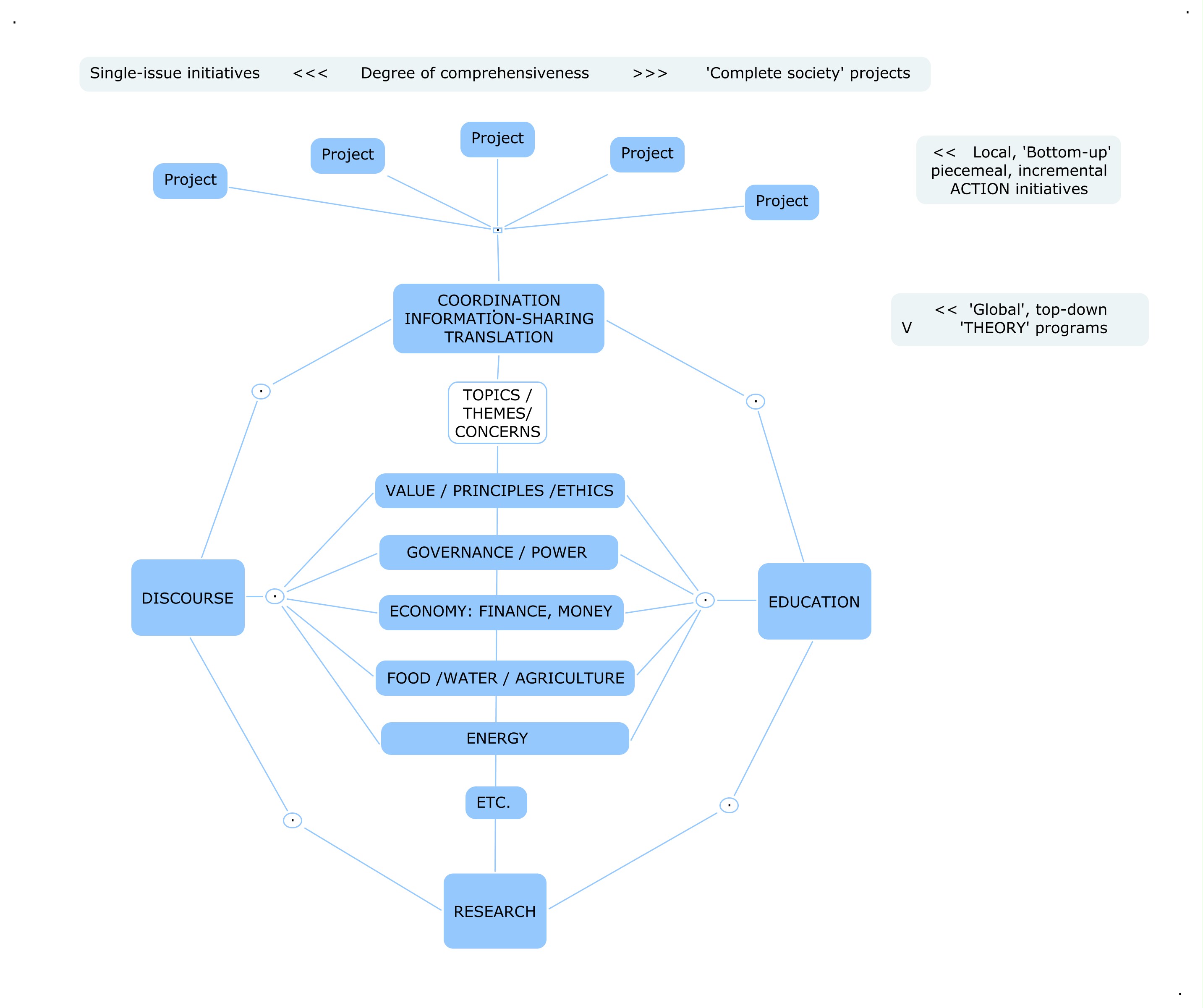
– Das siehst du am besten in dem Diagramm hier — ein Vorschlag für eine Struktur der Initiative, mit mehreren Komponenten, die insgesamt sowohl die ‘top-down’ als auch die ‘bottom-up’ Funktionen zusammenbringt.
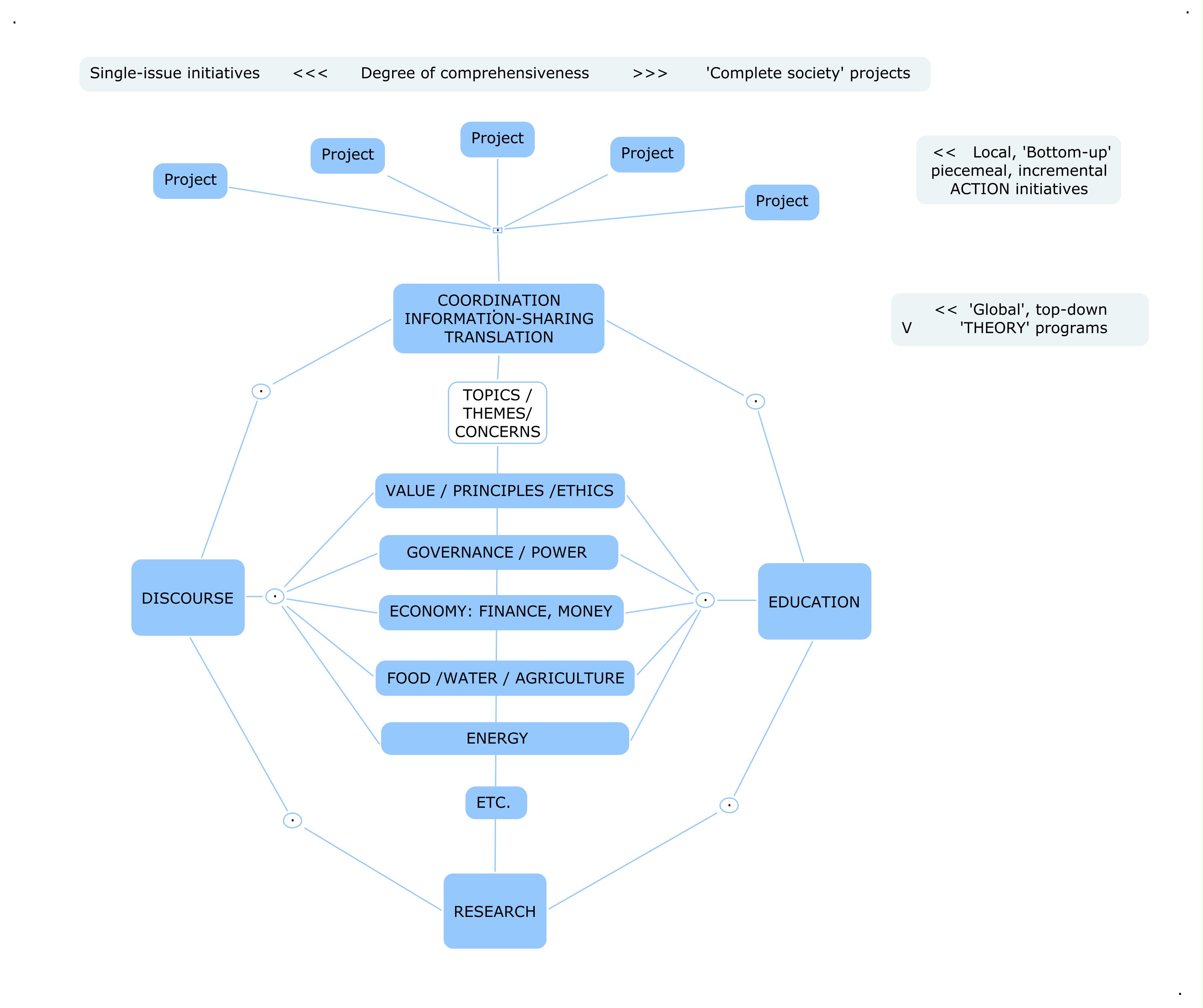
– Aha. Wieso sind da die ‘bottom-up’ Initiativen oben angebracht?
– Um das ‘Oben’ und ‘Unten’ ihrer Bedeutung nach im richtigen Wertverhältnis darzustellen. Die vielen kleinen, lokalen Projekte, (‘Action Projects’) in denen Leute die Dinge schon in die Hand genommen haben und etwas Neues versuchen. Diese Initiativen sollten insgesamt gefördert und ermutigt werden — selbst wenn sie nicht alle denselben Prinzipien folgen, noch einem Gesamtplan entsprechen. Wir brauchen die Vielfalt dieser Experimente: viele verschiedene Ansätze, um zu lernen, was funktioniert und was nicht. Das sind also die vielen Projekte, die in der Diskussion zusammengetragen wurden, die schon an verschiedenen Orten im Gang sind — aber es sollten auch neue Ideen gefördert werden, die vorerst nur Ideen sind und noch erst weiter untersucht und entwickelt werden müssen bevor sie finanziert und verwirklicht werden können.
– Also meinst du, alle solche Projekte sollen gefördert werden — ohne Unterschied? Das könnte teuer werden, meinst du nicht?
– Das siehst du vielleicht nicht ganz richtig. Viele solche Initiativen werde ja von Menschen betrieben, die damit ihre Unabhängigkeit von traditionellen Macht-und Verwaltungsstrukturen demonstrieren wollen. Also geht es nicht in erster Linie um Geld, sondern um Anerkennung, Ermächtigung — statt ihnen durch Bürokratie das Leben schwer zu machen — und moralische Unterstützung sowie auch nützliche Informationen über ähnliche Vorhaben. Aber eine Verlagerung der Förderung von grossen ‘top-down’ Vorhaben auf kleine Initiativen wäre denkbar und sinnvoll. Hinsichtlich der Unterschiede: wenn das nötig ist — zum Beispiel bei der Ausgabe von finanzieller Unterstützung — so würde ich vorschlagen, Projekte vorzuziehen, die nicht nur einen Aspekt betreffen, sondern versuchen mehrere Ziele — gemäss der System-sicht sich ja gegenseitig beeinflussen, — gleichzeitig verfolgen.
– Zum Beispiel?

Abb. 1 — Übersicht Gesamtvorschlag

– Ich sehe verschiedene Projekte, die versuchen, wie man sagt, mehrere Fliegen mit einer Patsche zu schlagen.
Ein eher bescheidenes Beispiel ist die Idee des ‘Cartmart’ zur Wiederbelebung der Innenstadt, — in vielen Städten nicht nur in den USA — aus der das Planungsprinzip des ‘best and highest use’ (die Grundfläche der Stadt vorzugsweise der höchsten und besten Nutzung zugänglich zu machen) sowohl die Bewohner als auch die kleinen Geschäfte zugunsten der Monokultur von Büros vertrieben hat. Die jetzt nach Büroschluss verödet und gefährlich sind. Viele Städte versuchen verzweifelt ihre Innenstadt wieder zu beleben, meist mit den falschen Mitteln.
– Kein Wunder — wenn sie das nicht mit anderen Flächen-nutzungs-regeln angehen. Oder auch mit Besteuerung: die Flächen am Boden, am Bürgersteig, sollten vorzugsweise von Geschäften benutzt werden, die eine Mindest-zahl von Kunden — pro Quadratmeterstunde — nachweisen können. Nicht Läden oder Büros, die die höchsten Mieten und Steuern bezahlen — wenn diese aus Geschäften kommen, die nur per Telefon oder Internet verhandelt werden. Die gehören in die oberen Etagen oder Innenhöfe.
– Einverstanden, das wurde der Stadt hier ja auch schon vorgeschlagen. Aber versuch mal die Stadt zu bereden, Bestimmungen einzuführen, welche auf einen Schlag all die Lobbyisten und Anwaltsbüros aus deren Erdgeschossen zu vertreiben…
– Schwierig, das sehe ich ein. Also wie kann das mit deiner Cartmart-Idee geändert werden?
– Mit einem Demo-beispiel. Die Idee ist, eine hinreichend grosse Fläche — ein unbebautes Grundstück oder das Erdgeschoss eines Gebäudes — mit mobilen Lieferwagen oder Karren zu einem Bazaar umzuwandeln — kleine Betriebe, die sich in diesen teuren Lagen kein festes Geschäft leisten können (mit den behördlich vorgeschriebenen Angestellten – und Besucher-toiletten, deren Fläche allein schon die Quadratmeter eines Zeitungs -und Zigearettenstands in Anspruch nehmen würden); Kaffee und Brötchen und Croissant-verkäufer, deren Hauptgeschäfts-zeit nur ein paar Stunden morgens darstellen; der Würstchenstand der nur mittags oder abends Zulauf hat. usw. Die Stände, die vorwiegend Waren für bestimmte Tageszeit anbieten, bleiben nur für diese Zeit in diesem Markt, und machen dann einem anderen Stand Platz. Toiletten, Halteplatz für Taxis, Informations-büro und andere Einrichtungen (Bankomaten, Telefon, Wifi-service usw. sind als gemeinsame Einrichtungen für alle vorgesehen.) Mit solchen Einkaufsmöglichkeiten wird die Innenstadt auch wieder für Wohnungen attraktiv, die sich sonst für jeden kleinen Einkauf ins Auro setzen müssten um in die grossen Supermärkte zu fahren, die alle kleinen mom-and pop-Läden in den US-Städten abgewürgt haben. Die könnte man sogar für diese Art Bazaar mit einspannen: für die Bauerlaubnis an den grossen Einfallstrassen kann man sie vielleicht verpflichten, die kleinen Lieferwagen-betrieben Waren zum Einkaufspreis abholen zu lassen. Sie können vielleicht ihr Logo auf einer Seite des Lieferwagens anbringen… Und wenn diese kleinen Händler nicht sowieso Halbtags-betriebe sind — für Studenten, Hausfrauen, Frührentner ohnehin eine gute Neben-erwerbsquelle — können sie vielleicht nach ihrem Einsatz in der Stadt zu dritt oder viert in die Schlafstädte fahren und dort für Rentner, Leute, die zuhause arbeiten, Hausfrauen für ein paar Stunden einen Mini-markt aufstellen, damit die nicht für jedes Brötchen in den Supermarkt fahren müssen.
– Gut, das hat ja Tradition; die sollte man wieder beleben. Ich erkenne auch die List: Damit würde also auch etwas zur Minderung des Verkehrs getan, — die Vorstädte sind nun einmal da, man muss jetzt mit ihnen leben. Auch für die Nachbarschaft: da können sich Nachbarn treffen, kennenlernen, schwatzen. Gut. Ich kann nicht sagen, ob sich das rechnen wird, aber untersuchen sollte man die Idee schon. Andere Beispiele?
– Ein Projekt, das in der Diskussion besprochen wurde, ist das ‘Project OASIS’, von einer Gruppe in England, das auf die Wiederbegrünung von Wüstengebieten z.B. in Nordafrika zielt. [6] Dazu sollen grosse Öltanker zum Transport von aufbereitetem ‘grauen Wasser’ aus den Zielhäfen ihrer Öltransporte benutzt werden. Die Tanker müssen normalerweise auf dem Rückweg von den Ölfeldern Ballast laden — leer wären sie auf hoher See nicht stabil — wozu sie heute einfach Seewasser benutzen. Vor der Wiederbeladung mit Öl wird das aufbereitete Wasser in neue landwirtschaftliche Anlagen und Aufforstungs-gebiete gepumpt. Damit werden nicht nur neue Anbaugebiete in Gegenden angelegt, die heute Wüsten sind, aber etwa zur Römerzeit noch fruchtbar waren, sondern auch deren Klima verbessert, so dass dort auch wieder mehr Regen fallen kann, womit die Gebiete von den Wassertransporten unabhängig werden.
– Ja, irgendwann wird ja der Öltransport mit Tankern auch ein Ende nehmen, wenn man den Prognosen und den Befürwortern von Sonnen-und Wind-energie Glauben schenkt. Es erinnert mich an den Vorschlag, die breiten Rasenflächen der Strassen mit geeigneten Pflanzen zu bewachsen, mit ebensolchem grauen Wasser zu wässern, und sie dann zu Bio-treibstoffen zu verarbeiten, mit denen dann wenigstens die Fahrzeuge der Strassenmeisterei betrieben werden. Hat sich jemand dafür interessiert?
– Nein. In dem Buch, (das sowieso kaum jemand gelesen hat) wurde ja spasseshalber angedeutet, dass da auch andere Produkte angebaut werden könnten, Freudenspender anderer Art. Das geht natürlich nicht.
– Schade. Obwohl es die inoffizielle Handelsbilanz verbessern könnte.
– Ein anderes Beispiel für solche Multifunktions-projekte — etwas anspruchsvoller — ist der Vorschlag, in Gebieten, die von Katastrophen betroffen wurden und wo Häuser und Infrastuktur zerstört wurde, nicht nur Katastrophenhilfe zur Wiederherstellung der alten Zustände hineinzupumpen — und damit Futter für die nächste Katastrophe vorzubereiten — sondern diese Gebiete als Innovations-projekte auszuweisen. Da können dann verschiedene Experimente — mit Freiwilligen — entwickelt, finanziert und ausprobiert werden — nicht nur hinsichtlich Bauweise und Stadtplanung, Innovative Infrastruktur für Energie, Wasser, Nahrungsmittelanbau, sondern auch für die partizipatorische Entwicklung innovativer Selbstverwaltungs-organisation.
– Das wäre mal an der Zeit. Das Gerede von Bürgerbeteiligung, ist ja auf die Dauer lähmend, wenn es sich immer nur damit erschöpft, bürokratische Missgeburten mit Demonstrationen und Debatten zu verhindern, nach denen aber die Verwaltungs-struktur dieselbe bleibt, und nur gewiefter wird, den Leuten das nächste Projekt unter dem Radar unterzujubeln… Aber wie kann das verwirklicht werden?
– Es wird erst einmal eine nur streng zeitlich begrenzte ‘Projekt-verwaltung’ der Katastrophenhilfe eingeführt, um den Wiederaufbau anzukurbeln. Dessen Regeln, Entscheidungs-strukturen, Finanzverwaltung usw. werden dann schrittweise durch neue, von den Bewohnern selbst entwickelte Regeln und Gesetze ersetzt.
Damit können nicht nur viele der Vorschläge und Ideen für eine nachhaltigere Wirtschaft und Gesellschafts-ordnung ausprobiert werden, deren Einführung anderswo immer in Konkurrenz mit bestehenden Strukturen und gegen deren Widerstand erkämpft werden muss. Viele verschiedene Experimente dieser Art sollten gefördert werden; Katastrophengebiete gibt es ja genug, und die Bedingungen sind überall verschieden. Die Möglichkeit solcher Experimente in den Bruchstellen der bestehenden Ordnung, meine ich, wird als Anreiz wirken, sich wirklich Gedanken über praktische alternative Selbstverwaltungsmodelle zu machen.
– Meinst du, dass alle die theoretischen Querdenker, die heutzutage nur am Stammtisch über die Verhältnisse schimpfen aber nie etwas Konkretes tun, sich aus ihrer Apathie aufraffen werden, um sich ernsthaft für solche Projekte einzusetzen?
– Das wird man abwarten müssen. Die Apathie beruht doch auf dem weit verbreiteten Eindruck, dass man gegen die bestehende Ordnung mit ihren eingefahrenen Interessenverflechtungen nichts tun kann. Aber das Angebot praktischer, konkreter Gelegenheiten zur Verwirklichung neuer Ideen — wie gesagt, in Katastrophengebieten, in denen die bestehende Ordnung mal vorübergehen ausser Kraft gesetzt ist, kann das ja vielleicht doch ändern? Und wenn mal solche Experimente anlaufen, können sie nicht nur wichtige Erfahrungen für Innovation liefern. Sie wirken dann als eine Art Konkurrenten der bestehenden Ordnung und können deren Erneuerung beschleunigen, wenn sie erfolgreich sind.
– Und wenn nicht?
– Wenn nicht, werden sie nach und nach wieder in die bestehende Ordnung absorbiert; aber wirkungsvolle Details können von dieser übernommen werden. Und die Lehren aus Fehlschlägen sind ja auch wertvoll; manche meinen, noch wertvoller als Erfolge…
– Gut, es gibt also Beipiele, von Projekten, die man ausprobieren sollte. Wir sind hier doch etwas vom Thema abgekommen; du wolltest erst mal dein Gesamt-schema erklären?
– Richtig. Für die Unterstützung solcher Projekte, aber auch zur Aufgabe, aus denen zu lernen, gleich ob Erfolg oder Fehlschlag, ist eine globale Koordinations-struktur nötig. Informationen zu sammeln, Erfahrungen von einer Sprache in alle anderen zu übersetzen um sie einander zugänglich zu machen — all das ist nun nicht mehr eine lokale Initiative, sondern eine globale Aufgabe. Das wäre eine Aufgabe für eine Organisation wie die UNO. Es wurde da in der Diskussion eine neue Organisation vorgeschlagen, die nicht wie die UNO auf der Nationen-basis beruhen würde [7]. Ich weiss nicht wie ernst die zu nehmen ist. Wohlgemerkt: ‘Koordination’ sollte hier nicht als Leitung oder ‘Management von oben’ verstanden werden, diese Initiativen nach einem Standard-Schema oder auch nur in eine bestimmte Richtung zu lenken, sondern sie zu verfolgen, wo nötig zu unterstützen, zu ermächtigen, vernetzen, und ihre Ergebnisse festzuhalten.
– Also nur Protokolle, Berichterstattung, Dokumentation?
– Es gibt natürlich Aufgaben und Probleme, für die allgemeine, ‘globale’ Übereinkünfte, Verträge ausgehandelt werden müssen. Es kann nicht alles auf lokale Initiativen verschoben werden.
– Also eben doch ‘top-down’ Entscheidungen?
– Nicht als Entscheidungen einer globalen Obrigkeit, ohne Rücksicht und Rücksprache mit lokalen Betroffenen. Sondern es muss einen Dialog geben,in einem Forum für Diskurs, Verhandlungen, kollektive Planung. Die Regeln dafür sind am besten als eine Art globale ‘Verfassung’ für kollektive Planung zu verstehen. Das muss von einem Informationssystem unterstützt werden muss, für das meiner Ansicht nach die Idee von Rittel, der Streitfragen-orientierten Informationssysteme — Issue Based Information Systems (IBIS) oder Argumentative Planning Information Systems (APIS) die beste Grundlage bildet [8]. Rittel’s Vorschlag beruhte auf den Prinzipien, dass Planung Information braucht über die einander widersprechenden Meinungen, (nicht nur Fakten, wie herkömmliche Informations-systeme), welche die Betroffenen über Planvorschläge haben, und diese mit einander oft widersprechenden Argumenten stützen, verteidigen oder Gegenargumente angreifen, und dass die Entscheidungen dann aufgrund der Argumente getroffen werden sollten. Die Frage, wie man sich über die Triftigkeit der Argumente unterhalten bzw. diese bewerten soll, so dass sie sich dann auch transparent auf die Entscheidungen auswirken, hat Rittel nicht mehr aufgenommen. Vorschläge zu dieser Frage der Bewertung von Planungsargumenten haben wir ja schon öfters diskutiert [5, 9]. Die Einrichtung des Forums müsste also auf die Diskussion von Streitfragen über Planungsvorschläge ausgelegt sein — und müsste statt der traditionellen Methode der Mehrheits-abstimmung (deren Mängel zum Trotz sie immer noch als Inbegriff demokratischer Entscheidungsmethoden angepriesen wird) ein Verfahren der Argumentations-bewertung enthalten. Der Diskurs muss natürlich allen Gruppen der globalen Menschheit zugänglich sein, weshalb auch hier genau wie bei der Koordination von lokalen Initiativen die Komponente der Übersetzung unerlässlich ist. Unter ‘Übersetzung’ muss man hier nicht nur jene von einer Sprache in alle anderen verstehen, sondern auch die Übersetzung der verschiedenen Spezial-ausdrücke der verschiedenen Disziplinen in eine allgemeinverständliche Sprache. In der STW-Diskussion zeigte sich, dass es sogar innerhalb des Gebiets der System-theorie schon so viele verschiedene Fachausdrücke und Konzepte gibt, dass sich die Vertreter verschiedener Teilgebiete oder ‘Schulen’ kaum noch ohne vorherige mühsame Begriffsabklärung verständigen können. Dies wäre natürlich ebenfalls eine Aufgabe einer globalen Institution.
– Worum würde sich diese Mammut-diskussion drehen? Was sind deren Themen?
– Die Themen sind alle anstehenden Vorschläge, Probleme und Entscheidungen, die nicht nur auf lokaler Ebene behandelt werden können. Ein Beispiel dafür wären die Regeln für den globalen Schiffs- oder Luftverkehr. Das mögen manchmal sogar triviale und willkürliche Regeln sein — wie im Strassenverkehr die Rechts-oder Links-verkehr – Regel; man muss sich einfach auf eine gemeinsame Regel einigen, sonst herrscht Chaos.
– Das sehe ich ein, — obwohl ich auch im normalen Rechtsverkehr oft Chaos-ähnliche Situationen erlebt habe… Aber?
– Aber dann gibt es den ganzen Katalog von dringenden Problemen, — ein grosser Anteil der Themen im IBIS — für die nicht nur Übereinkommen getroffen werden müssen, sondern für die erst einmal bessere Lösungen gefunden und entwickelt werden müssen, über die man verhandeln und Absprachen treffen könnte. Dazu gehören die Fragen die wir oben angeführt haben: Machtkontrolle, die Entwicklung von besseren Entscheidungs-verfahren (die Vorschläge zur Argumentenbewertung brauchen ja auch noch einige Entwicklung und technischen Support, bis sie in für grosse Aufgaben praktisch anwendbar sind), die Entwicklung von Sanktionen für Verletzung von Absprachen oder ‘Gesetzen’ die nicht auf Anwendung grösserer Gewalt beruhen (deren höchste dann der Versuchung des Machtmissbrauchs ausgesetzt aber nicht mehr anfechtbar ist).
– Langsam: Was wären das für Sanktionen — die müssen doch immer von einer mächtigeren Instanz angewandt werden — auch wenn es nur die Macht der öffentlichen Meinung ist, die mit Blossstellung und Beschämung arbeitet?
– Das ist schon richtig; aber nur wirksam, wenn die öffentliche Meinung erstens ausrecihend informiert ist und zweitens nicht ihrerseits von Mächten gleich welcher Art — politisch, wirtschaftlich, religiös, ideologisch — manipuliert und kontrolliert wird. Das Prinzip: Sanktionen, die beim Versuch der Übertretung eines Abkommens oder Regel selbsttätig in Kraft treten. Wie der alte Dampfmachinen-regler von Watt, der bei Überschreitung der vorgesehenen Geschwindigkeit das Ventil schliesst. Oder wie die Idee des Autoschlüssels, der, mit einem Alkohol-blasgerät verbunden, den Anlasser abschaltet, wenn der Lenker zu benebelt ist um sicher zu fahren…
– OK; die Erweiterung dieser Idee auf Korruption und ähnliche soziale Probleme anzuwenden wird wohl einige Arbeit erfordern.
– Sicher. Genau wie die angemessene Vorbereitung für Naturkatastrophen, die Neuordnung des Finanzwesens, der Erziehung der wachsenden Weltbevölkerung, der Minderung sozialer Ungerechtigkeit, und so weiter.
– Wären das nicht Aufgaben für die Forschung?
– Richtig; und das siehst du auch im Diagramm hier; Forschung muss sowohl den Diskurs als auch die Einzelprojekte und deren Koordination unterstützen, natürlich auch die Erziehungs-komponente, über die wir gleich reden müssen.
– Das ist auch einfacher gesagt als getan. Forschung wird ja heute in den verschiedensten Bereichen betrieben, nicht nur an den Universitäten, die einmal den Löwenanteil der Forschung darstellten. Heute betreiben sowohl Privatfirmen als auch Regierungen und sogenannte Think Tanks Forschung, mit sehr unterschiedlichen Mitteln aus unterschiedlichen Quellen. Und aus unterschiedlichen Motivationen, die oft nicht sehr kompatibel sind. Da gibt es vor allem rechtliche Probleme — das Interesse des sogenannten intellektuellen Eigentums gegen das Prinzip dass Forschung dem Gemeinwohl dienen sollte, zum Beispiel; die Problem der sogenannten Industriespionage, das Patentrecht.
– Genau: Das wird vor allem wieder Koordination, Vernetzung (und Vereinfachung der bestehenden Netze) erfordern. Für alle diese Fragen müssen brauchbare globale Übereinkommen erarbeitet werden, damit Forschungsresultate sinnvoll in den Prozess von Diskurs, Innovation, Koordination, Erziehung eingebracht werden können. Eben auch eine globale Aufgabe, die eben nicht der Privat-wirtschaft oder Einzelprojekten überlassen werden kann, wie es manche lautstark fordern, für die Staat und andere kollektive Einrichtungen das Problem und nicht die Lösung darstellen.
– Das wird wohl auch für die Komponente ‘Erziehung’ in dem Diagramm zutreffen, oder sind dafür auch schon Patentlösungen vorhanden?
– Patentlösungen nicht, aber ein paar Grundsätze gibt es schon dafür, jedenfalls was die Rolle dieser Komponente in dem ganzen Prozess betrifft, der hier vorgeschlagen wird.
– Was meinst du damit?
– Zum ersten soll damit nicht ein grosses allgemeingültiges Richtlinienprogramm erlassen werden, das dann allen Schulen überall aufgezwungen wird. Sondern es geht zunächst darum, das bestehende Schulsystem um einen Aspekt zu bereichern, der bisher eher unterbelichtet wurde: die Frage wie die Menschheit Sollfragen, Planung eben, angehen kann. Der ewige Streit über die Fakten welche die Schule den Kindern eintrichtern soll, geht gerade an dieser Frage immer vorbei. Die Fakten sogar der Wissenschaft und Forschung, die sich dauernd durch neue Erkenntnisse ändern, an denen sich das Erziehungswesen wundreibt, und wofür die Kompromisse zu den angeblich notwendigen Standards eigentlich immer nur die Qualität untergraben…
– Dieser gordische Knoten soll hier durchgehauen werden? Na, viel Glück!
– Durchhauen? Keineswegs. Das ganze Problem wird man so schnell nicht bewältigen. Der Gedanke hier ist vielmehr, schrittweise einige bisher fehlende Aspekte einzuführen, und dazu die neuen Medien und technischen Mittel sinnvoll einzusetzen. Denk an das System, das den Diskurs und den Prozess die globalen Übereinkommen und Entscheidungen unterstützen soll. Im alten Fakten-pensum des herkömmlichen Schulbetriebs ist das doch noch gar nicht vorhanden.
– Nein? Aber es gibt doch den sogenannten ‘civic’s – Unterricht, der den Kindern die Strukturen der jeweiligen Regierungsform — und deren Anforderungen an die Bürger — vermittelt?
– Schon, aber immer nur über das jeweils geltende System, mit all seinen Kurzschlüssen.
– Was meinst du damit?
– Na, denk doch mal darüber nach. Da gibt es — neben Systemen in denen die Sollfragen aufgrund der Exegese von religiösen (oder auch ideologischen)Traditionen entschieden werden — die sogenannten demokratischen Regierungsformen. Die werden jedenfalls in den Demokratien selbst, bei all ihrer zugegebenen Beschwerlichkeit als die besten Systeme angepriesen welche die Menschheit entwickelt hat. Es sind ja gute Prinzipien, die dem zugrunde liegen: das parlamentarische Prinzip, ‘lassen wir erst mal die Keulen draussen und reden wir über unsere Konflikte’, versuchen wir Lösungen zu verhandeln, die allen Betroffenen und deren Besorgnissen wenigstens akzeptabel wenn schon nicht besser als vorher erscheinen. Versuchen wir uns gegenseitig von den Vorzügen unserer Vorschläge zu überzeugen — mit Argumenten. Und selbst da, wo diese Prinzipien nicht nur als scheinheilige Beruhigungsmittel wirklich angewandt werden: was passiert am Ende?
– Ich sehe, worauf du hinaus willst: Es wird abgestimmt.
– Genau. Die Mehrheit bestimmt; die Minderheit muss sich fügen, ob es ihr passt oder nicht. Und selbst die Oberen, welche die Leute — wieder per Mehrheit — zu Regierungsaufgaben gewählt haben und den Leuten versichern, dass sie ernsthaft und ‘sorgfältig alle ‘Für und Wider’ der Planvorschläge abwägen werden, die haben keine Antwort, wenn sie erklären sollen wie sie das mit dem Abwägen eigentlich machen. Weder die Rhetorik noch die Logik hat nämlich der Frage der Bewertung von Planungsargumenten die nötige Aufmerksamkeit geschenkt, sondern sich immer nur um die Gültigkeit einzelner Argumente gekümmert, welche die Wahrheit der Schlussfolgerungen garantieren soll, wenn alle Prämissen wahr sind. Als wenn das für Sollprämissen überhaupt zutrifft, über welche die Menschheit ja doch mehr streitet als über die Fakten-fragen, die natürlich auch wichtig sind , aber eben nur als einer der Prämissen-typen im Planungsargument. Dessen Form und Schluss-muster von der formalen Logik ohnehin als ‘unschlüssig’ abgetan wird, weil es nicht wie ein aristotelischer Syllogismus logisch zwingend zum wahren Schluss führt. Das man also ignorieren kann.
– Aha. Wieder mal unser Lieblingsthema.
– Sicher. Aber wenn das Prinzip: reden, argumentieren, und dann Entscheidungen, vielleicht sogar etwas transparent, aufgrund von Argumenten zu treffen, — wenn das dem globalen Diskurs zugrunde liegen soll, dann muss die Frage der Argument-bewertung doch ernstgenommen und geklärt werden, und die daraus folgenden Spielregeln den Leuten — nicht nur den Kindern — doch erst einmal erklärt und deren Gebrauch eingeübt werden. Das wäre die erste Aufgabe dieser Erziehungskomponente. Das bedeutet, dass weltweit die Leute erst einmal lernen, dass wir Menschen, so gern wir unsere Entscheidungen aufgrund wahrer Erkenntnis der Realität und deren Naturgesetzen treffen möchten, diese nie mit Sicherheit wissen, sondern die Entscheidungen aufgrund unserer jeweils besten Einschätzungen dieser Wahrheit, und der Vorstellungen davon treffen wie wir die Welt gern einrichten würden, soweit wir das können. Meinungen eben, nicht nur Fakten. Und dass die Menschen in verschiedenen Kulturen verschiedene Kriterien und Verfahren entwickelt haben, mit denen man Meinungen beurteilen kann, mit denen man deren Gewicht und Plausibilität einschätzen kann — unsere Vorschläge zur Argumentenbewertung sind ja nur ein weiterer Beitrag, von deren epochemachender Bedeutung wir natürlich überzeugt sind. Aber erst einmal müssen die Leute etwas über alle diese Entscheidungsmethoden lernen, um sich dann sinnvoll über deren Anwendung auf globale Entscheidungen unterhalten zu können. Oder bessere Methoden zu erfinden. Das einfach mit Abstimmen besorgen zu wollen ist einfach nicht mehr tragfähig.
– Und wie willst du das vermitteln, wenn nicht durch den normalen Schulbetrieb?
– Da gibt es verschieden Möglichkeiten. Es sollten dazu die neue Technik eingesetzt werden: Internet, Mobiltelefon. Nicht als Übertragung von altschulmeisterlichen Vorlesungen, sondern eher in Form von Spielen — so etwas wie das Argumentations-Planspiel, das wir gerade entwickeln [9]. In dem bekommen alle Teilnehmer — an fiktiven oder realen Planungsproblemen — erstmal Punkte für alle Arten von Beiträgen — für Fragen, Vorschläge, Argumente, Fakten — die dann aber erstens durch die Bewertung dieser Beiträge auf Relevanz und Plausibilität abgewandelt werden, und zweitens durch die Qualität des Planes, das schliesslich durch die kollektive Bearbeitung dabei herauskommt. Dabei geht es also nicht darum, als individueller Teilnehmer mit den meisten Punkten zu gewinnen, sondern mit den individuellen Beiträgen dem Gesamtunterfangen das beste Resultat zu erarbeiten. Ich bin sicher, dass sich für solche Spiele — sowohl online als auch wirkliche ‘live’ Turniere Sponsoren für Durchführung und Preise finden lassen. Aber das ist nur ein Beispiel — auch da sollte man Ideen von kreativen Leuten einholen — eine weitere Aufgabe für Forschung und Diskurs. Wenn genügend Leute durch Spiele diese Art von Planungsdiskussion und Entscheidung gelernt und durch eigene Ideen verbessert haben, wird man damit wirkliche Probleme angehen können.
– Oder zumindest an die offizielle Planung gezielt vergleichende Erwartungen und Maßstäbe anlegen und aus den Traditionen der Hinterzimmer-deals herausholen; das kann ich schon sehen. Aber Alles in Allem schon nur als Prozessvorschlag ein ziemlich anspruchsvolles Aufgabenpaket. Schon fast revolutionär. Hat das wirklich eine Chance?
– Ich meine es ist eher evolutionär als revolutionär: die Vorschläge fordern doch nicht einen radikalen Umsturz bestehender Strukturen sondern bauen auf diesen, oder besser in den Bruchstellen der jetzigen Institutionen neue Lösungen auf. Ist das revolutionär? Nur wenn man darauf besteht, dass die alten Einrichtungen unversehrt erhalten bleiben, und so wie sie sind weiter wursteln sollen. Es ist doch offenbar sogar den WEF-Leuten klargeworden, dass es so nicht weitergeht. Ob das alles eine Chance hat ist schwer zu sagen; die Geschichte ist ja voll von Beispielen von Imperien, die sich — gerade wegen ihrer Grösse? — nicht an veränderte Bedingungen anpassen konnten. Und dann kläglich untergegangen sind. Aber man muss doch irgendwo anfangen — und mit diesem Vorschlag kann man sowohl Schritt für Schritt mit kleinen Projekten und Experimenten anfangen, als auch eine globale Struktur zur Diskussion stellen, die erstens nicht zu einer dominierenden Big Brother- Weltregierung führt bzw. eine solche voraussetzt, sondern mit schrittweisen Minimal-übereinkommen darauf abzielt, die bestehenden Strukturen zu öffnen, viele Möglichkeiten für die Entwicklung neuer Strukturen innerhalb einer friedlichen Gesamtordnung zu schaffen.
– Meinst du nicht, dass das alles auf einmal ein zu grosser Happen ist?
– Möglich. Was hat doch mal ein weiser Mensch gesagt? Die Menschheit formuliert immer wieder Probleme, deren Lösung gerade etwas ausserhalb ihrer Fähigkeiten liegt. Und wenn sie sie nicht lösen kann, werden sie einfach vergessen.
– Sic pereat…
– Prost.

Quellen

[1] Ansprache des UN-Generalsekretärs Ban Ki-Moon am Welt-ÖkonomieForum 2011 in Davos:
http://www.un.org/apps/sg/sgstats.asp?nid=5056
[2] Diskussion “UN call for revolutionary thinking and action to ensure an economic model for survival… How to make this happen?”
Warning for global suicide and time running out, Ban ki-moon called last Friday at Davos for revolutionary thinking and action to ensure an economic model for survival. What is needed to take a global interconnected perspective on the issues and threats our planet is facing and start action? How can this gain traction and produce the desired effect?
Moderatorin: Helene Finidori [Giraud] . http://www.linkedin.com/groupAnswers?viewQuestionAndAnswers=&discussionID=41977268&gid=2639211&commentID=51569978&trk=view_disc&ut=3Wjqeb1uY3FQU1
[3] Summary H. Finidori: UN call for revolutionary thinking and action to ensure an economic model for survival… How to make this happen?
The question below is an on-going discussion that started on the LinkedIn Systems Wiki Group in February 2011. After 1100 posts, we felt the need to start a summary to refine the discussion on particular issue and collaborate on some tools and models to help bring more sustainable practices to life. The various sections of the summary can be accessed through the link below. Do not hesitate to comment. If you wish to comment on the question itself in more general terms and participate in the discussion, please join us on the LinkedIn thread.
http://www.systemswiki.org/blog/?p=285&cpage=1#comment-155
[4] Working IBIS TM: Auf Anfrage als PDF-Datei: thormann@nettally.com
[5] Arbeiten über Bewertung von Planungsargumenten:
Mann, Thorbjoern: Argument Assessment for Design Decisions, Dissertation, Department of Architecture, University of California, Berkeley, 1977.

– “Some Limitations of the Argumentative Model of Design” in: Design Methods and Theories, Vol. 14, No. 1, 1980. Also published in Polish in the yearbook of the Department of Praxiology, Polish Academy of Sciences, Warsaw, Poland 1983.

– “Procedural Building Blocks: The Interface Between Argumentative Discourse and Formal Evaluation Procedures in Design” Proceedings, Eighth European Conf. on Cybernetics and Systems, Vienna, 1986.

– “Linking Argumentative Discourse with Formal Objectification Procedures” Chapter 8 in: Knowledge Based Systems for Multiple Environments, Kohout, Anderson, Bandler, eds. Ashgate, Gower,UK.1992.

– “Application of the Argumentative Model of Design to an Issue of Local Government” Proceedings, Eleventh European Meeting on Cybernetics and Systems, Vienna 1994.

– “Expert Systems for Design and Planning: Requirements and Expectations”, (Poster presentation) Proceedings, International Conference on Engineering Design, Prague, 1995.

– “Development and Evolution of the Argumentative Model of Design” Presentation, Gesellschaft für Mathematik und DatenVerarbeitung, Bonn 1999.

– “The Fog Island Argument” XLibris 2007. In German: “Das Planungsargument” (E-book: CIANDO 2008)

– “Das Internet und der politische Diskurs aus der Sicht der Planung: Gedanken und Vorschläge”
(E-book: Nordmarketing) 2008

– “The Fog Island Tavern” — chapter 20: “The Commissioner’s New Expert System” and 21 “Expert System Morphing into Design Participant” Unpubl. manuscript 2009

– “The Structure and Evaluation of Planning Arguments” (Informal Logic Journal) Dez. 2010
[6] OASIS: http://operationoasis.com
[7] Proposal World organisation: on the Linked-In discussion: http://lnkd.in/vF_PtP
http://participedia.net/wiki/ International_Organization_of_Citizens_for_the_Sustainable_Management_of_Societies
[8] Horst Rittel publications on Issus Based Information SYstems and related matters:
Kunz, W. und Horst Rittel: “Issues as Elements of Information Systems’ Working paper 131, Institute for Urban and Regional STudies, Univerity of California, Berkeley 1970.
– Rittel, H. and M. Webber (1974): “Dilemmas in a General Theory of Planning” in Policy Sciences 4, 1974.
– Rittel, H. et al. (1972): Intensivere Nutzung der räumlichen Kapazität im Hochschul-bereich, Project for the German Bundesministeriums für Bildung und Wissenschaft, Bonn, Project report. Heidelberg: Studiengruppe für Systemforschung.
– Rittel, H. (1972) “On the Planning Crisis: Systems Analysis of the ‘First and Second Generations’.” BedriftsØkonomen. #8, 1972.
– (1977) “Structure and Usefulness of Planning Information Systems”, Working Paper S-77-8, Institut für Grundlagen der Planung, Universität Stuttgart.
– (1980) “APIS: A Concept for an Argumentative Planning Information System’. Working Paper No. 324. Berkeley: Institute of Urban and Regional Development, University of California.
– (1989) “Issue-Based Information Systems for Design”. Working Paper No. 492. Berkeley: Institute of Urban and Regional Development, University of California.
[9] Argumentations-spiel: Auf Anfrage Manuskript als PDF-Datei: thormann@nettally.com.
—–
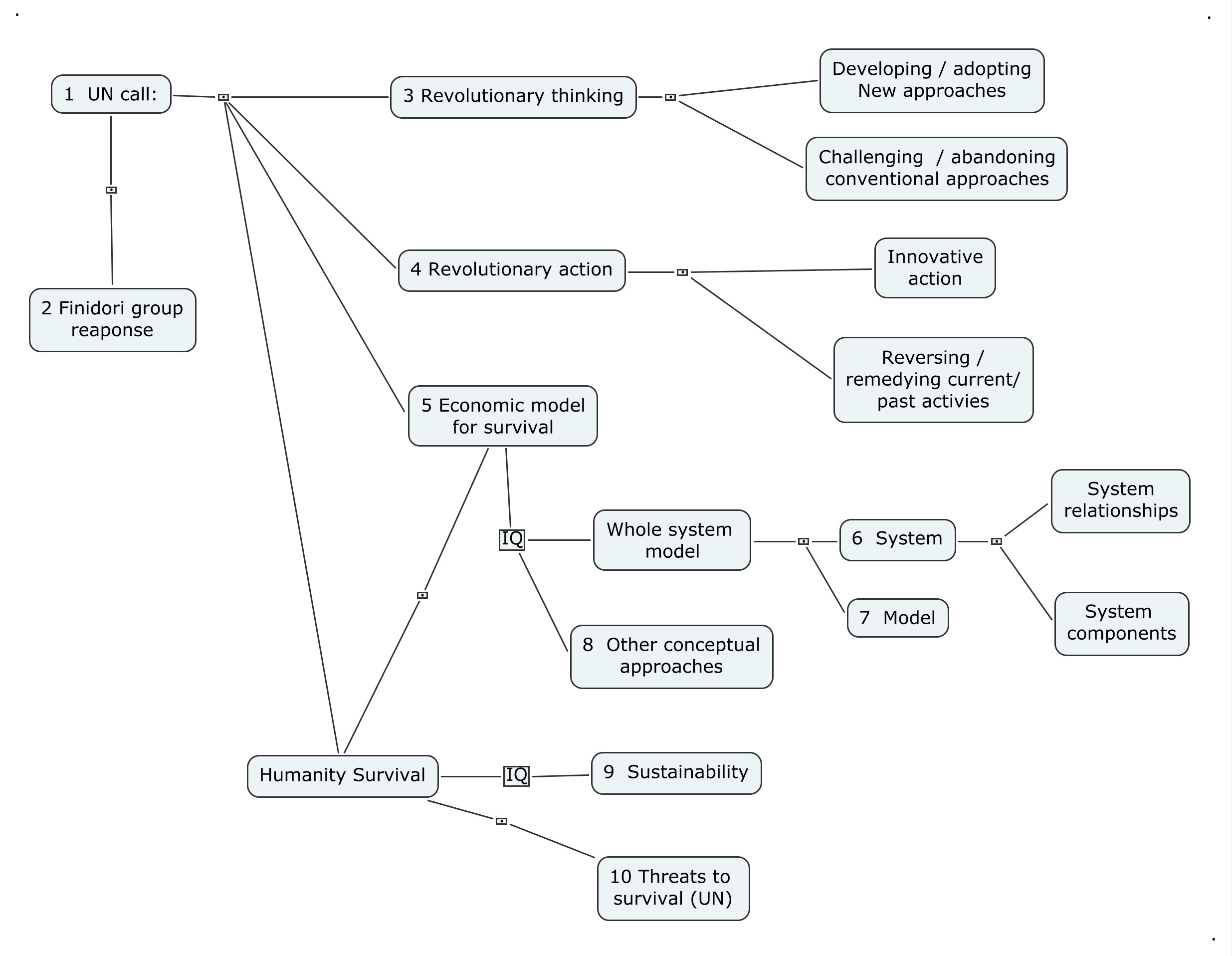
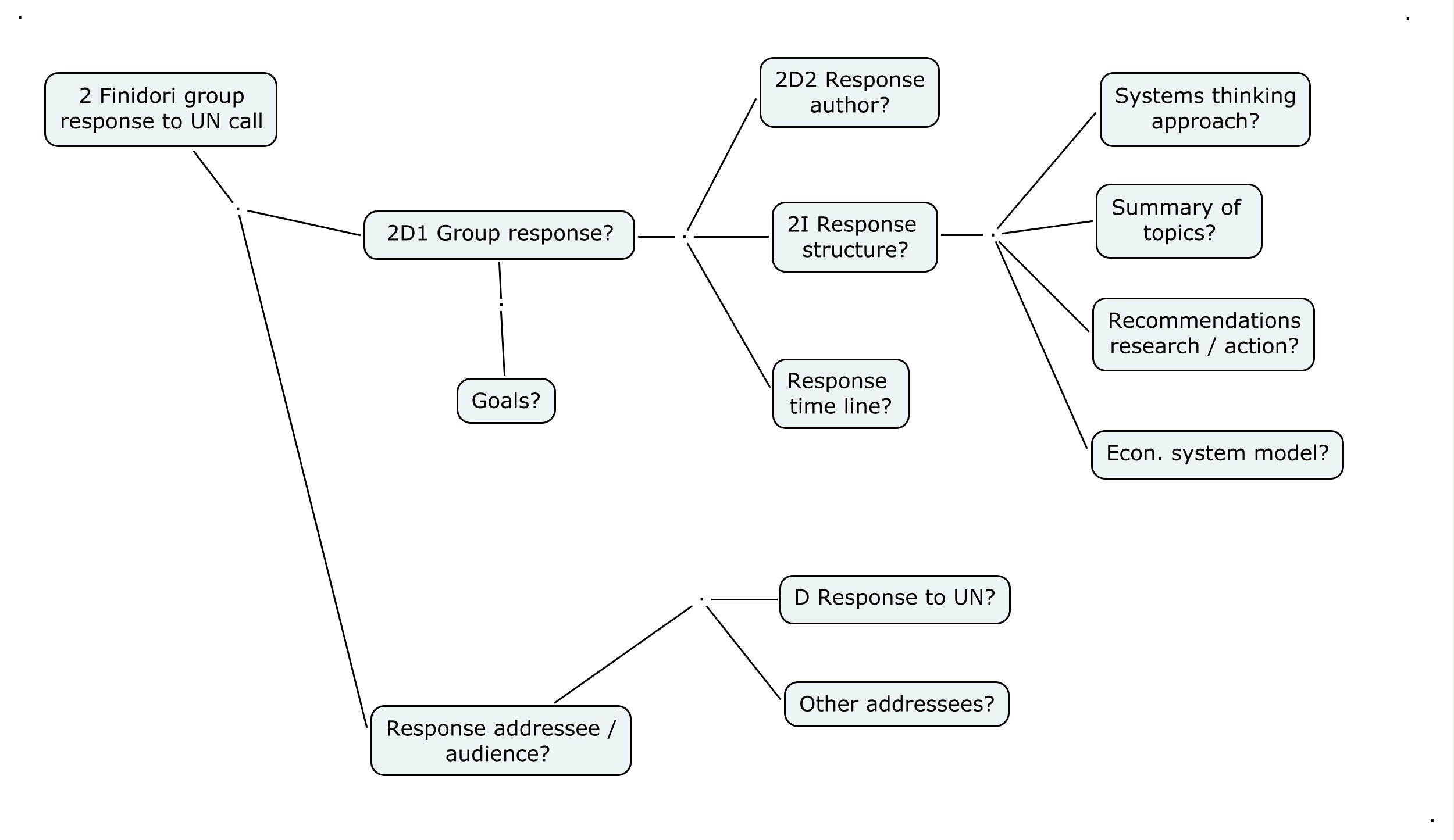
The UN Secretary General’s Call for “Revolutionary Thinking and Action to ensure an economic model for survival” at the World Economic Forum 2011 — A Response based on the Linked-In ‘Systems Thinking World’ forum discussion moderated by Helene Finidori [Giraud]

(This is an abbreviated version of a report that includes more examples and IBIS entries)

July 2011

Abstract

The call for ‘revolutionary thinking and action to secure an economic model for survival’ raised in an address by
UN Secretary General Ban Ki-Moon at the World Economic Forum in Davos 2011 [1] , led moderator Helene Finidori [Giroud]
to start a discussion on the Linked-In forum “Systems Thinking World”: “How to make this happen?”. [2] The discussion generated well over 2200 posts and a vast number of links to documents, websites and initiatives of groups already being involved in projects aimed at a transformationtowards more sustainable practices. It led to a suggestion to prepare a summary report of the discussion and its findings. The efforts by several participants to prepare such a summary have not yet resulted in an overall report; the discussion is still continuing, and limitations of the discussion format made it difficult to arrive at a report based on genuine participation by all or most of the members of the group, as initially intended. This led to the author’s decision to write a partial, separate review of his impressions of the discussion, and of the resulting recommendations for a process framework for a global effort coordinating many local initiatives, rather than attempting to formulate an actual systems model in response to the UN call. This report describes that framework, and selected new (previously unpublished) proposals illustrating individual aspects and projects within its major components of ‘local’ action projects, the global coordination, discourse, research and education networks to support these. Key features of the proposed framework are the discourse component based on the IBIS concept spearheaded by H. Rittel 3] complemented with the author’s approach to argument evaluation to support decision-making; [4] and a proposal to encourage experiments towards formation of new economic, governance, and production/distribution systems in areas where existing infrastructure has been destroyed by natural or man-made disasters; and the development and use of games to educate children in cooperative rather than competitive activities that can evolve into actual problem-solving tools.

1 INTRODUCTION

UN General Secretary Ban Ki-Moon’s Address to the World Economic Forum

At the 2011 World Economic Forum in Davos, UN Secretary General Ban Ki-Moon issued an emphatic call for ‘revolutionary thinking and action to secure an economic model for survival’ in which he warned the audience of the dangeous consequences of the past and current economic model of fuelling economic growth by unconstrained exploitation of natural resources, and challenged the representatives of the institutions assembled at the WEF meeting to rethink “How we organize ourselves economically?” and “How we manage increasingly scarce resources?”; to “ensure sustainable, climate-resilient green growth.” He ended his call for a revolution of thinking and action to revise the current ‘global suicide pact’ by reminding the members of the urgency of the task: “let me highlight the one resource that is scarcest of all: Time. … There is no more time to waste”. Full text: Appendix 5-1: [1]

The Discussion on the LinkedIn System Thinkers World Forum

On the Linked-In Systems Thinking World forum, a discussion was started by Helene Finidori [Giraud] about “how to make this happen” [2]. Starting in February 2011, the discussion has generated more than 2200 comments by early July, resulting not only in a lively exchange of widely differing opinions about the issue, but also an impressive wealth of references to reports, books, action proposals and actual initiatives already underway, that are relevant to the problem in one way or another.

The Call for a Formal Response by Discussion Participants

A suggestion was made to summarize the results of the discussion into a concise report that could be presented to the UN and the public. This desire was based on the general interest and urgency of the subject, on the range of opinions, suggestions and researched material that was assembled in the course of the discussion, and on the conviction of many participants that a systems perspective might make valuable contributions to the problems addressed by the UN call. Several participants began to assemble material for such a response. The moderator Helene Finidori compiled the various suggestions and links, and organized this into an organized survey of themes, presented this on a special ‘systems wiki blog’ page established for the purpose by the moderator of the overall Systems Thinking World Forum moderator Gene Bellinger (to get around the 4000 character limitation for posts on the forum itself) and invited other members to prepare drafts and organized contributions for a formal summary or report. [5] This precipitated a discussion about the basic assumptions both regarding the problems and challenges as referenced by the Secretary General, the understanding of these problems by the discussion members, the role and potential of Systems Thinking and Systems modeling in tackling such problems, and the limitations of the discussion format towards preparing valid recommendations. This discussion revealed what appeared to be different attitudes towards the overall direction of this effort that have not been fully resolved (as of this writing, with the discussion still continuing), and precipitated this author’s decision to articulate one such set of attitudes as a contribution to the overall challenge.

2 ANALYSIS OF THE STW DISCUSSION

Range and Themes

The discussion covered a wide range of subjects far beyond a narrow understanding of ‘economic’ model.
In fact, comments pertaining to narrow economic issues such as the global financial system, trade agreements, employment, taxation, distribution of income and wealth, were in the minority. Even the threats to survival such as those specified in a UN list of disasters were taken up only in a few posts. The term ‘survival’ in the Secretary General’s appeal was quickly supplanted by ‘sustainability’ as applicable to most human activities and their relationship to the natural environment. Many posts were devoted to the nature and understanding of systems, how they should be modeled, represented, studied, diagrammed. The framework for the study and discussion itself of these issues was a surprisingly substantial part of this theme. Much attention was devoted to the problems of food — agricultural production and gardening — water supply, and energy. Governance issues were discussed: local participation and decision-making, the problems of power both in government and private enterprise, with many contributions from corporations who are striving to improve their ecological impact as well as their productivity. The controversies surrounding growth as an undisputed goal of private enterprise as well as governments resulted in calls for replacing the dominant assumptions regarding growth as a main condition for economic success and the corresponding performance measurements guiding economic policies, with performance measures aiming at human well-being and quality of life. A number of posts dealt with what might be called philosophical or mindset issues: values, ethics, principles guiding individual and social behaviors and habit, with the common theme of having to changing these before any real transformation can be achieved, indeed seeing a massive consciousness change reaching some ‘tipping point’ as a necessary condition if not as the actual mechanism for the desired changes.

The wide range of topics of the discussion, enhanced by the research of participants who contributed a wealth of information about literature and initiatives by individuals, companies, and groups, revealed an already significant level of concern, awareness and activity related to the very problems mentioned by the Secretary General. The impression could arise that there already are adequate answers and solutions to most of the problems — that these merely have to be identified, the information made available, and the solutions implemented, rather than having to focus on the development of new, creative, innovative ideas. This impression may have been strengthened by the variety both of existing technological innovations that just have not yet been implemented at large scale, and small organizational initiatives by various local groups, companies, and individuals.

The overall findings suggest an urgent need for innovation at the organizational level. It is evident that all those small initiatives are largely uncoordinated (though easy access to information by new technology is helping at all levels). Funding and government support is inconsistent at best and at times even inhibiting implementation of innovation. In part, this is caused by the resistance of existing industries who perceive innovation as competition and use their size, economic power and influence in government to preserve their status, and in part by the inertia of large organizations especially in government.

Limitations of the Discussion

Any recommendations derived from the discussion, however, must be assessed within a perspective of its inherent limitations. Observations about these limitations (which are likely to also apply to any wider, global discussion) include the following:

a. The discussion was constrained by the online forum format and the common phenomena and distractions resulting from the fact that such online discussions serve various human needs in addition to seeking effective resolution of the problems discussed. Many contributors pursued different areas of interest within the overall topic, without any agreed-upon process or structure. Therefore it cannot be expected to produce concrete answers to the key question of the Secretary General’s address: a valid complete ‘economic model for survival’, much less coherent system descriptions in the form of mathematical models that would have been tested and evaluated for validity.

b. Nevertheless, a number of suggestions for the construction of such models were made, based on the knowledge, experience and judgment of participants with a wide range of backgrounds. The group did not, of course, have the resources or time to perform the work needed for actual in-depth data collection, analysis and model development. This coincided with the shared principle that any coherent global strategy to address the problems could not and should not be proposed for implementation by fiat, by any authority, but should result from a process of experimentation, experience from actual projects and initiatives that are already underway, theoretical work and research, but most importantly from a global discourse fed by the results from both, with wide participation, and a process of education distributing the resulting agreements and knowledge. The role of such models must be seen more as tools to enhance understanding of the system relationships involved than actual instruments for prediction of system performance and policy formation.

c. The attempts to develop more specific models for understanding (and to reach agreement about these even within the group) encountered surprising difficulties not only with regard to time and resources for the work, as mentioned, but also with regard to two aspects inherent in the Systems Thinking perspective itself. One is the fact that even within that perspective, there are already so many different variations of approaches and conceptual frames of reference with their own vocabulary, that remarkable problems of communication occurred. Many groups working on applications of systems thinking have felt it necessary to develop ‘brand names’ for their versions of the approach and their constituent concepts, resulting in a flurry of esoteric names and acronyms. Such communication problems must be expected to be even greater outside of the group. The other aspect resulted from the very success of e.g. commercial applications of the approach, that have turned into prescriptive routines for ‘systematic’ work on problems for clients. Insistence on agreement to follow the sequence of such steps as a condition for even beginning to discuss subsequent steps and solutions at times significantly delayed the group’s progress towards formulating a coherent response to the UN call. This was evident for example in discussions about ‘essential first steps’ and conditions for the evolution of a new model: while some participants urged starting and continuing various action initiatives and projects, expecting more widespread change and shifts in consciousness to result from such activities, others saw a change in mindset and values as a prerequisite ‘first step’ for any meaningful action. The frequent lack of concrete suggestions for how such consciousness shift would be achieved in practice contributed to the disagreements and misunderstanding.

d. While the composition of the group looked quite diverse in some respects — with participants from many different professions and disciplines, there were few if any participants from economics and political economics. It should also be noted that participation from many areas of the world, — the Middle East, much of Europe, Africa, Latin America and most of Asia — was less than representative of the variety of cultural beliefs and values in all these regions, — beliefs and values seen as playing a significant role in confronting the challenges. This could of course simply be a result of the fact that the discussion was started in English; but the question arises whether Systems Thinking as a whole is independent of such cultural beliefs, or whether it must itself be seen as a representation or manifestation of one culture among many.

e. The admirable decision by the group to respond to the call with more than some superficial or standard blog comments must be seen as an indication of the participants’ conviction that they can contribute something of value to the problem, that they feel able to produce — from their systems perspective — revolutionary thinking if not action that would help solve the problems. A simple textbook answer to the question of how the systems approach would go about this task suggests that the analyst would examine the system, meaning: to identify its components, the relationships between the components (some views are speaking of components as ‘stocks’ and the relationships as ‘flows’ between them), and to describe these entities and relationships so as to first ‘understand’ the system. The analysis and understanding might mean to develop mathematical models of the system structure, to carry out calculations and simulations of the system behavior, testing the models to see if its behavior matches observed behavior in the real system. The validated model then enables the analyst to identify critical system components (‘leverage points’) where appropriate intervention might produce desired results. It is usually not entirely clear whether the analyst is able and/or entitled to define what system behavior (outcomes) are desirable, or where these determinations would come from.

The discussion has, understandably, not produced such results. A curious dichotomy of responses could be observed: On the one hand a willingness, even eagerness to pronounce basic conditions that must be met, achieved, before meaningful system transformation (which is almost universally seen as desirable, while the precise nature of the transformation is hotly disputed) can be attempted. Most such posts had to do with thinking, attitudes, beliefs, values and ethics. On the other hand, one could observe a reluctance to engage in the development of more detailed system design recommendations — with the argument that ‘first, we must understand the system’. Many contributions provided links to reports, books, blogs, talks (videos), studies and links to reports of actual initiatives and projects already being undertaken, that represent ‘change’ from current normative practices and processes. Recommendations attached to such links rarely went beyond pointing out that it is an ‘interesting’ effort or view, perhaps that ‘more’ such actions should be encouraged. The basis of such recommendations rarely was a demonstration of superior system performance — according to some valid measure of performance — but the insistence that the effort is guided by valid, desirable principles.

f. A different assessment of what such a discussion could produce might focus on the ‘understanding the system’ precondition for action. Resulting recommendations would be based on participants’ judgment presumably honed by training and experience with such work. So far, no effort has been made to systematically examine the over 2200 posts to arrive at reliably consistent patterns or consensus of insight by the participants, much less for looking at how such insights might translate into firm recommendations for solutions. Much of the considerable effort by some members (and especially the moderator) to summarize the discussion was focused on developing a system for organizing the material from all the posts and links, and relating the items to topics such as the UN list of threats to survival. Data mining, data clustering, “synergising of data into ‘bubbles’ of information much like the synergisms that seem to appear at the boundary conditions of chaos” were seriously being proposed as vehicles for culling meaning and sense from the 2200+ posts.

General Considerations for a Response Based on the STW Discussion

As explained above, a discussion on a forum such as the Linked-In Systems Thinking World group cannot be expected to produce a comprehensive result, specifically: a comprehensive, validated economic model with full scientific or professional validity. It is therefore necessary to state the assumptions upon which a report and possible recommendations rest, and the goals it could reasonably be aiming for.

Assumptions regarding the UN Secretary General’s Call

a.  There was a general acceptance of most of the underlying assumptions of the Secretary General’s call:
– that there indeed is a crisis both as regards the development of human activity as well as the threat from natural catastrophes and disasters,
– that the current patterns of the human economy are unsustainable and will create crisis conditions, and
– that there is little time left for meaningful change.

b.  Even the remarkable call for ‘revolutionary thinking and action’ was accepted as a device for emphasizing the urgency of the situation.

c.  Disagreement arose about whether actual ‘revolutionary action’ would be the appropriate response: most of the recommendations favored an incremental, piecemeal, evolutionary strategy, or envisioned any radical, sudden change as a result of substantial but essentially evolutionary shifts in consciousness (‘tipping points’) of many individuals.

d.   Some questions were raised about whether the organizations represented at the WEF in Davos would be able or willing, or even be the appropriate agents to take the lead in the needed transformation.

e The underlying optimistic assumption (in spite of the Secretary General’s dramatic reference to the ‘global suicide pact’ of current practice) that meaningful change is urgent but possible was questioned only by a minority of posts.

Assumptions regarding the contribution by the STW group

f.   The participants in the Systems Thinking World discussion see the problems with a somewhat wider focus than just an ‘economic’ model: Meaningful response to the threats listed and to ensure survival will have to consider all systems, the wider issues of sustainability, the water, energy, food networks, the social, ecological, political and governance systems, the philosophical, ethical, human aspects, the financial services, technology and transportation infrastructure etc., and the relationships between these systems.

Specifically, if the UN Call is based on the assumption (as may be inferred from the fact that it was addressed to the WEF) that the entities represented there will be the main agents for developing the needed economic model for survival, the group believes that the needed transformation must be developed and carried by a much wider basis of participation and cooperation.

g. The group of participants in the STW discussion does not have the resources, time nor organizational structure to develop a comprehensive new ‘economic m o d e l’ that would ‘solve’ all these problems.

h.  Even if it did, such a solutions cannot be ‘imposed’ but must be the result of a wider global discourse with participation by all affected groups.

i.  While the group embraces the need for revolutionary t h i n k i n g, re-assessment of traditional assumptions, habits, institutions, and mantras underlying current practice, most participants differ from the (perhaps merely rhetoric) call for ‘revolutionary a c t i o n’ especially on a global scale. The needed transitions must be evolutionary, fed by many l o c a l, initially small scale initiatives, experiments and projects but coordinated and discussed in a global discourse. More profound, sudden (‘revolutionary’) change is seen as a possible, even desirable result of shifts in the consciousness of many people around the globe reaching a ‘tipping point’, but not as the result of measures imposed ‘top-down’ fashion without or against popular consent.

j.  The group has produced a number of ideas and proposals, even for the development of ‘economic models’, but its main contribution is seen as that of recommending a framework for the p r o c e s s that will bring about the needed transformations, and offering this for discussion.

k.   Existing institutions of governance, industry, trade, financing etc., including nations, international corporations, and regional and global institutions such as the EU and UN, are considered by many as part (even as the cause) of the problems we face, or as getting close to the limit of their ability to confront the challenges. They will have to change, but such change cannot happen fast enough, even if many of these institutions are beginning to adapt and institute more sustainable, effective and constructive practices. Such efforts must be encouraged and supported at all levels. However, there are reasons for the view that entirely n e w institutions, forms of governance and economic interaction will be needed. Therefore, the group recommends that opportunities and support will be provided for the development of such alternative forms of organization.

Decision to Prepare an Independent Report

The general assumptions listed above were not shared by all members of the group. A common overall direction for the structure of the report and its recommendations did not emerge as decisively as desired. This led to the decision to draft a separate report articulating one of the evolving directions, as a contribution towards a common statement. The goals of this report will be slightly different from that of a comprehensive general summary of the overall discussion and place less emphasis on a comprehensive review of all topics touched upon (a brief sketch of which has been attempted in the above section on range and themes of the discussion) and a thorough account of the researched literature and other material. It will not attempt to present a faithful account of all the perspectives and viewpoints voiced, but for the sake of brevity concentrate on the considerations that support the recommendations

Modified Agenda and Goals

The analysis of the findings of this discussion may be used to sketch this somewhat revised or refined agenda for addressing the challenges. A comprehensive response to the UN call would have to address even the issues that were given comparatively less attention in the discussion and for which not as much material could be compiled, and no equally carefully substantiated justification can be provided. The main points or priorities of this agenda can be described as follows:

– The many individual initiatives and experiments should be given continued and increased support, for two main reasons: First, data and experience from many different experiments will be needed to develop effective overall policies, and secondly, the needed transformation must be perceived by the people involved and affected by changed policies and projects as ‘their own’ creation, not as imposed measures by some larger power or authority. Thus, a main priority would be to find an effective way to support and encourage these initiatives.

– There is a need for overall coordination — for sharing information, data, experiences, and for the development of agreements, treaties, interaction rules e.g. for trade, conflict resolution. The dilemma involved in this urgent task is the following: It will have to be pursued by a global constellation of entities supported at least initially by existing nations and other organizations — but must remain open to the formation of entirely new institutions and forms of organization. The coordination task will involve several different but interconnected components: the coordination and support of the various small scale ‘local’ (a label chosen for the sake of simplicity) initiatives; a framework for the discussion and negotiation of global agreements (discourse); research, and education.

– The design and implementation of such a coordination framework — the institution within which a ‘new model’ can evolve on the basis of sharing of insight and negotiation — will be of a higher overall initial priority than the analytical effort to determine a more efficient model (through mathematical and systems modeling and simulation). The framework and platform through which all groups of humanity can communicate and meaningfully process the insights of such analysis into negotiation and mutually acceptable decisions must still be considered an incomplete project not yet adequate to the task, and therefore a task of high priority.

– The development of such a global coordination framework, as indicated, will take some time to become fully operational. Yet as the Secretary General emphasized, ‘we are running out of time’ — some essential steps must be started very soon even though the shape of the new model is far from clearly visible. An immediate task must be the identification of measures that can be started and carried out immediately without pre-judging the eventual results and without ‘painting ourselves into a corner’ of unsustainable dead-ends. Such measures must necessarily be of the small-scale, local initiative kind, utilizing currently available knowledge and technology. The best candidates for such immediate measures would be projects of preparation for natural (and other) disasters.

– The preparation for disasters we know will occur (but don’t know where ore when) offer a significant opportunity for innovation. In many places where such disasters have struck, entire systems of infrastructure, governance, economy have been destroyed and must be rebuilt ‘from scratch’. Deplorable as this is for the affected population, it also offers a significant opportunity for innovation in that new experiments that might be tried out in the reconstruction effort do not have to ‘compete’ with and overcome resistance from existing entities. Potentially, this appears to be a better opportunity for speeded-up change than the prospect of reformation from within established structures. The effort for transformation should therefore focus on finding effective ways to take advantage of this opportunity.

These considerations are the basis for the recommendations described in the following section.

3.   RECOMMENDATION:
A PROCESS FRAMEWORK FOR EVOLUTION OF AN ECONOMIC MODEL FOR SURVIVAL

R a t i o n a l e

The discussion yielded a surprising variety of ideas, activities, initiatives and programs that are already being published and carried out in many places and institutions. The very variety, the apparent lack of coordination and consistent funding and the still too slow pace of adoption of more sustainable patterns overall, that spurred the Secretary General to the warning that ‘time is running out’ all led to an attempt, in the following recommendation to seek out projects and activities that might speed up transformation by

– combining global coordination with the enhanced encouragement of many small, local experiments;

– encouraging projects that serve two or more purposes simultaneously, rather than only focusing on a single issue (which should not be seen as a judgment on the merit of such projects);

– encouraging projects in which new patterns of operation, governance and economic policies evolve as a result of the active participation and discussion among the people involved in the projects over changes perceived by people as being imposed or enforced without their consent (again, regardless of the benevolent intentions of such measures); and

– exploiting opportunities of situations in which entirely new forms of governance and economic activity might evolve (from the participatory effort of the people involved) and grow without being encumbered by the resistance of existing structures that might see new developments as undesirable competition: interstitial zones or ‘cracks’ in the rigid structure of the existing order.

These priorities results in a selection among the many ideas that to some might appear arbitrary; it is designed to yield an overall concerted strategy that leaves room and opportunity for many different initiatives and experiments but aims at getting meaningful coordinated and speedy transformation underway with support from as many parties as possible.

In recognition of the fact that a convincing, coherent alternative model to the current economic system does not as yet exist, and will require research, analysis and discussion on a much broader base than that of the Linked-In forum, the following proposal will focus on sketching out a framework for the p r o c e s s that could bring about the necessary transformation.

The proposal is based on the following distinctions among the types of such projects and activities, according to their position on a ‘practice — theory’ scale, or rather on a scale of ‘readiness for implementation’ .

– ‘action’ or ‘practice’ initiatives: Actual projects targeting a variety of projects by small groups tackling problems ranging from ‘single-issue’ concerns to more complex and comprehensive efforts to establish viable communities. (Examples include many historical ‘commune’, intentional communities on religious, spiritual or social ideology basis, local initiatives for sustainable agricultural practices, renewable energy production, efforts of complementing or replacing the monetary system and banking with different currencies such as time and bartering exchanges or community credits.) These are usually small scale, at least initially, mostly local, with intensive citizen participation and involvement, and must be considered piecemeal efforts that provide examples for others to adopt and apply on larger scale. This includes similar efforts implemented by governmental agencies and private enterprise corporations in an effort to increase their competitive stance and profitability while improving their practices and reducing their environmental impact.

– ‘theory’ efforts: Attempts to analyze, understand and predict the behavior of systems and subsystems, using scientific and systems analysis tools, based on systematic data collection, mathematical modeling, simulation, in the hope of reaching insights to support recommendations for control and recovery of the overall system.

– ‘philosophical’ efforts: The view that to a considerable extent, the problems we face are caused by currently held views, beliefs, values and principles (or the lack of such), has generated many books and reports offering recommendations for ‘awakening’ (to the detrimental effect of these beliefs and resulting habits), and reversion to or adoption of more valid values, principles and habits. Many of the action initiatives are influenced or based on such systems of spiritual and philosophical thinking.

An overall structure of the process must accommodate the various functions involved in these efforts, that can be loosely grouped into the following process components: the coordination and support function for the action projects that are ready for implementation, the research function for the collection and analysis of data, the construction and testing of mathematical models etc; the discourse function in which goals, recommendations and strategies for the transformation will be discussed, and an education and information function that makes the results of the other components available to all sectors of the global population.

P r o c e s s    O v e r v i e w:   Overall structure

To complement the multiple l o c a l, mostly small scale action initiatives and projects using available tools and resources, that are ready for application or already being applied, the proposed g l o b a l process framework consists of several coordinated components:

– A coordination and support agency or network for the many local initiatives, to coordinate the funding, information sharing, monitoring of such efforts, and to make the lessons from such efforts widely available;

– A  d i s c o u r s e  framework to orchestrate the global discussion about a number of problems and issues that require both further theoretical analysis and public debate and decision-making;

– A network of  r e s e a r c h  entities supporting the other components; and finally

– A concerted program of   e d u c a t i o n   and public   i n f o r m a t i o n, to make the results of initiatives, the results of theoretical research, the issues, results and remaining open questions of the discourse available to as wide a public as possible so as to support both the transformation of understanding and values and the provision of skills, tools and empowerment to people to implement needed changes.

In each of these components, levels of generality can be distinguished: there are questions of practical application or implementation and action; there are issues of conceptualizing, constructing models of systems, testing, validating these and using them for guiding actions to best advantage; and there are issues of overview, principles, philosophy. In each component, we can also distinguish ideas, proposals, concepts that are ‘ready to go’, already available for immediate implementation or continuing support; there are ideas and proposals that require more detailed planning and refinement before they can be implemented; and there are issues, promising but possibly controversial ideas that require not only more research and careful planning but a thorough and broad discussion.

The following is a diagram showing the overall framework of the process recommendation.

Diagram 1 — the proposed process framework

P r o c e s s   C o m p o n e n t s: Detailed Description

Action / Implementation projects

A first level of concern and initiative by any organization aiming to play a leading role in meeting the challenges are the many efforts towards innovation and sustainability that are already underway, carried out by concerned individuals and groups in many places and fields of application. They are typically local, small scale efforts, with a wide range of differences in focus, techniques, organization and philosophy. The very variety of these initiatives should be supported in principle, unless they violate basic standards of human rights, dignity, freedom and justice. They are too numerous to be listed here. Beyond their primary objectives of improving sustainable food or renewable energy production, for example, their value consists in the activation of the energy, enthusiasm and pride of ownership of local population. Therefore, such efforts should be encouraged and funded even if there are as yet no generally accepted standards, goals, performance benchmarks and immediate (conventional) cost savings.

A rough distinction can be made between such projects according to their primary focus. In no particular order of importance, and with considerable overlap between them, the group has discussed initiatives in the following areas:

– Agriculture: Permaculture, Biodiversity especially as it relates to industrialized, mechanized agribusiness and their impact on small farmers livelihood, the use of fertilizers, genetically modified organisms, possibilities for intensive production of fruits and vegetables in small farms and gardens, even within cities; and projects for utilization of unused areas through innovative irrigation — for example restoring desert areas for agriculture.
.
– The problems of securing adequate supply of clean water for drinking and cooking, but also for gardening, agriculture, livestock, and various production processes; as well as the disposal and treatment of waste-water.

– The problem of energy, both as regards energy resources, especially the transition from fossil and nuclear energy to renewable and nonpolluting energy sources, in view of the dilemma of increasing demand for energy by the growing human population, and the effects of the use of many energy sources on global climate change, air and water pollution.

– The many efforts and programs by industry and corporations to respond to sustainability concerns to improve the efficiency and reduce their CO2 footprint of their production and distribution processes. Some of these efforts exhibit the most intensive use of sophisticated systems modeling and technology.

– Increased efforts by local and national governments to improve waste management through more effective recycling and waste treatment.

– Improved transportation systems, especially for public transportation;

– Industry efforts to develop and use new technology for improved energy production, more efficient control of utilization patterns, more energy-efficient devices.

– Efforts to increase public, and especially children’s, awareness and understanding of the problems and solutions for sustainability aiming at improved behaviors and habits. Such efforts aiming at transformation of awareness and consciousness, inspiring, empowering and enabling people towards a ‘tipping point’ that can precipitate the massive and radical changes are seen by many as necessary to achieve a truly sustainable future.

– Changes in the structure and regulation of the financial services systems.
– Efforts to achieve changes in government and governance patterns, aiming at reducing the potential for corruption and abuse of power.

Of special interest and recommended for priority implementation are ‘multitasking’ projects that combine several different ideas and purposes. Examples are: the use of filtered waste-water transported by supertankers on their return trip to irrigate desert areas for restoration to fertile land [6]; growing crops than can be converted to biofuel on highway medians and right-of-way areas; shell roof building systems for reconstruction of shelter for disaster areas that can be used for rooftop gardening, storage of rainwater, water heating and solar distillation, or the provision of opportunities for creating ‘innovation zones’ or ‘innovation laboratories’ in areas that require emergency aid for recovery from natural disasters of armed conflict for experimentation with new forms of habitat design, food and energy production as well as economic, financing and governance systems etc. The latter idea is recommended as a main tool for speeding up transformation based on a wide variety of different approaches both within such zones (where innovation is not slowed down by resistance from existing structures) and in the existing larger neighboring states or structures that may feel compelled to intensify their own ongoing efforts. The more successful results in both can then be mutually adopted.

Action projects versus stopping detrimental activities

A successful strategy for meeting the challenges of the future in a sustainable manner will also involve the cessation of current activities, behavior patterns and practices that contribute to the problems. Two aspects of this deserve special attention.

Even more than the decision to engage in ‘new’ activities and projects, the admonition to ‘stop’ pernicious behaviors requires the re-examination of basic life principles, values and assumptions. The reason for this is that many current behavior patterns — in contrast to their polemical representation in many cases — are not all based on despicable motivations such as ‘greed’, ‘lust for power’, ruthless ‘exploitation’ of weaker segments of society, reckless destruction of natural resources etc. but on principles that are or have been widely accepted and taught to children as admirable and desirable virtues: Competition, success in business (as measured by profit, increase and accumulation of wealth; justified by ‘serving consumer demands with better products than the competition, etc. The expectation that such behaviors can be ‘stopped’ as a result of mere admonition to adopt ‘better’ values and principles will remain unmet as long as the relationship and tension between the value sets are not understood and resolved.

An example of this kind of tension is the second aspect. The cessation of any practice, especially economic practice, will in most cases imply the shrinking, weakening or complete dissolution and disappearance of the institutions engaged in that practice. This is seen as the desirable goal from a competition perspective: — ‘beating the competition’ — in a win-lose mode. But then people working in those institutions — who are not necessarily the ones responsible for their less successful performance — will lose their jobs. This consequence necessarily creates resistance to change; and it is only very inadequately addressed by the institution of unemployment compensation by the state, in turn resented by the ‘successful’ companies which see their taxes having to pay for unemployment benefits as punishing their success. A more constructive approach to this problem would require a reassessment of the governing principles of business, its guiding measures of performance, and of the way society as a whole deals with innovation, change, and its side-effects and consequences.

Priority action / implementation projects

Examples of small-scale, local projects within this group that can be implemented or begun immediately include:

– Enhanced planning and preparation for emergencies; possibly in view of establishing ‘innovation experiment projects’ for areas affected by disasters;

– Use of highway medians to grow crops that can be used for biofuel production.

– Development of shell roof construction systems that can accommodate rooftop gardening, rainwater collection, water heating;

The Coordination and Support Component

To encourage and support as well as deriving the full benefit of the various action projects, a global coordination service or network should be developed. Its functions will include:

– Provision of Funding of local action projects including the orchestration of the startup phase of ‘innovation zone’ projects beginning with disaster emergency response but also

– Planning and preparation for emergency response to disasters;

– Networking and coordinating the provision and sharing of information (as one of the key resources of implementation projects);

– Monitoring the development and performance of iplementation projects;

– Translation services, not only in terms of translation between different languages, but also between the different conceptual frames of reference, value systems, philosophies that guide those initiatives.

– An Inventory of action initatives and experiments may become a vital source of helpful information for the design of new projects. The inventory and record of performance monitoring will become the basis for the discussion and evaluation of project features (for suitability in general application elsewhere) in the following discourse component.

Many aspects of this component can be built upon existing global networks and institutions, with some focused overall coordination.

Priority tasks for the coordination component

Examples of tasks requiring urgent priority attention in this component are:

– Development of a coordinated disaster planning and response strategy. This should include coordinated preparation for emergencies in areas know to be susceptible to natural disasters — earthquakes, floods, hurricanes and tornadoes — as well as coordinated preparation for establishing innovation zones in stricken areas, and actual construction of disaster / emergency planning and preparation centers.

– Development of the translation service (which will also be needed for the discourse, research, and education/information components);

– Development of an inventory of technologies and procedures being applied and tested in action projects as a basis for evaluation of their effectiveness and performance and sharing of this information.

The Discourse Component

The second vital global framework component would be that of a platform and orchestrating support for the discourse from which a new model for survival would emerge. It would include the same component of translation between the different languages and vocabularies as the coordination component above. An important task will be that of facilitating a genuine discourse, a function not yet adequately served by current platforms of national or supranational institutions or information search and exchange e.g. in social networks. Discussions need to be supported by research and information, as well as by visual tools such as diagrams and ‘maps’ (to inform participants about the state of discourse about a topic as well as the network of related topics); and finally, of tools for evaluation of arguments to reach well-informed decisions. Better software for this function will have to be developed. The structure of this component would include the following:

– A public, global forum for the raising, discussion and resolution of issues. The forum should be open in all languages and accessible through a variety of media and platforms.

– As mentioned in the coordination component above, the component should include or share a translation service for the language-to-language translation of posts from all parts of the world. It should also address the problem of ‘translation’ of the many specialized vocabularies of disciplines and commercial ‘brand’ concepts and services that have developed especially in connection with new information technology and management.

– A networking service connecting the component with information and results from the other components — especially research, but also emerging problems and experiences from the many ‘local action’ projects;

– A documentation service that supports ongoing discussions with the results, arguments, data etc. from previous discussions and historical studies. (A ‘library’ component geared to quick provision of pertinent information to ongoing discussions rather than to mere collection and preservation of documents like traditional libraries).

The STW discussion research indicates that a technology and software platform that would adequately serve the required functions of this component does not yet exist. One model that may provide a workable conceptual basis — but has not been provided with satisfactory software solutions — is the IBIS (issue based information system) concept initially proposed by H. Rittel [3] and elaborated upon by various academic and commercial enterprises. It sees ‘issues’ (controversial questions) as the core elements of such information systems for design, planning, policy-making, and focuses on the explicit articulation of the ‘pros and cons’ (arguments for and against) of proposals and controversial issues. Development of mapping programs would provide for convenient overview of the state of the discourse. The mapping programs still are in need of better integration with the basic discussion framework; especially desirable would be the automatic generation of maps in step with the discussion process, and their real-time display. A proposed addition to this kind of system [4] would allow for the systematic and transparent evaluation of arguments in support of decisions, an important step towards improved decision-making even in ‘democratic’ regimes where the dominant practice of majority voting by elected representatives still is a long way from decision-making based on the merit of arguments and concerns of all affected parties.

Discourse topics

A key element of the IBIS system is the list of topics addressed by the discussion; the content of this type of information system is organized by topic, each of which generates a ‘family’ of issues. The system will also serve the coordination, research and education components; the topic list will be coordinated with these components. The following are examples of such topics; a more detailed (but not yet complete) list of topics raised during the STW discussion is presented in the appendix [Appendix 5-3.1] Some examples of topics where the discussion has produced observations and insights relative to the UN call are added [Appendix 5-3.2]

Priority tasks for the Discourse component

For an effective orchestration of the global discourse, the following tasks are seen as urgent:

– Refinement of the proposed IBIS framework for the given purpose, its components and procedural provisions;

– Development of a sturdy, comprehensive (software) platform that efficiently integrates the different parts and tasks of the discourse framework — especially, the linking of the discussion component with the mapping and evaluation services;

– Priority topics for discussion include the following:
• Values, principles, ethics; the philosophical and spiritual basis guiding the desired transformation;
• Governance and power, with related topics of
– The relationship between freedom and power;
– The problem of controlling power
(the need for controls and sanctions triggered automatically by attempts to violate rules and agreements rather than sanctions enforced by a ‘stronger / bigger force)
– Taxation
– Alternative measures of performance: Quality of life, Environment value replacing growth and GDP
– The role of religion in governance
– The public policy discourse
– The development of public decision-making procedures based on merit of arguments
• The economic system: finance, money, banking;
– Growth
– Profit controls
– Complementary or alternative currencies
– Property (land; means of production)
• Subsistence essentials
– Food, Agriculture, Permaculture;
– Water
– Housing / shelter
• The natural ecosystem
– Climate
– Biodiversity
• Energy
– Renewable energy technology
– Large systems versus independent (individual household) technology
• Research
– The role of research in supporting discourse and education
– The implications of research moving from the university to government and private enterprise.

The Research Component

The systematic investigation of unresolved questions both as related to understanding nature including human behavior, and to policy issues regarding human activity within the natural environment has been and is properly understood as the role of ‘research’. This is a function that overlaps and serves both the discourse component of the proposed policy, and education, as well as the action projects as the underlying knowledge basis for the technology and techniques they use.

While research has traditionally been one of the primary responsibilities of universities, a more recent shift has seen research activity being taken over by both governments and private industry. The implications of this development have not yet been adequately investigated and understood, though problems have become quite apparent. They include issues regarding secrecy of research done in government research institutions, controversies about research results produced by private enterprise investigators (legal issues about the right to profit from research billed as ‘intellectual property’); or problems that have spawned an entirely new category of crime in the form of ‘industrial espionage’. The common problems here include questions about how commercial and state interests influence research objectivity (let alone the question of research priorities and funding), and about ethical implications of withholding publication of research results to protect commercial (profit) interests. For some kinds of research tasks, the internet itself constitutes a new form of data-gathering and analysis tool whose potential has yet to be fully realized.

It is widely accepted that answers to humanity’s problems are to a significant degree going to be provided by research. For the short term, it is obvious that most research for the global effort called for by the Secretary General will have to rely on the existing research institutions, and this will require extensive coordination. The question whether entirely new institutions and networks will have to be developed to meet this global challenge and resolve the issues surrounding current research practices should therefore occupy a place of highest priority on the agenda of any forum or institution attempting to coordinate the effort to ensure the development of a better model for survival.

The proposed IBIS-based framework for the discourse component could help alleviate a problem regarding the relationship between social policy and research that has caused significant controversy. It is the blurred boundary between scientific-technological expertise and the legitimation to make policy decisions, that has led scientists and technology experts to claim the right to influence policy decisions on social goals on the basis of their scientific and technological expertise — and political decision-makers to defer to such experts, leading to decisions that were unacceptable to wide segments of affected populations. The explicit distinction between the different types of issues and argument premises in planning and policy arguments make it clear that the scientific-technical expertise is inescapably necessary for the validation of facual and factual-instrumental claims but does not extend to the assessment of plausibility and valuation of deontic (ought-) claims. The role of research in the discourse of policy development would thereby be clarified, to the benefit both of research and the policy discourse.

Priority Topics for Research

One of the most critical tasks regarding the research component of the proposed framework is the development of a new set of agreements and ethical rules for the use or exploitation of research results by both governments inasmuch they see themselves in competition with other governments, and private enterprise for the purpose of securing competitive advantage in pursuing commercial advantage and profit. A new balance must be found between the principle that knowledge derived from scientific research should benefit society in general, and the right of entities sponsoring research to be the primary beneficiaries from research.

The Education / Information Component

General considerations

The results of the work done in the Discourse and Research components — the discussion and the analysis / theory realms, as well as the lessons learned from the Action initiatives, must be distributed and made available to the public everywhere. Two main concerns should be distinguished here, because they will need different approaches. The first: To increase awareness, induce awakening, a transformation of beliefs, values, principles, habits; to work towards a transformation of consciousness about the problems we face. The second task is to provide practical information, the necessary tools and skills: enabling and empowering people for action. Both might be seen as simply providing and distributing information, but arguably go beyond merely making information available: it really is an education function, critical in achieving a fundamental change of direction of the global human project.

With regard to the first aspect, many voices are urging a mental or spiritual awakening and reorientation as the key to a new model, even a precondition for meaningful change. Not much is said in the discussions about how this may be achieved. It will have to be done on several different levels. The first will involve the development of brief, concise, memorable information items — ads, cartoons, images, short videos — to catch people’s attention and interest, a second level would be aiming at generating better understanding of the processes and problems, with easily available but more in-depth information. This should be as widespread — global — as possible, spread by the new technology and social networks, and it would have to involve universal, cross-cultural common denominators; mainly ethical in nature: An overall set or framework of common principles and agreements.

For the second aspect, the label ‘education’ might suggest that the material in question should be injected into the existing education systems everywhere. The traditional approach would be for some entity / authority to develop a standard syllabus for this, which the various educational systems (schools) will be expected to adopt and teach. This is perhaps plausible for the long run, but unrealistic as a tool for achieving the necessary results in the short term; action and movement must be achieved much faster and with fewer resources than it would take to revamp all the world’s educational systems. Instead, a different approach should be considered. To be effective, new behavioral guidelines and rules cannot be imposed by authority. They must also be accepted by everybody, as mutual commitments freely engaged. In turn, this means that it must be the result of dialogue and negotiation (which of course can address traditional canons as well.) Only then will people take effective advantage of the actual content made available for learning. Therefore it is suggested to initiate a concerted effort feeding directly off the results achieved in the discussions of topics in the discourse, using the same list of topics or subjects, for a start. The results — understood not as the ‘facts’ about the world that schools have been charged with conveying to children (with resulting destructive, unproductive fights about wat should be counting as truth about facts) but as information about the issues and controversies people argue about, and what we (humans) ought to do — presenting the different opinions with their supporting evidence, and seeking to empower learners to effectively and meaningfully evaluate that material and arrive at their own judgments to creatively construct their own future.

The instruments for this crucial task must take advantage of the rapidly evolving information technology — especially the internet and the increasing ubiquity of cellphones — which could facilitate a global dialogue (discourse) with wide participation. Thus, the recommendation would be: to initiate the development of a framework for not only disseminating the education material using these technologies, but providing the opportunity for communicating about it: it cannot be a one-way traditional instructional model but must be two-way.

Similar considerations apply to the information function of this component.

Reliance on technology should not be the only pillar of such a campaign. For one, people are more likely to accept mutual rules of cooperation if their understanding of the need for such rules arises out of actual experiences. There are two main possibilities for this: one is for ‘apprenticeship’ participation in experimental projects or emergency relief situations, where the normal societal structures have been disrupted and must be re-established. The Peace Corps offered a kind of such experiences, as an example. Another possibility is that of games. Even the traditional educational system relied on games (in sports) or game-like activities — music, plays, — through which qualities such as cooperation (besides competition), sportsmanship are conveyed. The recommendation therefore is for an effort to start an educational campaign via the internet, possibly complemented by TV: a survivor-type series of episodes highlighting both the kinds of situations where current / traditional attitudes and rules must be replaced by a new ethic, and the interactions conveyed in an interesting, entertaining manner. An intensive effort should be directed at the development of more cooperative games, both real and videogames where the ‘winning’ scores depend on adherence to cooperative and sustainability principles. The overwhelming majority of games children and adults currently engage in is competitive — resulting in ‘win-lose’ outcomes. It does not seem to occur to most people that in the process of helping, watching and celebrating the 1% champions — the winners, we are inadvertently creating 99% losers. A widely advertised competition for the development of ‘win-win’ shows and games according to the motto ‘If I do better, you will do better, and vice versa’ might be a starting point.
An outline for such a game that could be run online with a wide number of participants, or as a ‘live’ game in a modified parliamentary setting assisted by an IT support system is presented in Appendix 5-2.3. It can be considered and run as a game or, once people become familiar with the approach, as a real problem-solving or planning project.

The design of a complementary education system along the lines suggested must take into account society’s dual expectation of education: On the one hand, education — the acquisition of knowledge, skills and information must be freely accessible to all members of society (not only during childhood but throughout life, as the kind of information and skills change over time). Knowledge, skills and information are among the most important resources for people to be able to take advantage of available opportunities in a society. On the other hand, the outcomes of this process in the form of acquisition of skills etc. must be able to be certified, that is, demonstrated, according to some articulated and agreed-upon standards: a document certifying the mastery of some specific skills must mean the same everywhere. The balance between these two functions must be re-examined; the opportunities for acquisition of knowledge and skills through new information technology should be acknowledged and accommodated. The linkage of the demonstration / certification function to the traditional educational institutions that once were the exclusive means for acquisition of knowledge can be replaced by other, more effective means.

This discussion is currently, it seems, made more difficult by the legitimate concerns for the second important level of the education system of a society: that of ‘socialization’, or acquisition of a common foundation of ideas and values — a cultural dimension. In addition, the role of the ‘research’ mission of the educational system — the generation of new knowledge, traditionally also linked to the same institutions that were then transmitting research insights to students — adds to the complexity of this challenge. The discussion might be more constructive if these different functions — knowledge acquisition, certification, socialization, research — were clearly acknowledged as separate tasks, but a common forum provided for the orchestrated exchange of information, opinions, discussion and resolution of concerns (such as allocation of funds for each function). This could allow experiments to be conducted for each function to arrive at innovative, improved means to pursue its purpose, without having to encumber the innovation process with negotiations about how the entire structure of a combined system would be affected by an experiment in one part.

This is an example of a global initiative, and one in which private enterprise (corporations in the technology and entertainment industries) should be enticed into joining the public effort. It can of course also be combined with any small-scale, local experiment or initiative.

Coordination / framework for the education component

The education component will have to include a global forum on educational content. The difficulties of establishing what should be taught in schools are a well-known source of controversy in most countries, from the local level to the international mutual certification levels; it is aggravated by the common assumptions that what schools should teach should be ‘the truth’; the fact that there are always widely varying opinions as to what that truth is, about almost any subject, and that even — or especially — in those areas where the ‘standards’ for what can be accepted as truth — in the natural sciences, for example, new research is constantly revising and often completely challenging what was previously accepted as true information. Thus, there is little if any basis for optimism about the chances for agreement on teaching content if the ‘truth’ criterion is maintained. The global effort on education should therefore abandon the effort to specify true content for education content for any but the most practical questions of skills and tools that are required for carrying out activities of responsibility in society. Instead, as mentioned above, the focus should be to establish a syllabus on controversies — teaching children about the major issues of humanity, about which there are profound and significant differences of opinion, at present and throughout history, including different opinions about how truth (and plausibility, a term suggested to replace ‘truth’ that also applies to questions of what we ought to do, which ostensibly are not ‘true’ in the same sense as past and current ‘facts’ of nature) should be sought, opinions about what people consider adequate guarantees fro accepting information or opinions as true or plausible — and leave the resolution of the controversies to the learners as their life challenges. (This is the kind of approach the game suggestion mentioned above — Appendix 5.4–  is aimed at.)

Of course, such a solution would itself require a considerable amount of discussion before even minor consensus decisions can be expected.

Priority Topics

Recommended tasks for the education component that should be initiated as soon as possible include the following:

– Establishment of a coordinating service to initiate and support the following tasks:

– Preparation of appropriate material for informing the public about the challenges, increase awareness and above all understanding to the nature of the problems, the relationships between the forces involved, possible solutions and the need for cooperation and willingness to change habits.

– Development of appealing and interesting games primarily for children (but also adults) that emphasize cooperation (‘win-win’ outcomes) rather than competition (‘win-lose’ outcomes).

– Development of ‘technical’ or How-to- information of innovative tools, procedures, approaches for sustainable practice, for wide public use at all levels from basic self-help to the development of sophisticated advanced technology.

4   SUMMARY

Synopsis

The attempt to present a coherent response to the Secretary General’s call for revolutionary thinking and action, which was intended to be part of a more comprehensive presentation encompassing the entire STW discussion, necessarily falls short of providing a balanced account of all the ideas and considerations accumulated in that forum, much less of the many ideas and initiatives reported by the participants. It had to focus upon the more preparatory problem of how the effort to transform the economic system into a more sustainable one could be initiated and organized: ‘how to make this happen’ without presuming to specify the nature of the new economic model. In doing so, it attempted to suggest and describe an overall process framework in which all the proposals, ideas, activities addressed in the STW discussion could find their proper place. In the description of a few selected projects within the overall framework, — project ideas that have not been published and implemented before but were generated within this discussion — the focus was on the kinds of projects that serve several simultaneous purposes, rather than other ‘single-issue’ projects, without implying less merit or significance of the latter. With respect to a central and often controversial issue — that of ‘global‘ programs versus ‘local‘ initiatives — the proposal took a compromise position in recommending unreserved support for local and small scale initiatives of all kinds, but establishment of global networks of coordination, information-sharing, discourse, research and education. A key feature of the proposal is that of deliberately taking advantage of situations in which existing economic, governance and infrastructure systems have been destroyed by natural or man-made disasters to provide opportunities for and encourage experiments with entirely new economic and governance patterns that can accelerate transformation either by gradually inducing neighboring structures to take over the new practices, or by encouraging those existing systems to competitively speed up their own transition to more sustainable patterns before re-integrating the experimental entities.

Unresolved questions

A number of issues remain unresolved by this report — for various reasons, such as the limited resources and format of the online discussion, or because the issues have not yet been fully understood, or because the group’s opinion that resolution of major principles, issues and policies must be based on the results of a much broader discourse than that carried out by the relatively small group of participants in the STW forum. Some issues, especially those regarding specific economic and finance system subjects, have not been discussed in depth because of the small number of economists in the group. Examples of major unresolved issues are the following:

– A feasible and convincing solution for the transition of the current economic from a growth-, competition-, and debt-based model to a more cooperative, growth-to-maturity followed by equilibrium model driven by measures of performance that consider not only narrow economic/financial indices but the whole spectrum of human well-being, health, and happiness.

– The problem of the control of power and its abuse — not only in government (where traditional controls seem to have reached the limits of their effectiveness) but also in private enterprise and other human activities, where such controls have not been developed as intensely as for governments (leaving the control up to success or failure in the marketplace, with little regard for the collateral consequences for other aspects of human well-being.)

– The issue of distribution of goods and services that are increasingly produced by mechanized processes requiring less human labor — and therefore less work, leading to under- or unemployment resulting in the inability of the unemployed to purchase the goods and services with money earned from work. This is one of the factors leading to the lopsided accumulation of income and wealth by fewer and fewer people while an ever greater majority slides into poverty and an existence depending on ‘welfare’ payments by government financed by taxes that are perceived as unfair disincentives by those working.

Outlook

The multitude of initiatives researched by participants in the STW discussion is a reason for optimism: there are many people and organizations already at work trying to change their lives, organizations, life habits and patterns towards more sustainable and responsible practices. However, as mentioned, these activities are not coordinated and supported well enough, nor were overall data available to support reliable predictions as to their probable success in acieving the needed global transformation. There were, in contrast, significant indications of entrenched resistance or inability of existing institutions and practices to facilitate the transformation, which together with the available evidence of dwindling resources, growing populations, increasing inequality of living standards and wealth give many observes equally plausible grounds for pessimism. The suggestions for steps — priority actions listed separately for each of the components of the proposed framework — to take to more forcefully work towards a model for survival and avert disaster — are based on the hope that they will be proven wrong by the creativity and capacity for cooperation of mankind.

5    APPENDIX

Appendix 5-1 UN Secretary General Ban Ki-Moon’s Call for Revolutionary Thinking and Action

The address by UN Secretary General Ban Ki-moon to the World Economic Forum 2011: Davos, Switzerland, 28 January 2011 – World Economic Forum Session on Redefining Sustainable Development.

“For most of the last century, economic growth was fuelled by what seemed to be a certain truth: the abundance of natural resources.
We mined our way to growth. We burned our way to prosperity. We believed in consumption without consequences.
Those days are gone.
In the 21st century, supplies are running short and the global thermostat is running high.
Climate change is also showing us that the old model is more than obsolete. It has rendered it extremely dangerous.
Over time, that model is a recipe for national disaster. It is a global suicide pact.
So what do we do in this current challenging situation?
How do we create growth in a resource constrained environment?
How do we lift people out of poverty while protecting the planet and ecosystems that support economic growth?
How do we regain the balance?
All of this requires rethinking.
Here at Davos – this meeting of the mighty and the powerful, represented by some key countries – it may sound strange to speak of revolution.
But that is what we need at this time. We need a revolution. Revolutionary thinking. Revolutionary action.
A free market revolution for global sustainability.
It is easy to mouth the words “sustainable development”, but to make it happen we have to be prepared to make major changes — in our lifestyles, our economic models, our social organization, and our political life.
We have to connect the dots between climate change and what I might call here, WEF – water, energy and food.
I have asked President Halonen of Finland and President Zuma of South Africa to connect those dots as they lead our High Level Panel on Global Sustainability. […]
I have asked them to take on the tough questions:
How we organize ourselves economically?
How we manage increasingly scarce resources?
Those same questions guide our discussion here. I have asked them to bring us visionary recommendations by the end of December so they can be feed into intergovernmental processes until Rio 2012.
But as we begin, let me highlight the one resource that is scarcest of all: Time.
We are running out of time.
Time to tackle climate change.
Time to ensure sustainable, climate-resilient green growth.
Time to generate a clean energy revolution.
The sustainable development agenda is the growth agenda for the 21st century.
To get there, we need your participation, your initiative.
We need you to step up. Spark innovation. Lead by action.
Invest in energy efficiency and renewable energy for those who need them most – your future customers. Expand clean energy access in developing countries – your markets of tomorrow.
Join our UN Global Compact, the largest corporate sustainability initiative in the world. Embed those sustainability principles into your strategies, your operations, your supply chain.
To government leaders sitting here and elsewhere around the world, send the right signals to build the green economy.
Together, let us tear down the walls.
The walls between the development agenda and the climate agenda. Between business, government, and civil society. Between global security and global sustainability.
It is good business – good politics – and good for society.
In an odd way, what we are really talking about is going back to the future.
The ancients saw no division between themselves and the natural world. They understood how to live in harmony with the world around them.
It is time to recover that sense of living harmoniously for our economies and our societies.
Not to go back to some imagined past, but to leap confidently into the future with cutting-edge technologies, the best science and entrepreneurship has to offer, to build a safer, cleaner, greener and more prosperous world for all.
There is no time to waste.
Thank you very much for your commitment.” [1]

Appendix 5-2 Selected Proposals

The STW discussion participants researched and posted a large number of references and links to ideas and projects by others. However, some proposals and ideas were developed as part of the discussion, that have not been published elsewhere. The following is a small selection of such proposals.

Appendix 5.2.1 Adapted IBIS Framework for discourse and coordination

The discourse framework would consist of the following provisions and services:

a. An overview listing of issues and proposals, which are entered as ‘topics’ for discussion.

b. For each topic, the public is invited to contribute comments, suggestions, amandments, and arguments pro and con. These will be entered into a ‘verbatim’ collection in chronological order.

c. The contributions and arguments are reviewed. For each topic or issue x, a ‘family’ of related questions will be listed:
– conceptual and definition questions: “what is x?” (definitions, descriptions)
– factual questions: e.g. “is x the case?”
– factual-instrumental questions:“what are the consequences of implementing x?”; “does x cause y?”
– instrumental questions: “how can x be implemented?” (means for implementing / achieving x?)
– deontic (ought-) questions: “should x be implemented?” “Should y be aimed for?”
– ‘problem’ questions: “What are the problems with x?”
– ‘criteria questions’: “According to what criteria should plans for achieving x be judged?”

The contributions will be examined and condensed versions of comments, arguments, proposals will be entered into a concise, condensed list of answers for each question type.

d. Graphical representations of the topics, questions, and arguments and their relationships (topic maps, issue maps, argument maps) will be prepared to provide convenient overview of the state of the discourse.

e. The formalized collections of questions and answers (item c) and maps (item d) will be published as information to the public, either periodically in appropriate intervals, or for critical issues continually as new contributions are received.

f. For critical issues and decisions, argument evaluation worksheets are prepared, in which all arguments pro and con are listed, each with their individual premises iidentified for assessment: all premises according to their plausibility, and deontic premises als according to their relative weight of importance. Discourse participants and public decision-makers are asked to perform the assessment, from which argument weights and an overall plausibility score is calculated, for each participant.

The results can be analyzed to identify precise areas of agreement and disagreement, or lack of information to make judgments. This can guide the process by indicating the need for further research support, further discussion (e.g. clarification of argument premisses, or negotiating modifications to the proposed plans, or readiness for decision.

(Details of the approach for argument assessment: T. Mann: The Structure and Evaluation of Planning Arguments, Informal Logic, Dec. 2010)

The proposed framework will consist of the following components:

– A list of TOPICS proposed and entered for discussion, by any participant.

– A TRANSLATION service to facilitate participation by residents of all countries and languages — but also serving the task of ‘translating’ the many vocabulary and acronyms of many conceptual frames of reference from different disciplines, private enterprise proprietary ‘brand’ labels, philosophical and ideological systems.

– A ‘VERBATIM’ documentation of all contributions, organized in chronological order (as entered in the discussion) and by topic and issue;

– An ANALYSIS service identifying the following — issue types, answers and arguments — from the verbatim entries;

– For each topic, a list of ISSUES raised about the topic distinguished according to the type of issue or question: factual, factual-instrumental, explanatory, deontic (ought-questions), conceptual; perhaps questions about the problems related to the topic (actually a form of explanatory question);

– For each topic, a collection of ISSUE FILES, with answers and ARGUMENTS distilled into a concise format (that lends itself to condensed overview presentation in argument displays and issue maps);

– A MAPPING service producing TOPIC MAPS, ISSUE MAPS, and ARGUMENT MAPS. These will be distributed as appropriate and displayed to keep participants informed about the state of the discussion.

– As an issue discussion is exhausted and getting ready for a decision: an ARGUMENT EVALUATION service, preparing argument evaluation forms, collecting responses for participants, preparing statistical analysis of the responses, and presenting these to the participants in preparation for a decision.

– DOCUMENTATION or archives of discussions for future reference and use.

The framework does not make assumptions about decision-making procedures and rules; this is an issue that must itself be discussed and agreed upon in the discourse. The following diagrams show the components of the system and their relationships.

Diagram 2 — The IBIS – Argument Evaluation Process

5.2.2   Catalyst projects for new institutions: (Emergency Aid Areas)

An idea for ‘local’ initiatives that has not yet been widely published except in other comments on the STW forum is the following: To establish zones for experimental development of innovative and sustainable organization of new communities in areas requiring substantial international aid following armed conflict or natural disasters:

Buffer zones between Enemy States

– To establish ‘buffer area’ projects between enemy states that have been engaged in armed conflict resulting in destruction of housing, industry and infrastructure, neglected innovation, displacement of refugees, and similar problems. Such projects — for which international help would be needed anyway to provide humanitarian aid for the affected civilian populations — would establish a ‘demilitarized’ zone between such countries, where new technology, agriculture and infrastructure (power generation, water, health care and education) will be introduced. The areas would be populated by refugees and volunteers from both states who will be granted ‘citizenship’ to the new entity (it should not be called ‘nation’) upon declaring allegiance to a set of principles of cooperation and willingness to engage in cooperative activities resulting in experimental projects for new economic and governance patterns.

Such projects would initially be funded by focusing the aid for international refugee, development, renewable resource or emergency relief aid that would be devoted to such crisis areas anyway, on these experiment projects — more than on the neighboring states (in which such funds have in the past often been misallocated by corruption, mismanagement, or discriminatory allocation etc.)

First steps: Infrastructure, energy, shelter, water, food, health care, education, using available tools.

The first tasks besides the provision of immediate humanitarian aid would be the development of infrastructure based on sustainability principles: renewable energy resources, water and food production based on sustainability / permaculture techniques, urban settlement patterns aimed at walkability rather than automobile traffic, construction of housing according to energy-conservation principles, education and health care services. These are task that can be attacked with existing, proven technology, which currently may still be regarded as not yet cost-efficient compared to existing technology and infrastructure — but since no or only outdated infrastructure of the ‘old’ kind exists in such regions, the absence of ‘sunk costs’ in existing infrastructure which may not be considered in the cost comparison for developed areas will likely make new projects with new technology competitive.

Each project would aim at developing an agricultural food production system according to Permaculture, ecologically sound principles, sufficient primarily to serve its population. Private and community gardens in close proximity to residences should be encouraged. A further aim would be that of restoring soils and environments that may have been degraded, and developing areas for agriculture, forests and natural ecosystems that never had been fertile before. Transportation of food over long distances should be avoided for most of basic sustenance of the local population; though later production of suitable crops for export may be considered. The development of soils and water distribution should be guided by the needs of this kind of agriculture and gardening system.

Depending on local conditions, the projects should aim at preserving, restoring or establishing areas of natural environments with diversity of species, protected from damaging effects of human development such as air and water pollution, loss of habitat, imbalances due to invasive species, nutrient soil erosion. Reforestation, wetlands, wilderness areas are examples.

New forms of governance and economic / financing system need not be established initially for such projects as given ‘constitutions’, but should be considered one of the development tasks to be discussed and negotiated by the projects’ participants, on a participatory basis, supported by new information technology tools. As these provisions and agreements emerge from the discussion, they will replace the initial, strictly temporary project management structure. General guidelines should include the considerations described below under the topic of governance, power controls, economic system in the discourse section.

Similar projects starting in areas requiring substantial international aid after natural disasters — earthquakes, floods, hurricanes etc.

Such projects would simultaneously serve several important purposes:
– to provide the needed aid for areas devastated or damaged by disasters;
– to use such aid to introduce more sustainable practices for common processes of production, provision of food, water, energy, health care, recycling and waste disposal and education etc.
– to provide ‘interstitial’ space for the experimental evolution of new forms of societal organization, economy, and governance;
– to develop a global network of similar projects for the sharing of information and cooperation
– to provide the opportunity for the introduction of safeguards against armed conflict through sanctions ‘automatically triggered’ by the attempt of violation of agreements and treaties;

– to speed up and enhance the development toward more sustainable practices in adjacent existing countries and areas, (through the element of competition) allowing practices that prove successful to gradually be taken over in either area.

5.2.3 Proposal for A Cooperative Argument Evaluation Game

( to be developed)

The ‘Argument Merit Game’

Participants (‘Players’) in the game select a ‘challenge’ or problem for which solutions need to be developed. The problem would not be one for which there exist ‘true’ or ‘correct’ answers (‘tame’ problems) but rather one of the ‘wicked’ kind for which no or many different solution responses may be found, which would not be ‘correct’ or ‘false’ but ‘good’ or ‘bad’. Players will contribute ‘responses’ (solution proposals) for the problem, raise questions, offer arguments pro and con, suggest modifications of proposed solutions. They will receive ‘base’ credit for all such contributions. However, the base points will subsequently be modified (increased or decreased) according to the results of evaluation of solutions and arguments. (Argument merit), as well as to overall criteria for the group’s work as a whole: thoroughness of deliberation, cooperativeness (e.g. raising questions that enable other players to contribute valid, creative, significant ideas). Also, aspects such as validity of initial intuitive, spontaneous judgments (as compared with final evaluation results) or willingness to learn (changing judgments in response to new information and consideration of others’ opinions and concerns) can be rewarded.
The game does not aim at individual players ‘winning’ by accumulating the most individual posts, but on collective quality of the discourse and eventual results: To develop solutions to problems / challenges through cooperative, creative discussion, and reach agreement on solutions, based on the quality / merit of arguments; encouraging participation, contributions, creativity, cooperation, critical thinking / assessment, and learning

It can be played with minimal technical support by small groups, even of children; more elaborate versions with full IT support (for which programs must be developed) can be used for actual collective planning decision-making projects.

Appendix 5.4 References

[1] Ban Ki-Moon statement to the World Economic Forum
http://www.un.org/apps/sg/sgstats.asp?nid=5056

[2] STW discussion:
(http://www.linkedin.com/news?viewArticle=&articleID=346319469&gid=2639211&type=member&item=41977268&articleURL=http%3A%2F%2Fwww.un.org%2Fapps%2Fsg%2Fsgstats.asp%3Fnid%3D5056&urlhash=EAqJ&goback=.gde_2639211_member_41977268)
(http://www.linkedin.com/groupAnswers?viewQuestionAndAnswers=&discussionID=41977268&gid=2639211&commentID=39198661&trk=view_disc).

[3] Kunz & Rittel: “Issues as Elements of Information Systems”. Working Paper No. 131. Berkeley: Institute of Urban and Regional Development, University of California, 1970.
Also:
APIS: A Concept for an Argumentative Planning Information System. Working Paper No. 324. Berkeley: Institute of Urban and Regional Development, University of California, 1980.

[4] Thorbjoern Mann: “The Structure and Evaluation of Planning Arguments” in ‘Informal Logic’, Vol. 30, No 4 (2010)
http://ojs.uwindsor.ca/ojs/leddy/index.php/informal_logic/issue/view/360 Dec. 2010
Abstract: The structure of ‘planning arguments’ — arguments commonly used in discussion about plans and policy proposals — is discussed. Based on the conceptual framework of the ‘argumentative model of planning’ proposed by H. Rittel, an approach for their systematic and transparent evaluation by discourse participants is presented. Procedural implications for its application in the planning process are discussed, and the potential for information technology support for such processes explored.
Also:
– The Fog Island Argument (XLibris 2009).

[5] Blog posts on the Systemswiki blog established for the STW discussion:

Sπ 3 problems

[6] Operation OASIS : http://www.operationoasis.com/
Operation OASIS is a plan to utilize the return ballast capacity of Bulk Crude Oil Carriers to treat and transport screened wastewater from Europe to the desert coastlines of countries affected by desert and desertification including, North and South Africa, Australia, USA, Middle East, Pakistan, China, Thailand, to create self sustaining coastal rainforests in deserts, working from the coast so that fog and rain can assist the operation by reducing the need for further irrigation, affording the project to move inland and along the coast.

PARTIAL DEMO IBIS ON THE UN CALL FOR AN ECONOMIC MODEL FOR SURVIVAL

The following is a partial demonstration of how a ‘formalized’ IBIS – type structure might represent a discussion such as the Linked-In SystemsThinkers World thread started by Helene Finidori [Giraud] on the UN call for revolutionary thinking and action to ensure an economic model for survival. The posts on the thread are the ‘verbatim file‘ of the discourse support system; the following are a first sample of a topic list (A) and a list of issues (B). In a project accompanying a discussion, these would have been generated as the discussion proceeds; in this case, the selection represents a subset of ‘basic’ questions I summarized from a large number of posts at the time I joined the discussion. None of the parts should be considered exhaustive representations of the subject matter.
The beginning discourse is displayed in the two overview maps: one for the first ten or so tbasc topics, the other for one specific question.

A) Topics:
The topics are numbered, roughly in the sequence they are raised, for reference.

1 UN Call: Revolutionary Thinking & Action
to ensure economic model for survival
2 Finidori group response
3 Revolutionary thinking
4 Revolutionary action
5 Economic model for survival
6 System
7 Model
8 Other conceptual approaches
9 Sustainability
10 Threats to humanity survival

B) Issues
(Reminder: Each topic generates a set (‘family’) of potential issues or questions:
Factual questions (F); Deontic Questions (D); Explanatory of description questions (E)’
Instrumental questions (I); Factual-instrumental or relationship questions (FI);
Associated problems questions (PR); Questions for criteria for solving / answering the respective questions) (CR).
The issues are identified by topic number abd question type, plus additional number if there are several issues of the same type for the topic. Questions that have not been explicitly raised may not have a number yet.
WQ: “Wrong question”; inadequate view of problem (with suggestion for different view or issue)

1 UN Call
>> 2 Finidori group response?
>> 3 Revolutionary thinking
>> 4 Revolutionary action
>> 5 Economic model for survival

2 Finidori group response
2 D Group response?
Should the Finidori Group / Systems Thinking World
develop a response to the UN call?
WQ: Goals of effort?
2 I Possible response structure / organization / nature?
>> Systems thinking approach?
>> Summary of posts?
>> Organization of material (Grouping/Classification/)
>> Use data mining /clustering programs to develop structure?
>> One recommendation?
>> Set of a few major recommendations?
>> 5 Economic system model?
>> 10 Analysis and response to threats (UN list)?
2D2 Report author?
2D3 Report timeline?

3 Revolutionary thinking
3E Revolutionary thinking?
>> Developing / adopting new thought approaches?
>> Challenging / abandoning past/current thinking?

4 Revolutionary action
4E Revolutionary action (to ensure economic model)
>> Innovative initiatives / programs /actions?
>> (Revolutionary) reversal of current activities?
4D Revolutionary action?

5 Economic model for survival
5E1 Economic model for survival?
>> 7 Model
>> 6 System
WQ: Economic system is only part of overall system that should be discussed
WQ: The problem should be discussed in terms of >> 9 Sustainability
5E2 Current economic model?

6 System
6D Use systems thinking as approach for response to UN challenge?
6E1 System (Definition? Description?)
6E2 Systems Thinking: Approach?
WQ: Explore other conceptual approaches to the problem
>> 8 Other approaches

7 Model
7E Model?
7D (Group:) Develop a new model?

8 Other conceptual approaches
8E What other approaches to the challenge could be considered?

9 Sustainability
(Group changed discussion vocabulary from ‘survival’ to ‘sustainability’)
9E Sustainability?
9CR Criteria for sustainability?
10 Threats to humanity survival (UN List of threats)
10 D1 Use threat list as vehicle for analyzing response to UN challenge?
10E Threats to humanity survival (UN list)

—-
C Individual issues (selected sample)

2 I Possible response structure / organization / nature?
1 The response should be a result and demonstration of Systems Thinking Approach to such problems >> Systems thinking approach?

2 The report should be a (condensed, organized) summary of the different posts
>> Summary of posts?
>> Organization of material (Grouping/Classification/)?
>> Use data mining /clustering programs to develop structure?

3 The group should attempt to arrive at one coherent set of recommendations
>> One recommendation?
4 The report should present a few major recommendation packages
(since different contributors presented different views of the problem)
>> Set of a few major recommendations?
5 The report should respond to what the UN calls for: an economic model
>> 5 Economic system model?
6 The report should adopt the approach of responding to the UN list of threats
to humanity survival (already analyzed by the UN) >> 10 Analysis and response to threats (UN list)?
7 The report should not presume to arrive at an answer (since it does not have the time or resources to actualy perform analysis, model construction and testing (e.g. by simulation):
it should suggest a process for the global broad based discourse to arrive at a solution
>> Process for Discourse?
====

Map 1: the first set of ‘basic issues’ of the discussion
====


Map 2: Issues for one selected topic

====

RESPONSE TO UN SECRETARY GENERAL’S CALL FOR REVOLUTIONARY THINKING AND ACTION TO ENSURE AN ECONOMIC MODEL FOR SURVIVAL

PREFACE

UN Secretary General Ban Ki Moon issued a call for ‘revolutionary thinking and action to secure an economic model for survival’ at the 2011 World Economic Forum in Davos. On the Linked-In Systems Thinking World forum, a discussion was started by Helene Finidori (Giraud) about how to make this happen.
(http://www.linkedin.com/news?viewArticle=&articleID=346319469&gid=2639211&type=member&item=41977268&articleURL=http%3A%2F%2Fwww.un.org%2Fapps%2Fsg%2Fsgstats.asp%3Fnid%3D5056&urlhash=EAqJ&goback=.gde_2639211_member_41977268)
(http://www.linkedin.com/groupAnswers?viewQuestionAndAnswers=&discussionID=41977268&gid=2639211&commentID=39198661&trk=view_disc)

Starting in February 2011, the discussion had generated more than 1100 comments by May, resulting not only in a lively exchange of widely differing opinions about the issue, but also an astounding wealth of references to reports, books, action proposals and actual initiatives already underway, that were relevant to the problem in one way or another. Also, a proposal was made suggesting that the results of the discussion be summarized into a concise report that could be made available to the UN and the public.

I had contributed a number of comments, including some ideas that — to my knowledge — had not been published before. On the request of some key contributors to the discussion, I began drafting an outline for such a report: a framework into which the main conclusions and recommendations of the discussions could be inserted. It became apparent, however, that the differences in conceptual frames of reference, values and world views that had been recognized as one of the contributing factors to the current global problems also permeated this group of ‘Systems Thinkers’, to the point that it seems unlikely for such a document to emerge that would be a convincing contribution and answer to the UN challenge, rather than mainly an unwieldy compilation of published material on the issue, organized according to one grouping or another from a set of plausible classification schemes — but an ultimately arbitrary choice. This, and the insistence of some participants to develop a coherent set of goals, values and principles as a precondition for assembling the report (the very question I see as being the task of a much wider discussion) led me to the decision to try to organize my insights from the discussion and my own contributions into some coherent summary, and to post this here for discussion rather than wait for the group of contributors of the Systems Thinking World thread to reach a consensus about what to inlcude in such a report. The following is the result of that effort.

INTRODUCTION / OVERVIEW

The following attempt to present a coherent response to the Secretary General’s call for thinking and action consists of a
– clarification of my own basic assumptions and preliminary conclusions regarding this problem, followed by an
– overview of my impressions of the results of the discussion. This informed my
– proposal for a rough framework of recommendations, grouped loosely into three or four categories:
– recommendations to support action initiatives and projects using available tools and resources, that are ready for application or already being applied — mostly small scale, local projects;
– recommendation to coordinate the funding, information sharing, monitoring of such efforts on a global scale, to make the lessons from such efforts widely available;
– recommendations to orchestrate a global discourse about a number of problems and issues that require both further theoretical analysis and public discussion; and finally a
– recommendation for a concerted program of education, to make the results of initiatives, the results of theoretical research, the issues, results and remaining open questions of the discourse available to as wide a public as possible so as to support both the transformation of understanding and values (seen by many as critical to a sustainable future) and the provision of skills, tools and empowerment to people to implement needed changes.
– recommendations regarding the research needed to support the development of knowledge and tools for transformation.
Some ideas and proposals of my own are inserted and referenced into this framework in the respective sections.

BASIC ASSUMPTIONS

The recommendations assembled here are based on the following views (of mine) that are widely (but not necessarily universally) shared among the participants in the LinkedIn discussion:

* The ‘economic’ model is only a part of the overall system for humanity’s survival in the face of the various threats currently emerging. The posting of the question in the Systems Thinking World forum was based on a view that proposals for for a response should therefore be discussed within a larger systems perspective, one that considers other significant system components and their interactions. The diversity of views and attitudes win the group of participants suggests that the ‘systems perspective’ itself is pervaded by enough differences and contradictions to question its validity and usefulness as an overarching perspective and framework for a global discussion.

* The discussion revealed a wealth and variety of efforts and initiatives already undertaken by many people, institutions and companies worldwide. They can be distinguished, at one level, according to their underlying view and corresponding preferences about whether significant change should be achieved through overall ‘top-down’ programs on a global scale, or through a variety of small scale, local, piecemeal ‘bottom-up’ projects and initiatives. The global-local controversy is, in my opinion, a contributing factor to the problems. Both kinds of efforts are needed, for a variety of reasons; the global ‘top-down’ programs should, however, adopt a facilitating, inclusive, coordinating role rather than a directive one.

* A view emerged that roughly distinguishes the following types of such efforts, according to their position on a ‘practice — theory’ scale, or rather on a scale of ‘readiness for implementation’ to ‘needing more discussion, analysis and research’:

– ‘ACTION’ or ‘PRACTICE’ initiatives: Actual projects targeting a variety of projects by small groups tackling problems ranging from ‘single-issue’ concerns to more complex and comprehensive efforts to establish viable communities. (Examples include many historical ‘commune’, intentional communities on religious, spiritual or social ideology basis, local initiatives for sustainable agricultural practices, renewable energy production, efforts of complementing or replacing the monetary system and banking with different currencies such as time and bartering exchanges or community credits.)
These are usually small scale, at least initially, mostly local, with intensive citizen participation and involvement, and must be considered piecemeal efforts that provide examples for others to adopt and apply on larger scale. Similar efforts have been implemented by private enterprise corporations in an effort to increase their competitive stance and profitability while improving their practices and reducing their environmental impact.

– ‘THEORY’ efforts: Attempts to analyze, understand and predict the behavior of systems and subsystems, using scientific and systems analysis tools, based on systematic data collection, mathematical modeling and simulation, in the hope of reaching insights to support recommendations for control and recovery of the overall system.

– ‘PHILOSOPHICAL’ efforts: The view that to a considerable extent, the problems we face are caused by currently held views, beliefs, values and principles (or the lack of such), has generated many books and reports offering recommendations for ‘awakening’ (to the detrimental effect of these beliefs and resulting habits), and reversion to or adoption of more valid values, principles and habits. Many of the action initiatives are influenced or based on such systems of spiritual and philosophical thinking.

* I perceive a number of problems in the emerging picture of these responses. This pertains not so much to the list of challenges (risks, threats) we face — even though there are some disagreements about those as well — but about the appropriate approach to be taken to meet them. They include the following observations:

– There is no one model or even a single overall direction for the development of a successful economic model for survival;

– While there is considerable consensus about the need for transdormation, for humanity to adopt more ‘ecological’ and sustainability practices, there are wide differences of opinion (even within the relatively small group of participants in this discussion) about such issues as the proper value system to guide those practices, whether the needed transformation should be based on ‘top-down’ regulatory programs — and which institutions should be expected to assume leadership in such programs — or ‘bottom-up’ incremental efforts by individuals and small groups; and of course about the causes of the problems (and thus the solutions);

– The ‘practice’, ‘theory’ and ‘philosophical’ efforts all exhibit a wide variety of conceptual frames of reference, each with their specialized jargon and vocabulary. This trend is aggravated by the habit of using acronyms, which often are unintelligible to people from a different background or conceptual frame. This leads to considerable problems in communication even about shared goals and ideas.

– Well-intentioned efforts even by small groups have often been stopped or resisted by more powerful entities, either because of fear of losing influence, profit or stature, or because of lack of understanding.

RECOMMENDATIONS

GUIDING PRINCIPLES

– No single individual or group (such as the participants in the Systems Thinkers discussion) is in a position to make definite recommendations for a viable global model or system for survival, nor should the recommendation by anyone group, however well argued and supported by analysis and data, be adopted as a general policy to be implemented (‘imposed’ in ‘top-down’ fashion). Such a policy must be the result of agreements following a discourse based on wide public participation.

– The necessary discourse has not yet been carried out let alone run its course towards achieving results. Yet action and efforts to experiment, improve, apply new solutions cannot wait for such a discourse to be completed. Action in the form of initiatives described above must be encouraged; they should follow the principle of piecemeal, incremental improvements rather than large-scale ‘revolutionary’ change; the latter have often proved to trigger unforeseen consequences that rival the problems they were trying to solve.

– The recommendations made here are based on the assumptions that any ‘new’ model must be adopted by nonviolent, peaceful means, not as a result of coercion either by military action or other (e.g. economic) sanctions or pressures. The principle to avoid violence will therefore be a key part of the challenge of developing such a model.

– It must be acknowledged that the assumption of any such globally orchestrated initiative — that of nonviolent resolution of conflicts and peaceful cooperation — is at variance with some ideological and/or religious convictions. They range from acceptance of some ‘survival of the fittest’ positions that justify violent struggle for survival, implying subjugation or elimination of competitors, to religious beliefs that acceptance of a certain faith must be fought for ‘by the sword’, that nonbelievers must be punished and put to death, and that fighters getting killed in the inevitably resulting struggles with nonbelievers will be rewarded as martyrs in the hereafter. Whether such ideologies are genuine beliefs or — as many suspect — mere convenient cynical justifications for mundane power struggles, there seems to be little hope for conciliation except two arguments: One, regarding the survival of the fittest: modern human weaponry does not allow for any discrimination of fitness among victims: weapons of mass destruction kill the fit and the unfit indiscriminately and thus defeat the principle. Secondly, regarding the killing of infidels: the possibility that the respective God might yet see a way to achieve conversion of nonbelievers should be given a chance, which is only possible through mutual nonviolence agreements combined with the mutual admission of free exchange of conversion efforts. These arguments should be articulated and distributed globally with priority. To the extent states or other entities do not accept these precepts, unfortunately, the necessity of maintaining military defense forces remains. This can only be counteracted by creating sufficiently attractive examples of coexistence and cooperation, in the hope that these will over time will convince all societies to adopt the same principles.

The following is a diagram showing the overall framework of recommendations.

LOCAL ACTION PROJECTS

The variety of already ongoing local efforts — local, small scale initiatives — should be supported in principle, unless they violate basic standards of human rights, dignity, freedom and justice. They are too numerous to be listed here — see appendix …. (or selective summaries?)

Their value consists in the activation of the energy, enthusiasm and pride of ownership of local population; so such efforts should be encouraged and funded even if there are as yet no generally accepted standards, goals, performance benchmarks etc. They should be monitored and their success or problems made available as information for other or more global efforts.
Implementation of specific, initially small scale experiments to create such examples can take many different forms, depending on circumstances. The recommendation follows the principles of:
– Piecemeal implementation in specific actual locations;
– Global coordination;
– Focusing funding;
– Allowing exploration of a wide range of approaches and ideas (responding to local conditions, prevailing cultural or philosophical views of participants) while developing a workable set of necessary ‘global’ agreements for cooperation and nonviolent conflict resolution;
– Providing ‘laboratory’ conditions for innovative models that do not require violent or disruptive change of existing conditions but encourage older institutions / nations to adapt to successful new patterns.
– Demonstration of viability of even small scale experiments as complete (as much as possible) self-sustaining and stable systems, that can serve to convince existing larger entities to adopt the same design.

A new idea for such initiatives that has not yet been widely published except in other comments on this blog is the following:

– To establish ‘buffer area’ projects between enemy states that have been engaged in prolonged conflict for a number of reasons; resulting in destruction of housing, industry and infrastructure, neglected innovation, refugees, and similar problems. Such projects — that would be needed anyway to provide humanitarian aid for the affected civilian populations — would provide a ‘demilitarized’ zone between such countries, where new technology, agriculture and infrastructure (power generation, water, health care and education) projects. The areas would be populated by refugees and volunteers from both states who will be granted ‘citizenship’ to the new entity (it should not be called ‘nation’) upon declaring allegiance to a set of principles of cooperation and willingness to engage in cooperative activities resulting in experimental projects for new economic and governance patterns.
Such projects would initially be funded by focusing the aid for international refugee, development, renewable resource or emergency relief aid that would be devoted to such crisis areas anyway, on these experiment projects — not the neighboring states (in which such funds have in the past often been misallocated by corruption, mismanagement, or discriminatory allocation etc.)
Infrastructure, energy, shelter, water, food, health care, education: available tools.
The first first tasks would be the development of infrastructure based on sustainability principles: renewable energy resources, water and food production based on sustainability / permaculture techniques, urban settlement patterns aimed at walkability rather than automobile traffic, construction of housing according to energy-conservation principles, education and health care services. These are task that can be attacked with existing, proven technology, which currently may still be regarded not yet cost-efficient compared to existing technology and infrastructure — but since no or only outdated instrastructure of the ‘old’ kind exists in such regions, the absence of ‘sunk costs’ in existing infrastructure which may not be considered in the cost comparison for developed areas will likely make new projects with new technology competitive.
Each project should aim at developing an agricultural food production system according to Permaculture, ecologically sound principles, sufficient primarily to serve its population. Private and community gardens in close proximity to residences should be encouraged. A further aim would be that of restoring soils and environments that may have been degraded, and developing areas for agriculture, forests and natural ecosystems that never had been fertile before. Transportation of food over long distances should be avoided for most of basic sustenance of the local population; though later production of suitable crops for export may be considered. The development of soils and water distribution should be guided by the needs of this kind of agricuture and gardening system.
Depending on local conditions, the projects should aim at preserving, restoring or establishing areas of natural environments with diversity of species, protected from damaging effects of human development such as air and water pollution, loss of habitat, imbalances due to invasive species, nutrient soil erosion. Reforestation, wetlands, wilderness areas are examples.
New forms of governance and economic / financing system need not be established initially for such projects as given ‘constitutions’, but should be considered one of the development tasks to be discussed and negotiated by the projects’ participants, on a participatory basis, supported by new information technology tools. As these provisions and agreements emerge from the discussion, they will replace the initial, strictly temporary project management structure. General guidelines should include the considerations described below under the topic of governenace, power controls, economic system in the DISCOURSE section.

Similar projects starting in areas requiring substantial international aid after natural disasters — earthquakes, floods, hurricanes ect.

GLOBAL PROGRAMS

Recommendations for proposals and efforts that are not limited or implemented in specific locations or intended for the development of general policies are listed here as ‘global’ programs for which some gobal entity — such as the UN, or a similar organization created for that purpose should assume leadership. Such global effort should serve the following main functions:
– Coordination, information sharing, translation, support of local projects
– Orchestrating the Discourse needed to develop a global policy and model;
– Education
– Research.

I COORDINATION, INFORMATION SHARING, TRANSLATION,
SUPPORT OF LOCAL PROJECTS

A global system for the development of a sustainable economic model should contain a coordinating component primarily serving the purpose of providing support for the variety of local action projects. This may involve funding, information sharing, monitoring their development and performance. A key part of this function will involve translation, not only in terms of translation between different languages, but also between the different conceptual frames of reference, value systems, philosophies that guide those initiatives. An inventory of such initatives may become a vital source of helpful information for the design of new projects. The inventory and record of performance monitoring will become the basis for the discussion and evaluation of project features (for suitability in general application elsewhere) in the following discourse component.

II DISCOURSE

The second vital global initiative component would be that of a platform and orchestrating support for the discourse from which a globally acceptable model would emerge. It would include the same component of translation as the coordination component above, between the diffent languages and vocabularies. An important task will be that of facilitating a genuine discourse, a function not yet adequately served by current platforms of information search and exchange e.g. in social networks. Discussions need to be supported by research, diagrams, and ‘maps’ (to inform participants about the state of discourse about a topic as well the network of related topics); and finally, of tools for evaluation of arguments to reach well-informed decisions. Better software for this function will have to be developed. Some suggestions for the structure of such a framework include the following:
A public forum that focuses on the explicit articulation of the ‘pros and cons’ (arguments for and against) of proposals and controversial issues, allows for the systematic and transparent evaluation of arguments, and provides convenient overview of the state of the discussion. The forum should be open in all languages and also provide the translation function mentioned above for the specialized vocabularies in different disciplines, theory and philosophy systems as well as commercial comapy ‘brands’.
The framework itself would consist of the following components:

a. An overview listing of issues and proposals, which are entered as ‘topics’ for discussion.

b. For each topic, the public is invited to contribute comments, suggestions, amandments, and arguments pro and con. These will be entered into a ‘verbatim’ collection in chronological order.

c. The contributions and arguments are reviewed. For each topic or issue x, a ‘family’ of related questions will be listed:
– conceptual and definition questions: “what is x?” (definitions, descriptions)
– factual questions: e.g. “is x the case?”
– factual-instrumental questions: “what are the consequences of implementing x?” or “does x cause y?”
– instrumental questions: “how can x be implemented?” (alternative means for implementing / acieving x?)
– deontic (ought-) questions: “should x be implemented?” “Should y be aimed for?”
– ‘problem’ questions: “What are the problems with x?”
– ‘criteria questions’: “According to what criteria should alternative plans for achieving x be judged?”

The contributions will be examined and condensed versions of comments, arguments, proposals will be entered into a concise, condensed list of answers for each question type.

d. Graphical representations of the topics, questions, and arguments and their relationships (topic maps, issue maps, argument maps) will be prepared to provide convenient overview of the state of the discourse.

e. The formalized collections of questions and answers (item c) and maps (item d) will be published as information to the public, either periodically in appropriate intervals, or for critical issues continually as new contributions are received.

f. For critical issues and decisions, argument evaluation worksheets are prepared, in which all arguments pro and con are listed, each with their individual premises iidentified for assessment: all premises according to their plausibility, and deontic premises als according to their relative weight of importance. Discourse participants and public decision-makers are asked to perform the assessment, from which argument weights and an overall plausibility score is calculated, for each patricipant.

The results can be analyzed to identify precise areas of agreement and disagrement, or lack of information to make judgments. This can guide the process by indicating the need for further reseacrh support, further discussion (e.g. clarification of argument premisses, or negotiating modifications to the proposed plans, or readiness for decision.

(Details of the approach for argument assessment: T. Mann: The Structure and Evaluation of Planning Arguments, Informal Logic, Dec. 2010)

Discourse topics
The discourse will have to address a number of key topics and problems such as the UN list of threats to the survival of humanity, and issues whose clarification seems to be a necessary condition for the emergence of viable solutions and agreements. The following are examples of such topics are the following, for discussion; for some I have added references to my own writings about these issues:

• The various risk and threat factors listed by the UN;

• Values, principles, ethics; the philosophical and spiritual basis guiding the development of the policies and model;
My own observations about this topic include a post on the Abbe Boulah blog:
https://abbeboulah.wordpress.com/2011/02/01/a-planning-perspective-on-ethics-and-morality/
and the development of basic assumptions for the planning discourse in “The Fog Island Argument”
(in German: “Das Planungsargument”)

• Governance and power
Subtopics that are in need of discussion:
– The relationship between freedom and power;
– The problem of controlling power
(the need for controls and sanctions triggered automatically by attempts to violate rules and agreements rather than sanctions enforced by a ‘stronger / bigger force)
https://abbeboulah.wordpress.com/2008/08/28/freedom-and-power/
https://abbeboulah.wordpress.com/2011/05/03/on-the-relation-between-freedom-and-power/
– Taxation
– Alternative measures of performance: Environment value
My article on the value of built environment as part of a better measure of quality of life
– The role of religion in governance
– Growth
https://abbeboulah.wordpress.com/2009/04/17/precipitous-exponential-growth/
– The public policy discourse
https://abbeboulah.wordpress.com/category/public-policy-discourse/
https://abbeboulah.wordpress.com/2010/11/30/ideas-and-questions-for-change/
“The Fog Island Argument”; Article in Informal Logic: “The structure and evaluation of
planning arguments”

• The economic system: finance, money, banking;
– Growth
https://abbeboulah.wordpress.com/2009/04/17/precipitous-exponential-growth/
– Profit controls
– Complementary currecnies
– Property (land; means of production)

• Subsistence essentials
– Food, Agriculture, Permaculture;
– Water
– Housing / shelter

• The natural ecosystem
– Climate
– Biodiversity

• Energy
– Renewable energy technology
– Large systems versus independent (individual household) technology

• Research
– The role of research in supporting discourse and education
– The implications of research moving from the university to government and private enterprise

More thought is needed to do justice to the connections and interrelationships between the topics. In the discussion, it could already be observed that comments about specific subject areas tended to develop into separate ‘disciplines’ with their own vocabularies and concerns that did not make connections to other system components (other than references amounting to see assumptions about them as the context within which they operate, not as component that themselves are subject to transformation).

The instruments for this crucial task should take advantage of the rapidly evolving information technology — especially the internet and the near ubiquity of cellphones — might make such a global dialogue with wide participation possible.

III EDUCATION

The results of the work done in the DISCOURSE component — both the discussion and the analysis / theory realms, as well as the lessons learned from the action initiatives, must be distributed, made available to the public everywhere: to induce awakening, understanding, a transformation of beliefs, values, principles, habits, and to provide the necessary tools for action. This might be seen as simply providing information, but arguably goes beyond merely making information available: it really is an EDUCATION function. And it is critical in achieving a fundamental change of direction of the global human project. There are many voices urging a mental or spiritual awakening and reorientation as the key to a new model. Not much is said in the discussions about how this may be achieved: perhaps it is taken for granted that it will have to taken the form of education (including adult re-education), that it should be as widespread — global — as possible, and that it would have to involve or at least aim at some universal, cross-cultural common denominators; mainly common ethical in nature. (The overall set or framework of common principles and agreements).

The label ‘education’ might suggest that the material in question should be injected into the existing education systems everywhere. A traditional approach would be for some entity / authority to develop a standard syllabus for this, which the various educational systems (schools) will be expected to adopt and teach. This perhaps plausible in the long run, but unrealistic as a tool for achieving the necessary result in the short run; action and movement must be achieved much faster and with fewer resources than it would take to revamp all the world’s educational systems. I recommend to instead adopt a different attitude. To be effective, a set of behavioral guidelines and rules cannot be imposed by authority; it must also be accepted by everybody, as mutual commitments freely engaged. In turn, this means that it must be the result of dialogue and negotiation (which of course can address traditional canons.) Therefore I suggest a concerted effort feeding directly off the results achieved in the discussions of topics in the DISCOURSE, using the same list of subjects, for a start. The results — understood not as the ‘facts’ about the world that schools have been charged with conveying to children (with resulting destructive, unproductive fights about wat should be counting as truth and facts) but as information about the issues people argue about, and what we (humans) ought to do — presenting the different opinions with their supporting evidence, and seeking to empower learners to effectively and meaningfully evaluate that material and arrive at their own judgments and creatively construct their own future.

The instruments for this crucial task should take advantage of the rapidly evolving information technology — especially the internet and the near ubiquity of cellphones — which could facilitate a global dialogue (DISCOURSE) with wide participation possible, and the educational task should consider taking advantage of this potential. So the recommendations would be to begin developing a framework for disseminating the education material using these technologies.

Reliance on technology should not be the only pillar of such a campaign, however. For one, people are more likely to accept mutual rules of cooperation if their understanding of the need for such rules arises out of actual experiences. There are two main possibilities for this: one is for ‘apprenticeship’ participation in experimental projects or emergency relief situations, where the normal societal structures have been disrupted and must be re-established. The Peace Corps offered a kind of such experiences, as an example. Another possibility is that of games. Even the traditional educational system relied on games (in sports) or game-like activities — music, plays, — through which qualities such as cooperation (besides competition), sportsmanship are conveyed. The recommendation therefore is for an effort to start an educational campaign via the internet, possibly complemented by TV: a survivor-type series of episodes highlighting both the kinds of situations where current / traditional attitudes and rules must be replaced by a new ethic, and the interactions conveyed in an interesting, entertaining manner; videogames where the ‘winning’ scores depend on adherence to cooperative and sustainability principles. A widely advertised competition for the development of such shows and games might be a starting point.
The design of a complementary education system along the lines suggested must take into account society’s dual expectation of education: On the one hand, education — the acquisition of knowledge, skills and information must be freely accessible to all members of society (not only during childhood but throughout life, as the kind of information and skills change over time). Knowledge, skills and information are among the most important resources for people to be able to take advantage of available opportunities in a society. On the other hand, the outcomes of this process in the form of acquisition of skills etc. must be able to be certified, that is, demonstrated, according to some articulated and agreed-upon standards. The balance between these two functions must be re-examined; the opportunities for acquisition of knowledge and skills through new information technology should be acknowledged and accommodated, and the linkage of the demonstration / certification function to the traditional educational institutions that once were the exclusive means for acquisition of knowledge can be replaced by other, more effective means.

This discussion is currently, it seems, made more difficult by the legitimate concerns for the second important level of the education system of a society: that of ‘socialization’, or acquisition of a common foundation of ideas and values — a cultural dimension. In addition, the role of the ‘research’ mission of the educational system — the generation of new knowledge, traditionally also linked to the same institutions that were then transmitting research insights to students — adds to the complexity of this challenge. The discussion might be made more constructive if these different functions — knowledge acquisition, certification, socialization, and research — were clearly acknowledged as separate tasks, but a common forum provided for the orchestrated exchange of information, opinions, discussion and resolution of concerns (such as allocation of funds for each funcion). This could allow experiments to be conducted for each function to arrive at innovative, improved means to pursue its purpose, without having to encumber the innovation process by having to discuss how the entire structure of a combined system would be affected by an experiment in one part.

This is an example of a globalized initiative, and one in which private enterprise (corporations in the technology and entertainment industries) might be enticed into joining the effort. It can of course also be combined with any small-scale, local experiment or initiative.

IV RESEARCH

The systematic investigation of unresolved questions both as related to understanding natue, and to policy issues about human activity within the natural environment has been the role of ‘research’ — a function that overlaps and serves both the DISCOURSE component of the proposed policy, and EDUCATION, as well as, of course, all the ACTION projects as the underlying knowledge basis for the technology they use. It has traditionally been housed in institutions of education (universities); a recent (20th century) shift has seen research activity being taken over by both governments and private industry. The implications of this development have not yet been adequately investigated and understood; though problems have become quite apparent: issues regarding secrecy for research results by government research institutions; which takes the form of controversies about research results produced by private enterprise investigators (legal issues about the right to profit from research billed as ‘intellectual property’); problems that have spawned an entirely new category of crime in the form of ‘industrial espionage’. The common problems here include both questions about how commercial and state interests influence research objectivity (let alone the question of research priorities and funding), and about the ethical implications of withholding publication of research results to protect commercial (profit) interests.

It is widely accepted that answers to humanity’s problems are to a significant degree going to be provided by research. The question whether new institutions will have to be developed to meet this global challenge and resolve the issues of current research practices should therefore occupy a place of highest priority on the agenda of any forum or institution attempting to coordinate the effort to ensure the development of a better model for survival.

SUMMARY

The ideas described in this attempt to clarify for myself what a reasonable response the the UN Secretary General’s call might look like should be taken as contributions for a much wider discussion. That discussion must even address the issue of what entity should be asked to organize, fund and orchestrate the ‘global’ part of the overall response I have outlined here, including the discourse itself. Since the call was issued by the UN, it might seem that the UN is the plausible addressee for responses like these, and the plausible agent for any initatives to meet the challenges. This assumption must be put up for questioning and discussion for several reasons. The UN is in its structure (and name) predicated on the current state of the world as one governed by nation-states, with representation in the UN therefore being provided and controlled by these states. But it might be that this very structure could be part of the range of causes for the problems humanity as a whole is facing. Secondly, given the problems I have identified regarding the role of entities charged with ‘enforcing’ agreements and laws, and thus imposing sanctions for any violation of such agreements. As long as violations involve coercion and use of power, the enforcing agency must always be a ‘bigger’ power. But as such, it will also alwasy be the object of suspicions of falling victim to the temptations of power — mainly that of not having to adhere to the laws it is supposed to enforce, since there is no bigger power to prevent and impose sanctions for such abuse. Such suspicions, justified or not, are currently the reason for the mistrust with which many regard the UN, and the reason why it is not given sufficient power to effectively enforce international agreeents, human rights, and treaties.

Many see the internet as a source of hope at least for the discourse part of the needed response. In its current form, it promises a much more free exchange, distribution and discussion of information — much to the consternation of powers that see control of information as being in their interest. But it does not yet lend itself very well to a more organized discourse aimed at constructive policy development much less evaluation and decisions. The exhilarating by arguably rather chaotic discussion in the Systems Thinking forum itself is a good example demonstrating this shortcoming; (it is only due to the exceptionally competent, gentle and patient guidance by its moderator Helene Finidori [Giraud] that even this discussion was prevented from deteriorating into the kind of mudslinging spectacle seen on too many such forum exchages). And any implementation of conclusions, recommendations and expressions of calls for action remains the prerogative of existing power structures. So the evolution of the internet towards becoming a more constructive and effective tool for public policy development is itself part of the transformation task, but its limitations must be acknowledged to prevent attention from straying away from the task of reshaping the structure of the powers that will have to carry the needed work forward, in small local, incremental steps as well as in terms of global coordination and action. The problem has been likened to the challenge of rebuilding a ship while underway on the open sea; it will require the contribution and cooperation of every member of its crew, even if the captain himself has thrown up his arms calling for ‘revolutionary thinking and action’ — on a ship, would it not be called mutiny?

‘Systems Thinking’: just another jargon ‘brand’ vocabulary?

Comments on a discussion on a LinkedIn “Systems Thinking” Forum

Looking at the impressive effort of a group of ‘Systems Thinkers’ on the Linked-In forum “Systems Thinking World” to respond to the call by the UN Secretary General for ‘revolutionary thinking and action to ensure an economic model for survival’ from one or two steps removed, it is interesting and instructive to note certain underlying assumptions that govern it — and that may have to be re-examined.

The first assumption is that the assessment by the UN Secretary is justified, by the threats and dangers of current developments, to call for ‘revolutionary thinking and action’.

The ‘revolutionary’ statement there is remarkable in itself, and should have caused some critical examination. Does it assume that past and current institutions and approaches have been fundamentally wrong — and that this might include the very institution he is heading? Would it suggest that these structures and approaches should be subject to ‘revolutionary’ reassessment, thinking — and action? What would such action possibly look like?

The admirable decision on the part of the group of (‘self-defined’?) systems thinkers to respond to the call with more than some superficial or standard blog comments must surely be seen as an indication that these thinkers are convinced that they can contribute something of value to the problem. One naive interpretation would be that they feel able to produce revolutionary thinking if not action that would solve the problems.

How would a systems approach (if this slightly outdated term is still acceptable) go about doing this? The textbook answer suggests that the systems analyst would examine the system, meaning: to identify its components, the relationships between the components (some views are speaking of components as ‘stocks’ and the relationships as ‘flows’ between them, and to first describe these entities and relationships: to ‘understand’ the system. The analysis and understanding might mean to develop ‘models’, preferably ‘mathematical models’ of the system structure, and to carry out calculations and simulations of system behavior, testing the models to see if the model behavior matches observed behavior in the real system. The understanding then is supposed to enable the analyst to identify critical system components where appropriate intervention might produce desired results. It is always a little unclear whether the systems analyst /thinker is able and/or entitled to define what system behavior (outcomes) are desirable, or where these determinations would come from. So has the effort of 1150 systems thinkers posts done this? The answer is a resounding ‘no’. There is not only a strange dichotomy of responses: On the one hand a willingness, even eagerness to pronounce basic conditions that must be met, achieved, before meaningful system transformation (which is almost universally seen as desirable, while the nature of the transformation is hotly disputed) can be attempted. Most of those had to do with the thinking, attitudes, beliefs, values and ethics of mankind (not the systems thinkers). On the other hand, one could observe a reluctance to engage in the development, and recommendation of more coherent and detailed system structure designs — with the argument that ‘first, we must understand the system’. Instead of such proper systems approach, there were a host of contributions providing links. Links to writings: reports, books, blogs, talks (videos), studies about the subject, all with their own recommendations, and links to reports of actual initiatives and projects that are already being undertaken, that represent ‘change’ from current normative practices and processes. If the contributor went as far as attaching a recommendation to such links beyond pointing out that it is an ‘interesting’ effort or view, it was inevitably an explicit or implied suggestion that ‘more’ such actions should be encouraged. The basis of such recommendations, interestingly, was rarely a demonstration of resulting superior system performance — according to a valid measure of performance — but the insistence that the effort is guided by valid , desirable principles. (Though the call for examining and clarifying principles was a frequent one as well). So the discussion did not — as might be expected just on the basis of the fact that none of the participants nor the group as a whole was paid and provided the time and resources to actually conduct a proper analysis — produce any recommendations for revolutionary solutions to the concerns of the Secretary General.

A closer, less naively optimistic and more sober assessment of what such a discussion could produce, might focus on the ‘understanding the system’ precondition for action. Again, since no actual collection of system behavior data was carried out (searching the internet for reports and activities by others, however admirable and certainly useful, does not qualify as such) recommendations for system understanding could only be based on the judgment of the participants, participants whose judgment presumably is honed by training and experience with such work. So far, no effort has been made to systematically examine the 1150 posts to arrive at reliable patterns (consensus?) of insight by the participants, much less for looking at how such insights might translate into recommendations for solutions — even for subjecting solution proposals to rigorous systems analysis testing. The current state of the discussion seems focused on developing a system for organizing, classifying the material from all the posts and links, and relating the items to topics such as the UN list of threats to survival. Data mining, data clustering, “synergising of data into “bubbles” of information much like the synergisms than seem to appear at the boundary conditions of chaos” are seriously being proposed as vehicles for culling meaning and sense (solutions?) from the 1150+ posts. The few actually new and creative ideas that have been proposed in the course of the discussion are studiously ignored in the resulting compilation of data — because they haven’t come from links and can’t be referenced…

A skeptical observer may therefore be justified invoicing some doubts about the effectiveness and usefulness of ‘Systems Thinking’. Indeed, one feature observed in the discussion was the preponderance of different vocabularies used not only by the studies and reports in the list of links and references — especially commercial companies offering management or analysis services seem to feel that a separate ‘brand’ terminology is a necessary requirement for competitiveness in the market — but also by participants in the discussion itself. This proliferation of terms and associated acronyms created considerable misunderstanding and confusion, and the conversation is in many places entirely unintelligible to any outsider who might be straying by looking for wisdom in this group. The “Systems Thinking World” is very far from having achieved a common conceptual frame of reference . This was the very central goal of the first systems thinkers in the middle of the last century: to find a common way of talking about the similarities in the structures studied by very different disciplines so that they could be represented in the new analysis tools of the computer. It raises the heretical question: is systems thinking, systems talk itself just a ‘brand’ phenomenon and vocabulary, and as such spawning ever more jargon brands by each new thinker? If so, it is little wonder that the impressive effort of the Systems Thinker discussion has — at least so far — not been able to produce any interesting, convincing results.

Response to the UN Secretary General call for ‘revolutionary thinking’ to secure a sustainable economic model

(Part of a discussion on Linked In: A diagram describing the overall framework of suggested response to the UN Secretary’s call.

There will be a variety of
LOCAL, INDIVIDUAL, SMALL SCALE, EXPERIMENTAL INITIATIVES
(‘SKUNKWORKS’)
They will vary according to the topic they address (agriculture, energy, education…)
and according to their degree of comprehensiveness:
(Some will be ‘single-issue’ efforts, others will have to address most or all of
societal components, even in small scale projects)
Though some such efforts will try to remain more independent than others, a global effort should accompany these, having basically three functions:

1. COORDINATION / INFORMATION- SHARING / TRANSLATION
This part will coordinate efforts, collect and share information, help in securing funding, track performance of each initiative, and translate not only the information between different languages but also between different mental and ideological models.

2. ORCHESTRATE THE DISCOURSE
and
3. EDUCATION

The discourse must attempt to clarify direction, approaches, research, principles and values
that require mutual translation, discussion, negotiation towards a set of common agreements; for none of which it can be taken for granted that a common, universally acceptable framework already exists. It calls for discussion with as comprehensive participation as possible.
These problems, agreements, attitudes, solutions and remaining unresolved issues must be presented to as wide a global audience as possible, aiming at the necessary transformation (of minds, skills, attitudes) through education. Again, this should not be seen as an effort to impose one view or paradigm on everybody, but as an effort to inform people of the issues, differences, and to encourage them to find cooperative means of resolving conflicts and achieving common tasks.

Both DISCOURSE and EDUCATION address a common set of topics or themes, paths (this is one example where vocabulary differs and needs translation); even the listing of topics is currently open to discussion — the cake can be sliced in several different ways. It can be argued that the overlap and connections between them are really what we are seeking to understand.
One tentative list is:
– Values, principles, direction, ethics
– Governance, power
– Food / Water / Agriculture
– Energy
– Infrastructure
– Economy: Money, finance.
Etc.

On the relation between freedom and power

A closer look at the relationship between power and freedom, and some suggestions (for discussion) for the control of power. The linkage between power and freedom may be surprising to some, but is almost given by definition (though not often stated): We want freedom, which comes in two versions: freedom to do what we want to do and live the way we prefer; and freedom from experiences and forces we don’t like. Freedom TO engage in an activity requires having the power — being ‘empowered’ — to do so. Power comes in several varieties as well: Power as related to the individual self, power as related to others, and power in relation to nature or the non-human environment. The matrix of these kinds shows six basic reationships, (which may have to be distinguished for the purpose of finding appropriate power controls):

.1 Freedom ‘TO” ; Power as related to
A) Self: – do what we want (pursuit of happiness)
B) Others: – getting others to do what we want;
C) Nature: – use natural resources and processes for our purposes;
.2 Freedom ‘FROM: Power as related to
D) Self: – resisting / avoiding effects of our own temptations, urges, desires; weaknesses;
E) Others: – freedom from others’ attempts to have us do what they (or others ) want;
F) Nature: – avoidance or freedom from effects of undesirable natural forces or events

Freedom ‘TO’: The basic freedom and power to exercise one’s freedom to pursue our happiness, interests, satisfy our needs, (A) is touted as the pure form of freedom, a quintessential human right. The choice aspect has been the dominant feature in the discussion of freedom of this kind; I would add as an essential one the ability to create new choices: new action options, new experience opportunities. It has the drawback that if pursued individually in social isolation, it is not necessarily acknowledged by others. It seems that such acknowledgment, recognition is something we (at least most of us) also seem to crave or need as part of the condition for ‘happiness’.

Pursuit of satisfaction of our needs and desires together with the recognition that others may be better positioned, or in possession of whatever we would like to have or experience, drives us towards (B) trying to gain power over others: the power to get (persuade, trick, force) others to do what we want.

Related to nature, we seek the freedom and power (C) to exploit and use natural resources (food, energy, minerals etc.) for our purposes. (This is sufficiently different from (A) because of the different requirements to pursue it.)

The desire for freedom ‘FROM’ seeks power to avoid being coerced or tempted into doing undesired things by D) one’s own temptations, desires, frailties, weaknesses, or E) other peoples’ demands. Here, we can further distinguish demands, constraints on our freedom, according to whether the demand or coercion is directed in the form of individual demands by another individual or by others (individuals or groups) exercising demands on their own behalf or on behalf of still others — e.g. greater powers.

Finally, the quest for freedom (F) from adverse effects of forces of nature, compels us to acquire power to prevent or protect ourselves from those forces.

It now should become clear that while freedom can be seen as an unqualified basic human right only in the form of (A) and (C) and perhaps (F). As soon as the desire for freedom takes the form of (B) and (E), the potential for conflict arises. If a society wishes to avoid such conflict to be settled by violence (elimination or subjugation of the other party by force and other forms of coercion), rules and agreements will have to be developed: in other words, means to control power. To examine what tools might be developed for each of these combinations, it is helpful to first distinguish the conditions needed and the means we have for gaining, keeping, and increasing power for each cell in the matrix.

(A) Individual power over one’s own actions: The ability to choose among different action options; our skills, dexterity, endurance in carrying out the activities involved: bodily and mental fitness. Many would add a mental and spiritual fitness dimension here.

(B) Power over others is achieved by different means: by force or threat of force, by persuasion (which can range from ‘brainwashing’ and deception to discussion by exchange of arguments); by negotiation and trade: offers of exchanging values (goods, money, experiences) desirable to the other party. These are ‘direct’ power tools than usually come to mind; we should also consider the indirect means of influencing others’ behavior that consist of expanding or reducing the range of opportunities, options available to others to choose from.

(C) The exploitation and use of natural resources and processes requires knowledge, skills, tools, usually some ‘start-up’ resources, and last not least control (possession) of the resources in question (e.g. land, mineral rights: possession in the form of power to exclude others from the opportunity to exploit a resource: ‘property’).

(D) Freedom from the deleterious effects of one’s own flaws and tendencies: weaknesses, drives, instincts etc. may not seem to belong to this discussion, but in fact is the subject of many recommendations for improvement of the human condition: All the recipes for education, self-improvement, exercising and discipline both of body and mind are intended as tools for increasing and maintaining individual freedom and power against the consequences of these internal forces.

(E) Most attempts by other people — even benevolent ones, such as the advice by parents, friends, teachers, leaders of all kinds — can be perceived as infringements on individual freedom (to choose, to behave). The means and tools used to resist such efforts are largely the same as those used to gain and exercise power (B), but used in different ways. Children learn very quickly how they can counteract parental power; even apparently ‘irrational’ means such as temper tantrums are soon found to be very effective power controls…

(F) The efforts to protect ourselves from adverse forces of nature require the same kinds of knowledge and resources as those for (C), but used in modes of either prevention or reaction to natural processes and events.

The table does not show an important further dimension: that of time. The outcomes of freedom/power interactions can be limited to the present, but increasingly. much attention is being devoted especially regarding factors relating to nature, to the ‘sustainability’ of relationships in the long term: How will our actions today affect our ability to secure the same benefits over time?

From this more differentiated perspective, we can now begin to examine how power might be contained or controlled, for those interactions where power interests begin to conflict with freedom and power interests of other individuals and groups. The matrix shows where such conflicts are likely to arise. We know, from history, that power/freedom conflicts can and all too often have been ‘resolved’ by the application of force, resulting in the elimination or subjugation of the ‘losing’ party, reducing or severely constraining its power and freedom. We also know that allowing some groups or individuals to accrue power to the point where it no longer can be restrained from abusing that power in the past has inevitably led to such abuse, situations that could only be rectified by ‘revolutionary‘ use of force by the ‘oppressed’ populations, but in the overwhelming majority of cases leading to the installation of another group in power, one which now sooner or later will be contaminated by the temptations and opportunity to abuse that power. Finally, we see that the tools for resolutions of such conflicts by force have become so destructive that their use not only becomes counterproductive in the short run in terms of costing lives and resources and severely reducing freedoms, quality of life for both ‘winners’ and losers, but more significantly endangers life for the entire planet for the future. This means, in my opinion, that the need for finding better tools for managing the relationship between freedom and power becomes critical.

There has been no shortage of suggestions and arrangements for power controls throughout history. A brief survey of the most common arrangements would include the following:

– Election of leaders to hold power, for limited periods of time; often with provisions for measures of performance that determine whether a leader will be elected to another term;
– Establishment of different ‘branches’ of government (executive, legislative, judicial) and designing a system of rules for maintaining a ‘balance’ of power between them;
– Introduction of rules governing the application of decision-making power in cases of conflict of interest
– Hierarchical structures of organizations, in which each level is subject to oversight and adherence to established ‘rules’, accountable to the next higher level, but given power over the respectively next lower level; the question of limiting the power of the highest level addressed either by elections or by admitting only very elderly people to the highest position (which provides an automatic if not very precisely defined time limit, besides reducing the number of temptations that induce younger people to stretching or breaking rules and agreements).
– From an economic viewpoint, it is often argued that a ‘free market’, undistorted by arbitrary regulations is providing an ‘automatic’ regulatory control device not only for purely economic transactions but for other kinds of social interactions as well. The discussion about whether truly free market are possible, and whether this principle can be applied to such problems as the freedom-power relationship is an important one, but one which exceeds the boundary of this essay.

In the present situation of the dramatic increase of global networks and relationships, information technology, unprecedented accumulation of wealth and power in fewer hands, and increasingly widespread problematic effects of the actions of individuals as well as corporations and governments, and the destructiveness of military weapons for conflict resolution, these historical arrangements appear to have run into limits of their effectiveness. The reasons are not only that their rule systems have become obsolete or too cumbersome to be able to work properly in time to prevent abuse, but also that new groups of players emerge for which the traditional rules are not clear, do not apply, or which extend beyond the borders of jurisdiction of established systems: international financing networks, crime syndicates, terrorism networks, religious organizations and movements are examples of such groups; the military arms of the executive branches even of governments with well-intentioned balance-of power provisions historically have shown a propensity to become a force within and against its own executive, as frequent military coups demonstrate. Another aspect is that many modern arrangements for power management have proven quite effective in controlling everybody’s power to engage in activities that might infringe on others’ freedom and power (especially on the power of the group in power) but quite disastrous in providing and securing basic freedoms and empowerment for the general population: the measures of performance for good governance have been slanted towards ‘law and order’, at the expense of the freedom and opportunities that determine the quality of life and even the economic health of the society.

Efforts to improve the tools for control of power and secure a sustainable balance of freedom and power at all levels might consider the following strategies (submitted here for discussion and expansion by more creative and knowledgeable experts):

1 Development and implementation of better measures of performance, that consider the range, quality and value of freedoms and opportunities at all levels of society — not just overall measures of purely economic performance such as GNP that ignore the distribution of freedoms (opportunities for choosing among different attractive experiences, activities, ways of life) across all levels. The extent to which government should be charged — and its performance measured — not only with ‘protection’ functions and basic infrastructure but actively increasing the range and value of opportunities available to citizens (including opportunities for creating new experiences) deserves discussion.

2 To the extent power can be considered a human ‘need’ (the exact borderline between ‘empowerment’ and ‘power to dominate’ being a matter for discussion), provisions might have to be developed for on the one hand securing a base level of meeting that need for all members of society, but on the other hand — like consumption beyond the basic necessities for life, health, shelter etc. — having power seekers ‘pay’ for meeting more advanced ‘domination-favored’ levels of power.

3 One provision might be to establish a ‘dual’ societal system in which every citizen is, in a sense, a public ‘employee’ who thus can work on common infrastructure provision and maintenance tasks, and is automatically and continually enrolled in basic health care, educational, insurance, retirement programs etc. Everybody can also choose to work in private enterprise entities; both the extent (percentage of public/private work) and scheduling should and can be extremely flexible. Enhancement services for all the above basic programs can be offered by the private sector. This provides individuals the basic security protection against exploitation that is currently threatened by the prospect of losing one’s job. Private enterprise will be freed from bureaucratic burdens of withholding tax, providing health insurance etc.; in times of economic slowdown, the possibility of reducing work time and employees shifting their work percentage to increased work in the public sector not only reduces the need for laying off valuable, experienced employees but reduces the disruption for those employees families resulting from layoffs: moving costs, changing children’s schools etc. Overall, as regards the freedom/power balance, such a system would reduce the frequency and severity of economic crises drastically reducing freedom, opportunity, and well-being of society.

4 The admission to positions of power might be linked to a requirement of candidates for such positions depositing an ‘investment’ — which ideally would be a currency consisting not of money but of credit points earned, say, with work and services in the public work sector (#3 above, in addition to basic life subsistence compensation). These points would be ‘used up’ as investments with each significant power decision or action, and lost if the decision resulted in an unsuccessful or detrimental outcome, but can earn more credit points ‘income’ or profit if successful.

5 With regard to the ‘enforcement’ of agreements and rules at every level of society, the system of enforcement by a bigger, stronger, more powerful agency pursuing and punishing violators should be replaced by a system of ‘automatically activated sanctions that are triggered by the very attempt to violate an agreement, rule, or law. There are some examples of low-level technology already available that demonstrate the principle: the ignition lock for cars that prevent inebriated drives from even starting a vehicle, thus preventing DUI violations entirely.
Sensors in cars could be installed to ‘read’ posted speed limits or red traffic lights and automatically warning the driver as the violation occurs, and automatically subtracts a ‘fine’ in the driver’s account (money or credit point account) for persistent and excessive violations. This would drastically reduce the need for expensive law enforcement manpower and technology (red light cameras, dangerous police chases oftne ending in crashes with innocent parties) with its accompanying growth in power, free law enforcement to focus on more important crime; and avoid the ‘big brother’ effect of having all citizen activities monitored at all times and recorded (which creates the opportunity for abuse): the record would be contained only in the individual citizens ‘credit point account’ and become a matter of interest for others only when a person wants to use that credit for power position ‘investment’ (a kind of performance bond). The technology for such controls for larger entities and international relations obviously requires development but could follow the same principle.

6 Special attention should be devoted to the issue of control of power accumulation through accumulation of money (profit). A general principle to be followed here is one that has long been applied to working wages, from which taxes were subtracted before the net income is disbursed — preventing ‘abuse’ (in the form of overspending in the case of workers) rather than fixing its consequences after the fact. So tools should be considered that would prevent the exorbitant accumulation of profit, rather than taxing it after the fact. For example, the profit rate charged on the sale of products and services might be tied to the overall number of items sold (after due accounting for costs, of course) — a kind of ‘decreasing marginal profit rate’ provision. Another issue calling for reform regulation is that of profit on financial instruments involving resale of loans; but this is probably a topic for the discussion of the design or reformation of the economic system of society, rather than its arrangements for the control of the balance between freedom and power.

7 Finally, it may become necessary to also re-evaluate the role of property in this picture of balancing freedom and power. It was noted that property — being in (exclusive) possession of — the means of production and exploitation of resources is a necessary condition for the freedom to pursue the corresponding freedom. With the accumulation of power through accumulation of money there comes accumulation of property, especially land. And with land being an intrinsically limited commodity, concentrating ownership of land in a limited number of hands will automatically have the effect of reducing the opportunities (and thus freedoms) of everybody who does not own property, as is every new child in the growing global population. The principle of honoring property rights as a vital guarantee for the freedom of the owner, that has been an important cornerstone of modern democratic societies in capitalist economies thus is also an intrinsic and growing constraint on the freedom of the numbers of people who don’t own property. For the design of a satisfactory and sustainable societal and economic system, that must include viable arrangements for the relationship between freedom and power, this issue also requires renewed discussion and creative solutions. As an aside, however, it may be interesting to note that existing property conditions inevitably constitute a significant distortion of the ‘free market’ that many suggest as the solution to these problems.

It is obvious, from this brief exploration, that the issue of an appropriate and sustainable balance between freedom and power is both a more complex as well as a supremely important one, and one that is far from having been adequately discussed (say, in comparison to the issues of renewable energy sources and human impact on climate change) let alone resolved.

Abbé Boulah reviews a book review on the science of morality

NYRB: H. Allen Orr on Sam Harris’ book “The Moral Landscape”.

– Hey Abbé Boulah, your coffee’s getting cold. What are you reading there?

– Ah, Bog-Hubert: and a good morning to you too. What I am reading while I am waiting for somebody to talk to in this deserted Fog Island Tavern? Something about the old quarrel between science and ethics: another round. In the New York Review of Books.

– Another round of that? Sounds like it’s all settled in your mind. So why are you even bothering with it?

– Trying to keep it open, that’s all. The mind, not the controversy. This time, the reviewer — H. Allen Orr — takes on the new book by Sam Harris about ‘The Moral Landscape’ .

– Have you read the book?

– Nah. And I don’t think I’m going to. The review seems to summarize its main points nicely enough for me to see that I don’t agree with them. Nor with the reviewer either, for that matter.

– Your mind opened a little and slammed shut again so soon? Not like you. And on both the author and the reviewer? How did that happen?

– You’re right in wagging your finger at the possibility that I’m jumping to unsupported conclusions. Especially about morals and neuroscience of which I admittedly know nothing. But wait ‘till you hear this.The insights of neuroscience — research about how the brain works when dealing with questions of scientific fact and moral issues — lead Harris to the claim that a science of ethics is possible. A science! And that this science, though it is a yet undeveloped branch of science, can discover objective moral truths. That the widely accepted distinction between ‘is’ and ‘ought’ claims (the view that one cannot derive moral ‘ought’ truths from scientific facts) is a ‘nonproblem’, and that the split between these claims is an illusion, and that the objective basis for a science of morals is the ‘correct’ conception of the good as the well-being of conscious creatures.

– I can see how you get aggravated by those views — I remember your tirades about how truth doesn’t apply to moral claims. And the reviewer bought all that?

– No. Orr remains unconvinced about the validity of these claims but is open to the possibility Harris’s belief that a science of morals might be possible — he just doesn’t think Harris has made his case. Yet.

– Maybe that’s just a polite way of saying that it looks like BS but that he’ll keep his mind open, eh? Just in case?

– No, I think they are both barking up the wrong tree. Wrong question. As long as they keep arguing from within the paradigms of science (and true facts about the world) and ethics or morals (and moral truths).

– But if that’s what they are worried about, what else should they be discussing?

– You’ve got a point there. But you see, they are stuck in their way of looking at the issue. And that way of looking at it makes it seem quite unlikely that the controversy will ever be resolved to the satisfaction of either camp — science and ethics, especially the religious-based ethics.

– So what’s the better way of looking at it, then? Are you going to get in the middle of that?

– Well, I might enter the fray with some observations about the concepts of truth, or about the human urge to find moral precepts. But, I admit, those are not backed by any superior expertise or authority of mine either as a scientist or as a philosopher of ethics, or even a religious expert, none of which I claim to be. Just by some stupid commonsense questions.

– I agree, common sense is often uncommonly stupid. So what are those questions?

– Starting with truth, doesn’t it seem obvious that if there IS a real world out there, it would be useful to know what it IS like, really: to know the truth about what the world is like and how it works?

– Right: that’s the job of science, is that what you are saying? So far, I don’t see the controversy.

– Not yet. To all that, the criterion ‘truth’ applies: we would like to know it — even though people may have expressed different opinions about what that truth is. Science is supposed to try to sort that out. And it seems equally obvious that there exists a human desire for moral or ethical guidance about what we ought to do. I don’t know about you, but it holds for a lot of people.

– Hey, what are you insinuating here? Better watch it all the time, buddy.

– Sorry, I didn’t mean to insinuate anything. It’s too early for insinuating. Coffee hasn’t even kicked in yet. Now: The precepts we are offered are often called ‘moral truths’.

– Ain’t that the truth. Just got on a radio station this morning that was full of that. Full of it, I tell you.

– I know what you mean. Well, while many of them look quite convincing, isn’t there a difference between such claims and the claims about reality?

– They both refer to fat books: what’s the difference?

– I think there is a big difference. You know it. The descriptions by science about the real world refer to the past and present, — what IS. Well, and sometimes carelessly about the future: predictions about what will be, based on what we know about what was and what is. Later, the predictions are then seen as having come true (resulted in true facts) or false (when things didn’t turn out as predicted). The test is the observed reality at that time. In contrast, aren’t precepts about what we OUGHT to do made precisely because they are not true (yet)? And because there is the possibility that we might not heed them and do something contrary to the recommended moral rule?

– You are right: the preacher on that radio sounded like most people are breaking the moral rules all the time. Got all worked up about it, too…

– So if we want to use the same term ‘truth’ for both the scientific and the moral claims, shouldn’t we make a distinction between the kinds of ‘truth’ involved: ‘reality-truth’ and ‘moral truth’? And then Hume’s warning that we can’t derive the latter from the former kind still applies — or would have to be convincingly resolved.

– Whose warning?

– Hume’s.

– Who’s Hume?

– David Hume. He was an old English philosopher who first stated that you can’t logically derive ought claims from facts. And it’s something that many smart people have pretty much accepted. And logic too.

– Oh. And now this Harris Neurowhatnot is saying that’s not true? And you are saying Harris is wrong?

– I am not in a position to make any comments about whether neuroscience can resolve that issue. I don’t believe it can, but what I do suggest is that its’ the wrong question. And that a resolution of a kind is possible from a different perspective — that of design, planning, policy-making.

– And you can prove that?

– I think it’s a better story. Proof, I don’t know: not about ought-claims. Which is the point.

– So what’s the story?

– It begins with the observation that humans (possibly other species too, but we know about humans for sure) act, and make plans for actions, for changing the environment they find themselves in. The purpose for such action is survival: food, shelter, procreation etc. at the basic level.

– And happiness, don’t forget.

– Right. Happiness, I guess. Now they find, unhappily, that such plans sometimes conflict with the plans of other people. They also find that they then have several options available, several possible actions among which they have to decide. For example: they can decide to just try to get rid of the guy with the other plan and go ahead with their own. Chase him, make him an offer he can’t refuse, hit him over the head with a blunt object, you know the routines. Or they might recognize the possibility of being gotten rid of by the other guy — perhaps he has a bigger club — and run away, forgetting about their plan. Or, to look for some way of reconciling the differences between the plans (all the while seeking to keep up the appearance of having the bigger club…). They may also entertain a vision that perhaps by joining forces in pursuing a common plan, they might achieve an outcome that would be even preferable to that of either individual plan, and opt for cooperation.

– I see. I think. So what should I do when that happens?

– Ah! You put the finger on it!

– I put the finger on what? The guy with the bigger club who’s interfering with my plan? Don’t think so.

– No: Think! You put the finger on the origin of basic ought – questions of the kind ‘what should I do?‘ Which of the options of fighting, fleeing or surrendering, or negotiating to choose. And of the more elaborate questions of the kinds of agreements that must be entered to ensure successful cooperative planning, if you select the last option of negotiating a common plan.

– What kind of agreements are you talking about?

– Good question. First, there is something of a vague acknowledgment that the outcome of the plan must be better than the existing (or predicted) situation or at least acceptable, for both parties. And secondly, that to find out what that mutually acceptable plan should look like, requires communication: talking, negotiation. It also requires some mutual assurance that the clubs will have to be left outside the negotiating hall. The talk must aim at clarifying the features of the common plan, and the application or threat of force, coercion don’t relate to the quality of the plan, and therefore would immediately revert the situation to the fight/flight option. So the agreement to abstain from force is a basic necessary element of such situations.

– Okay, I can see the need for those agreements. Now are you saying those are moral truths?

– Not truths: agreements. This distinction is important: these starting agreements or rules for cooperative planning are not truths — they are mutual understandings, commitments, promises. Even the concept of ‘thieves’ honor’ expresses this: two scoundrels may know and acknowledge that they are scoundrels when negotiating a deal — but also know that making certain commitments will have to be honored if the negotiating option is to be maintained — but that they can always switch to one of the other options.To call the agreements, promises, ‘truths‘ is not doing justice to the concept of truth, don’t you think? But they work just as well, don’t they?

– Yeah. At least I see that they are very different kinds of truths than the facts of reality. So truth is gone from planning, then?

– No: This does not mean that truth is absent from the process. Quite the contrary: In explaining to each other what features the plan should have or not have, the parties make proposals of the kind: ‘the plan should have feature x’ — and try to convince the other party with an argument justifying that suggestion. The argument will take something like the form: “The plan should have feature x, because having x will lead to (cause) a situation with feature y, and feature y is desirable”. Such an argument will ‘work’ in persuading the other party only if that ‘opponent’ or planning partner feels / is convinced that the claim ‘x will cause y’ is true. So at least for that part of the argument, we are looking for truth: ‘reality-truth’, if you go along with the distinction we made.

– Okay: but what about the part that says we ought to have y?

– Right. The problem is that we talk about this in different ways, some of which look like the term ‘truth’ applies, even though we saw that it doesn’t, or that it is a different kind of truth.

– Your are confusing me here.

– It can be confusing. Let’s see. You agreed, didn’t you, that saying ‘we ought to have y’ is not true in the same way as ‘doing x will produce y’. If only because different people may have legitimate and obvious disagreements about whether we should have y — one person’s benefit is another person’s cost, remember? But they should eventually come to an agreement whether x causes y: it depends on the nature of x and y, not on whether they like it or not. I’m not saying that is always easy to pin down. But the confusion comes when we speak about the effect or goal y like this: “Having y is desirable” or “Y is a good thing”. Notice the use of the word ‘is’ here? That’s the source of the confusion.

– Why?

– It sounds more like a statement about reality that’s independent of how we feel about it — so people use ‘truth’ for such statements as if they were also ‘reality-truths’. Blurring the difference.

– Okay: So what b… blurring difference does that make in deciding what we should do?

– Patience. There will usually be a number of such arguments being bandied back and forth, some supporting the plan having feature x, some against. Each party must decide whether and when to end the discussion by agreeing to the plan or ending the cooperation, based on some ‘weighing’ of all these pros and cons: a decision. What does this mean? It means, for one, that the decision is made on the strength of the person’s perception of the truth of the claims ‘x will lead to y’ etc. in all the arguments. More specifically, the decision is not made on the basis of the actual truth of the claims — but on the person’s degree of confidence that the claim is true. An important distinction: we never know with complete certainty whether x will cause y; it is a prediction that may turn out not true (due to all kinds of unforeseen circumstances) even if we know with reasonable certainty that in the past x has always caused y. But even that isn’t always very certain. What about the claim that y is desirable? Again: y may be desirable to one party but not so much for the other. So is ‘true’ the proper term for whatever level of confidence we have for such claims?

– Well,you convinced me that it isn’t quite the same. But what else do you suggest?

– I suggest that we use something like ‘plausible’ instead — with degrees of plausibility ranging all the way from complete agreement or conviction, to complete disagreement, with an in-between point of ‘don’t know’ or ‘undecided’. And all the ‘pro’ and all the ‘con’ arguments (of which there is always at least one, pertaining to the cost or effort involved of getting the desired outcome, plus any other disadvantages) must be weighed against one another according to their relative importance for each party.

– The short and long of all this is that the planning argument contains two different kinds of premisses: (at least two; there may be some qualifying claims added, or statements about conditions under which x causes y, and whether those conditions are present) but the two key premisses are these: one ‘factual’ or ‘factual-instrumental’ which will have to be justified, supported by means of what we might loosely call the ‘scientific’ approach: observation, logic, calculation. Aiming at ‘objectivity’ — our judgments about it should aim at conforming to the property of the reality, the object we are judging, not according to what we would like it to be or how we feel about it. But that kind of judgment is preciseley what we have to make about the second kind, the ‘deontic’ premiss: “we ought to achieve y”. Both premisses can of course we challenged’: the former will call for ‘scientific’ evidence for support, as I said — but the latter can only be supported with more arguments of the same kind. Which students of argument will have recognized the argument pattern as being inconclusive from a formal logic point of view: “y should be pursued because y will lead to z, and z is desirable” — more arguments that cannot be decided by ‘scientific’ means, if only because their deontic premises in turn may be desirable to one party but unacceptable to the other.

– This is getting kind of complicated. How does all this relate to a science of morality?

– If you think about it for a while, it will sort itself out. But here is where it gets back to morals and ethics. Some such discussions may end up invoking deontic claims, principles, rules that are accepted, even seen as ‘evident’ or ‘self-evident’ by all participants. Is the search for such universally claims and rules what morality, ethics is all about?

– From what I know about it, yeah. Obviously, it would be useful to have such a set of precepts that could help settle disagreements about what we ought to do.

– I quite agree. And the very planning discourse itself embodies some such rules: for example, we must assume, for a truly cooperative discussion towards a mutually desirable plan, that the claims we make are ‘true’, in the sense that we do not make claims which we are convinced are not true: our claims should have a reasonable degree of plausibility. We shouldn’t make deceptive or knowingly untrue claims; they would jeopardize the quality of the plan.

– That makes sense. But hey, not lying and not telling the whole truth can be different things, can’t they? Should we also be obliged not to hold back knowledge we have reason to believe would constitute weighty arguments for or against, for the other party?

– You are getting it, my friend. What about explicitly spelling out reasons — for and against some proposal — that some may feel are so obvious that they should be taken for granted as being known and taken into account by the other? What about mentioning possible effects of the plan that would be desirable for us, but undesirable for the other party — but that the other party is not aware of?

– Well how does all that relate to the claims of that book? Does he have an answer for these questions?

– To be honest, I’m not sure; since I haven’t read the book, only the review. But there seems to be a claim for some ultimate answer in there, that I have trouble accepting. It is the claim by Harris regarding the ‘correct conception of the good‘ being the well-being of conscious creatures. Ultimately, the deontic premisses that must be accepted as ‘self-evident‘ and not requiring further debate would rest on the identification of such well-being — in the planning case, of all parties involved in the planning discussion because they might be affected by the outcome in some way.

– And the author thinks science can do that?

– Apparently. Sure: If science could clarify what is required for such well-being, this would indeed provide us with at least a workable set of ultimately and commonly acceptable deontic premisses for the planning discourse: morality. This would then be described by the scientists who — as Orr seems to accept — may be in a position to do so because of their expertise in neuroscience. If neuroscience has those answers — which is another question.

– You sound like you don’t think so? And I imagine there would be other people who don’t like where this is going?

– You are probably right. Another round of quarreling. There is, from the planning perspective, at least one good reason for the visceral reaction one must expect to this vision, in my opinion.

– I’m glad you have more than another visceral reaction. What’s the reason?

– The notion of ‘well-being’. Doesn’t it look like a rather static concept: one set of circumstances that produces the optimal constellation of neural responses in the human brain? What if it cannot be determined with any degree of certainty?

– I’d suspect it won’t be that easy…

– Right — not just because of its complexity. The real difficulty is that it isn’t a static, constant condition. Don’t humans, at least many humans, have an innate desire to change not only their environment to increase their well-being, but essentially themselves?

– What do you mean? All I ever hear is about people wanting to find out ‘who they are’?

– That’s a distraction people have been brainwashed into accepting. Well, I guess it’s somewhat justified in that it helps people get out from under what other people keep telling them they are. No, the real issue is who they want to be. Think about it. Expressions such as ‘make a difference’ are one indication. People want to stand out, be recognizable as individuals, not as indistinguishable specimens of the same species. They’d be very unhappy if they found out that what they really are is just a cog in the wheel, one of millions of indistinguishable worker ants. They try to ‘live up to’ certain images, visions of what they could be. Don’t you agree?

– Not that you explain it — Was that what Bob Dylan was saying in his song ‘I’ve got nothing, ma, to live up to’?

– Right. And just the basic two or three choices of the original planning situation described above demonstrates that different images lead to very different ‘moral’ rules. Some people may have a stronger tendency (perhaps even on a genetic basis: that would be something for science to study) to deal with conflicts according to the ‘fight’ option.The ‘warrior ethics’ has some very demanding rules, internal consistency and ethical precepts that demand acknowledgment and even grudging admiration even from people who themselves are more inclined to the ‘cooperation, mutual assistance’ attitude with its very different ethical implication. And people throughout history have designed very different visions of who they wanted to be and to become, to be seen as — expressed in their art, their architecture, their manners, and their moral rule systems.

– To the casual observer such as myself, this may look like just baseless, what do they call it, moral relativism, without any firm foundation. Isn’t there a desire, a need for something more, something more universal, timeless?

– You have been listening to too much talk radio. No, the question is a valid one. Where does this desire for a firm foundation for morality come from? The individual, certainly, confronted with choices, must make decisions and justify these to others; with arguments resting on deontic premisses that are acceptable to others: this is one if not the major basis for a desire for morality. Yes: people want to ‘do the right thing’ — as acknowledged even by others from which they also want to distinguish themselves (‘stand out’…). A bit of a dilemma, right? But there are other motivations. For people whose existence involves intense interaction with other people — and especially for anybody aiming at leadership roles or positions of power in society, the predictability of the moral rules of others is a significant aspect of their own planning: so there is a strong incentive to try to influence people to adopt and adhere to a consistent set of moral or ethical rules.

– Are you saying they are trying to brainwash us to toe the line?

– Would I ever say any such thing?

– No, you sly devil, you trick me into saying it…

– Well… And to ensure adherence by imposing sanctions for violating them. If this conflicts with assumptions about avoiding ‘enforcement’ by application of force, the strategy has been to invoke supernatural beings who will carry out the requisite enforcement sanctions or rewards, if not in this life, then in the hereafter…

– I think you’d better watch it all the time. You are making yourself a tad unpopular here.

– Why, even in this mythical fogged-in tavern? I guess it can’t be helped: the questions just keep coming up. Can humanity find a workable balance between its members’ desire to invent and live up to ever new and different images of who we might be, encourage their creativity and ability to devise inspiring, noble, beautiful visions of what humans can be — and the need for predictability of the resulting ethic rules of each of those visions?

– Gee, don’t ask me, Abbé Boulah.

– Why not?

Skyscrapers ‘saving the city’?

The recent Atlantic Magazine showcases articles that suggest skyscrapers to be the salvation of the city. At the beginning of the 21st century, a good century after the construction of the first skyscrapers in various cities in the United States, this seems a curiously belated bit of news, — after all, wasn’t that what did ‘save’ the cities, allowing their densities in terms of people per unit of surface area to increase so prodigiously? Well. There are some new skyscrapers to report upon – newsworthy, because of their sheer size and height, so we’ll let that one go. But the part about ‘saving the city’ — well, that is sticking in my craw, and warrants some curmudgeonly critical comment. Because the role of sky scrapers in the well-being of cities has been studded with question marks for quite a while.

It was the dismal winter of 1967 when I played the role of hopeful immigrant to the US, stepping ashore in a foot or more of snow and traipsing up some deserted Brooklyn industrial areas to find the nearest subway entrance — the only means of public transportation that was still working reliably after the big blizzard that had just struck the city, killing about a dozen of its citizens in a directly attributable manner. I have to qualify that one. Because emerging out of the comfy subway into the cold air at the corner of 34th and Broadway, looking down 34th Street that was totally deserted due to the snow, I was nevertheless assaulted by an incredible cityesque noise. Turning around, I realized that Broadway behind me had been cleared, and anything driving in New York city that fateful February 8th was driving up and down Broadway, honking horns crazily. I enjoyed the unique possibility of being able to walk down the middle of 34th towards Sloan House (my cheap immigrant’s destination) with my two bags of earthly possessions, as the only user of that street that afternoon. At Sloan House, I was of course gobbled up by the very contraptions that I had come to the States to denounce as a Thing of the Past, a mistake, indeed a Dead End. For in my meager baggage I carried some drawings and pamphlets that proposed a very different vision of what cities of the future might, should be like.

I had earned my diploma of engineering in architecture at the stolid Technical University of Munich some years earlier, with some misgivings that prevented me from joining my friends in the boisterous post-war building frenzy of West Germany, and instead going to work in the office of a visionary fellow who was a member of a group led loosely (intellectually) by Yona Friedman called GEAM — ‘Groupe d’Étude d’Architecture Mobile’. Friedman had proposed large pilot-supported structures of space frames spanning over existing cities, its individual spaces filled in according to changing needs by users. In Schulze-Fielitz’ office, we had studied the space frames needed for such projects (I found out, for example that Friedman’s basic structural unit would never work structurally, something he never admitted), and we had a lot of fun entering competitions with visionary schemes of space frames — a proposal for the Bochum University, for example, a joint (with Friedman) proposal for a bridge across the Channel; an entry for the German Pavilion for the Montreal ’67 Expo. One insight that emerged from all this was that both the skyscraper solution (vertical extension of city space) as well as the Friedman ‘horizontal’ space frame city above existing ones suffered from the same problem that their transportation systems were essentially ‘dead ends’: changing from the horizontal street at ground level (which, for all its shortcomings, offered considerable flexibility in accommodating different modes of transportation from pedestrian to vehicular) into a vertical elevator system that ended at the (usually inaccessible to the public because reserved for the penthouse owner of the place..) top: dead end, as far as the public life of the city was concerned.

Our conclusion was the ‘diagonal city’. It would consist of a network of inverted (truncated) pyramids that on the outside would contain apartments with garden terraces (looking down on an area of public green space on the ground) and covering, entirely or partially, a common city space on the other side. It would be served by a three-dimensionally continuous transportation network in the corners of the pyramids:from any point in the structure, one could go to any other point by three different routes: the horizontal grid flanking the horizontal road grid on the ground; the ‘diagonal’ (escalator) network in the corners of the pyramids; the continuous horizontal pedestrian grid at the top of the interconnected inverted pyramids (perhaps better called ‘funnels’) and any vertical elevators and horizontal passages at levels in-between. I had calculated achievable densities for such schemes, sketched details and plan solutions, pictures of models of such cities in my portfolio. (I still have some of those pictures…)

I had realized that architecture school had not taught me everything I’d need to even begin to get involved in the realization of such schemes. So I had decided to go to the U.S. — to work and go to graduate school (to pick up the needed tools, I thought would be mainly methodological) because I had somehow gotten the impression that not only were there people — architects, even — who were working along such lines, but also potential clients who might be interested in these visions; the diagonal city, to my mind, had much more to offer to the individual dweller (residential space close to urban work and civic space, with terraces for outdoor activity and even modest gardening); high density; the possibility of even higher densities at the intersection of the pyramids (accommodating conventional high-rise office buildings if such were really needed); highly efficient public transportation systems in three dimensions; their efficiency guaranteed, like that of the structural systems and infrastructure, by the necessity of compatibility and therefore large-scale production and dimensional coordination; and the possibility of continual adaptation to changing needs by the separation of structure and infill, so that the latter could be changed out as needed.

It turned out that I has seriously mis-estimated the conditions in the U.S. (and everywhere else, for that matter). For one, the possibility / probability of getting every owner of land to agree to the degree of cooperation needed for such schemes turned out to be nil. Of course, the massive public resources needed to ‘provide’ or even help finance the common, coordinated infrastructure (that in our schemes would include not only utilities but even structural support) was not feasible given the rules governing public versus private construction.

But the real problem, it turned out, was a quite different one, — as I learned in the graduate studies where I was expecting to pick up the wherewithal to implement such visions): what the owners of skyscrapers really wanted was a phallic symbol. Each and every time. It just had to be TALLER than everything else around. And of course, something like either Friedman’s ideas nor the diagonal city schemes would never be able to deliver that.

We may have to accept this as one of the realities of the world, like gravity. But we don’t have to rationalize it as something that ‘saves’ the city: there are both cost, functional, and other civic interaction considerations (I have written about) that puts big question marks on to that proposition. So do we have to wait for women to take over the boardrooms of corporations to introduce some different common sense criteria about what might save cities? Or can we discuss that as a separate issue from that of satisfying the strange quirks of the egos of male CEO’s?

A Planning Perspective on Ethics and Morality

(These comments were triggered by Ronald Dworkin’s article in the New York Review of Books of January 2011 on ‘What Is a Good Life?’ and its moral and ethical implications. They try to put my insights on the theory of design and planning into a meaningful relation to morality and ethics.)

We find ourselves in the world, dealing with our needs , desires, and reality’s challenges to meeting those. Whether we call all that ‘pursuit of happiness’ or ‘problem-solving’, or anything else, a common feature is that we make plans —
plans to act in those pursuits.

Our plans can be made as individuals — ‘my plan’, or as groups of people. Either way — as soon as ‘my plan’ begins to relate to and affect others’ plans: ‘your plan’, the effort becomes ‘our plan’.

The natural expectation for any plan is that implementing it will result in a situation that is ‘better’ (1) than if it were not implemented.

This expectation must be extended to any participant in the effort; any person affected by the plans: a ‘good’ plan is one that is perceived to be ‘better’ or at least not worse, for all affected.

Plans whose acceptance is achieved by coercion (2) are not ‘better’ in this understanding.

The determination of what constitutes a ‘good’ plan must be sought and achieved by means of communication. This mostly takes the form of ‘argument’ understood as the common exploration of the ‘pros and cons’ — the advantages and disadvantages — of a proposed plan.

The resulting expectation is therefore that the decision about acceptance, or rejection or modification of the plan (towards a greater chance of acceptance) should be based on the ‘merit of the arguments’.

This raises the question of how such arguments should be evaluated: how their ‘merit’ ought to be established, so as to plausibly support the decision.

The tradition on argument assessment as studied in the past by the disciplines of logic, rhetoric, or critical thinking has not treated the evaluation of planning arguments adequately. The reason for this is the focus of analysis on individual arguments (3) — not the entire array of pros and cons –, on the ‘validity’ of argument patterns, and on the ‘truth’ of argument premises and conclusions (4).

The lessons from traditional logic argument analysis do apply only to the validation / verification of some of the premises in planning arguments:

The prototypical planning argument can be rephrased as follows (5):
Proposal x ought to be accepted (conclusion, a deontic claim)
because
(It is a fact that) x has a relationship REL to some effect y
(factual-instrumental premise, e.g. causal)
and
y is desirable (ought to be aimed for) (deontic premise) (6).

The merit of such arguments rests — in the subjective assessment of individual participants — on the following aspects:

– the plausibility (7) of each of the premise claims,
and
– the plausibility of the entire argument pattern.

The plausibility of an individual argument of this type will be a function of the plausibility values of the premises and the argument pattern.
Furthermore, the ‘weight’ of an individual argument in the entire set of pros and cons raised about a proposed plan must be seen in relation to all the other arguments: specifically, it will depend on its own degree of assessed plausibility and the significance or weight of relative importance of the deontic to which it refers, among all the deontic concerns of the entire argument set.

The question of how the arguments together support or don’t support the ‘conclusion’ to accept or reject the proposed plan is a separate issue, discussed for example in Mann (2010).

The question of morality and ethics arises with respect to the issue of necessary assumptions and agreements for a constructive planning discourse.

In addition to explicit and agreed-upon basic agreements (8), there are unspoken but important assumptions such as the following:

– The expectation that my arguments are given due consideration rests on the assumption that the information I present in them is a true (or plausible) representation of my actual beliefs — that I don’t misrepresent or distort what I believe to be the truth or desirable goals. In other words, it rests on the assumptions that I am seen as trustworthy by other participants. If not, I can’t expect them to pay attention to my arguments. This expectation may be mutually ‘granted’ up front as a good faith assumption. But it must be sustained by consistent performance, and will be damaged, sometimes irreparably, by revelation of violations in the form of deliberate misrepresentation, distortion, untruthful claims, or deliberate and intentional omission or withholding of critical information.

It is easily seen that this is the equivalent of the moral injunction ‘thou shalt not lie’; the difference is not only that is is not couched in ‘shalt not’ terms but in terms of a positive effort of truthful, honest, constructive sharing of information. In this sense, the agreement to refrain from the use of force or threat of force is the equivalent to the commandment ‘thou shalt not kill’ — but now phrased in the positive terms of seeking a commonly acceptable, ‘good’ plan: a plan including the killing of a participant who does not see it as all hat beneficial is not living up to the expectation of ‘good’ for all concerned.

Similarly, the expectation of ‘giving due consideration’ to all arguments put forward — even those dealing with aspects of the plan that are mainly or exclusively beneficial or detrimental to other participants — implies some degree of empathy, compassion, desire to care for others besides oneself; mirrored by the expectation that other participants harbor at least some similar feelings about others’ concerns even if they don’t affect themselves that much. Arguably, these are considerations that can be called moral, with the difference that they are not postulated as ‘categorical’ or imposed by some earthly or supernatural authority, to be adhered to on penalty of displeasing that authority (and incurring penalties here or in the hereafter) but simply as conditions for making reasonable plans with others in the here and now.

It is interesting, in this connection, to examine some of the deontic concerns that play a role of planning discussions — even though one might claim that these are not always, even not even as a rule, made explicit. The argument that implementation of ‘plan x’ will establish or strengthen the image of the implementers of the plan. (9) Here, ‘image’ refers to something like ‘who we are’, or ‘who we would like to be’ (or become). Some of these are quite general — and therefore easy to be included in general moral canon: fairness — in considering others, indeed everyone’s concerns equitably in evaluating the merit of arguments; compassion in considering the suffering of others; consistency in one’s adherence and observation of principles and guidelines — an element of predictability (and hence trustworthiness).

But there are other aspects of image that play a role in making plan decisions — sometimes alluded to in comments such as ‘that’s just not me’ or ‘that who I am’: we do all, some more than others, wish to ‘make a difference’ in the world of our existence. That includes not only to leave artifacts, memories of memorable acts, behind, but precisely not be just like everybody else, like all that came before. Again, the image concepts guiding such decisions can be standard societal roles: the warrior, the healer, the ruler, the humble servant, the wise man and teacher (guru). Sometimes, people or entire societies get hung up in trying to live up to images established in earlier times; the fascination with heroic figures of historic, even mythical periods has repeatedly gripped entire nations. But there is always a quest, hidden or explicit, for new, unheard-of images. What are the criteria that govern such ideas? Well, there is the ‘new’ — and in architecture, it sometimes seems to be the only criterion for making a difference. The innovative, here in the sense of new ways of dealing with old and current problems, plays are; being ‘creative’ is very much on people’s minds these days, it seems. These sometimes require courage to pursue, given traditional attitudes and constraints — and so courage is very much a part of image quest; that must be demonstrated in acts of standing up against resistance and reaction — it can be combined and manifested with the heroic into the tragic (suffering, ultimately defeated but for a worthy cause) hero. What about ‘appealing’? Is beauty an aspect of image to which people might aspire? Appeal these days often seems debased to ‘sex appeal’ — and physical appearance, to which considerable amounts of money is devoted; but sometimes ending up as travesties or even caricatures of more coherent concepts of beauty, of which integrity and genuineness are essential ingredients.

The point of enumerating (by no means exhaustively) such examples is that each such image will carry its own requirements for one’s corresponding conduct: ‘according to the image’. Internal coherence and consistency are important for each such image — but the specific criteria do not necessarily have to match those of other images. We might respect and appreciate the ethics of the warrior — as one arguably quite coherent design of who we might be — even if we are personally pursuing the virtues of the healer, the builder, the artist, or the teacher. And the question is: what are the precepts guiding our dealing with all these different image pursuits when our concerns begin to get in each others’ way?

These considerations are seen as a different perspective, as the heading implies, of ethics and morality. They do not seek to replace or deny the validity of theories that try to offer more universal, timeless, general basis for human morality and ethics. But they might be of some significance and perhaps help for some who have trouble accepting specific religious or political theory authorities as the arbiters and foundations for human rules of behavior .

1) ‘Better’: understood as an improvement of a current situation perceived as not sufficiently satisfactory, or as the prevention of a problem that would have resulted in a worse situation.
2) Coercion must be understood as any form of application of force (violence) as well as the introduction or threat of introduction of disagreeable conditions to participants who do not (yet) consider the plan acceptable. Economic constraints, psychological pressure, social pressure, all fall into this category. Their common denominator is that the features introduced into the discussion (‘An offer you can’t refuse’) are not features or qualities of the plan itself but of extraneous circumstances designed to extort acceptance from a less powerful participant. It is a question whether misrepresentation, omission of pertinent information, or distortion of true facts should be seen as forms of coercion; but they certainly are assumed to be equally inadmissible.
3) The discussion of argument assessment in logic is exclusively focused on single arguments, understood as a sequence of claims (premises — usually only two or three premises) that are listed in support of the truth or falsity of a conclusion.
4) The concept of validity of an argument – in traditional logic, especially formal logic, is restricted to arguments involving factual claims, and an argument is understood as being ‘valid’ if there is no way the conclusion can be false if all the premises are true. There have been various attempts to extend this view of validity to arguments involving deontic or ‘ought’ claims (modal logic, deontic logic) but these have all approached the task by a kind of ‘begging the question’ tactic — that of positing claims such as ‘permitted or ‘forbidden’ as ‘true’ and then basis for ought -conclusions following from them, but none of these approaches adequately deal with the nature of desirable or undesirable advantages or disadvantages of plans.
5) The pattern presented here has multiple variation forms derived from various combinations of assertion or negation of the premises, and of the relationship type claimed — in the factual-instrumental premise — to hold between the proposed plan (or plan detail) and the consequence claimed to be desirable or undesirable in the deontic (ought-) premise.
6) Expressed in formal notation, with ‘D’ standing for ‘deontic’, ‘F’ for ‘Fact-claim), and ‘FI’ for ‘factual-instrumental claim’, and ‘REL’ for one of the various relationship claims:
D(A)
because
FI( x REL y)
and
D(B)
The argument is sometimes extend (qualified) to include assertions about certain conditions under which the relationship REL holds; the pattern then looks like this:
D(A)
because
FI (x REL y given c)
and
F(c)
and (D(y).

7) While formal logic aims at establishing the ‘truth’ of premises as the condition for the truth of a conclusion, the predicates ‘true’ or ‘false’ apply only to the factual and factual-instrumental premises, not to the deontic claim. This is in contrast to some colloquial usage of referring e.g. to ‘moral truths’; since a desirable aim of a plan is discussed precisely because it is NOT yet true (though it may be true that it is desired by the proponent of an argument). Furthermore, even claims about hypotheses such as that x will cause y are not universally accepted as true, science has long adopted the custom of describing such claims with the ‘probability’ predicate, which also does not fit the deontic premise well. The suggestion is therefore to use the term ‘plausible’ and ‘plausibility’ as expressed on some agreed-upon scale for all claims as well as for the question of the entire argument pattern and its fit or applicability to the case at hand.

8) Basic necessary conditions for constructive planning discourse include such agreement as these: to talk become making a decision, to abstain from the use of foe or threats of coercion, to give each party to the discussion a chance to be heard, to listen to the arguments and to give them due consideration, and to abide by certain decision rules — to be agreed upon — such as the outcome of a vote, or the decision by a referee, in case no consensus or clear decision results from the vote. etc.

9) ‘Image’ here refers to a coherent concept of a societal role or life style; in plans for a building, for example, the building may through its forms and details convey
such societal roles (ref. Mann …. ). In social relations, images may refer to character, skills orientation: the ‘warrior’; the ‘healer’, the ‘ruler’, the ‘friend’.

References:
Mann, T. : ‘The structure and evaluation of planning arguments’ in Informal Logic, Dec. 2010.
— “Programming for Innovation: The Case of the Planning for Santa Maria del Fiore in Florence” , EDRA (Environmental Design Research Association) Meeting, Black Mountain, 1989. DESIGN METHODS AND THEORIES, Vol 24, No. 3, 1990.
— “Images of Government: A Comparative Analysis of Government Buildings in Renaissance Florence.” 1993. Presentation at EDRA (Environmental Design Research Association) Boston, 1995.
“Notes On the Value of Buildings” PROCEEDINGS, 28th Annual Conference of the Environmental Design Research Association (EDRA) Montreal 1997;
“User Survey on Image Preferences for a School of Architecture” 30th Annual Conference of the Environmental Design Research Association (EDRA) Orlando, FL 1999.